



 Chat with AI
Exam 4: The Market Forces of Supply and Demand

Exam 1: Ten Principles of Economics220 Questions
Exam 2: Thinking Like an Economist284 Questions
Exam 3: Interdependence and the Gains From Trade192 Questions
Exam 4: The Market Forces of Supply and Demand277 Questions
Exam 5: Elasticity and Its Application222 Questions
Exam 6: Supply, Demand, and Government Policies321 Questions
Exam 7: Consumers, Producers, and the Efficiency of Markets218 Questions
Exam 8: Applications: The Costs of Taxation203 Questions
Exam 9: Application: International Trade214 Questions
Exam 10: Externalities204 Questions
Exam 11: Public Goods and Common Resources182 Questions
Exam 12: The Design of the Tax System225 Questions
Exam 13: The Costs of Production261 Questions
Exam 14: Firms in Competitive Markets243 Questions
Exam 15: Monopoly231 Questions
Exam 16: Monopolistic Competition246 Questions
Exam 17: Oligopoly204 Questions
Exam 18: The Markets for the Factors of Production232 Questions
Exam 19: Earnings and Discrimination230 Questions
Exam 20: Income Inequality and Poverty194 Questions
Exam 21: The Theory of Consumer Choice209 Questions
Exam 22: Frontiers in Microeconomics185 Questions
Exam 23: Measuring a Nations Income231 Questions
Exam 24: Measuring the Cost of Living214 Questions
Exam 25: Production and Growth187 Questions
Exam 26: Saving, Investment, and the Financial System225 Questions
Exam 27: Tools of Finance198 Questions
Exam 28: Unemployment and Its Natural Rate361 Questions
Exam 29: The Monetary System210 Questions
Exam 30: Money Growth and Inflation201 Questions
Exam 31: Open-Economy Macroeconomics: Basic Concepts194 Questions
Exam 32: A Macroeconomic Theory of the Open Economy188 Questions
Exam 33: Aggregate Demand and Aggregate Supply189 Questions
Exam 34: The Influence of Monetary and Fiscal Policy on Aggregate Demand207 Questions
Exam 35: The Short-Run Tradeoff Between Inflation and Unemployment223 Questions
Exam 36: Six Debates Over Macroeconomic Policy154 Questions
Select questions type


A decrease in demand will cause a decrease in price, which will cause a decrease in supply.
(True/False)
4.9/5  (76)
(76) Currently you purchase ten frozen pizza per month. You will graduate from college in December, and you will start a new job in January. You have no plans to purchase frozen pizzas in January. For you, frozen pizzas are
(Multiple Choice)
4.9/5 (77)
(77) Today, producers changed their expectations about the future. This change
(Multiple Choice)
4.8/5 (77)
(77) Table 4-6
Price (Dollars per unit) Quantity Demanded (Units) Quantity Supplied (Units) 15 10 60 12 20 45 9 30 30 6 40 15 3 50 0
-Refer to Table 4-6. If the price were $12, a
(Multiple Choice)
5.0/5 (86)
(86) The line that relates the price of a good and the quantity supplied of that good is called the supply
(Multiple Choice)
5.0/5 (91)
(91) Figure 4-14
Consider the market for 2-packs of light bulbs below.
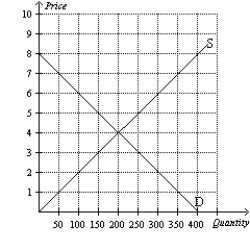
-Refer to Figure 4-31. Suppose there is an improvement in technology in this market and the price of lamps, a complementary good, increases. What changes do you predict in the equilibrium price and quantity?
-Refer to Figure 4-31. Suppose there is an improvement in technology in this market and the price of lamps, a complementary good, increases. What changes do you predict in the equilibrium price and quantity? (Essay)
4.8/5 (92)
(92) If the supply of a product increases, then we would expect equilibrium price
(Multiple Choice)
4.8/5 (83)
(83) Figure 4-6 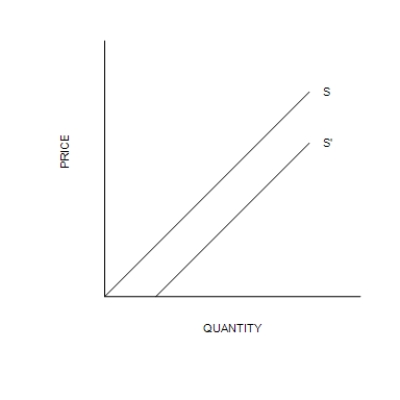 -Refer to Figure 4-6. The shift from S to S' could be caused by
 (Multiple Choice)
4.8/5 (79)
(79) A demand schedule is a table that shows the relationship between
(Multiple Choice)
4.7/5 (74)
(74) A movement along a supply curve is called a change in supply while a shift of the supply curve is called a change in quantity supplied.
(True/False)
4.8/5 (80)
(80) A reduction in an input price will cause a change in quantity supplied but not a change in supply.
(True/False)
4.8/5 (80)
(80) Individual demand curves are summed vertically to obtain the market demand curve.
(True/False)
4.8/5 (81)
(81) A market's equilibrium is the point at which the supply and demand curves intersect.
(True/False)
4.8/5 (72)
(72) In a perfectly competitive market, buyers and sellers are price setters.
(True/False)
4.9/5 (81)
(81) Fill in the table below, showing whether equilibrium price and equilibrium quantity go up, go down, stay the same, or change ambiguously.
No Change in Supply An Increase in Supply A Decrease in Supply No Change in Demand An Increase in Demand A Decrease in Demand
(Essay)
4.7/5 (94)
(94) When the price of a good is low, selling the good is profitable, and so the quantity supplied is large.
(True/False)
4.9/5 (76)
(76) Figure 4-13
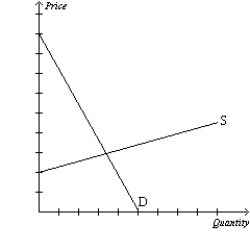
-Refer to Figure 4-30. In this market for tablet computers, more suppliers enter the market and the price of laptops, a substitute good, increases, while all other factors remain constant. Explain the change(s) in the equilibrium price and quantity.
-Refer to Figure 4-30. In this market for tablet computers, more suppliers enter the market and the price of laptops, a substitute good, increases, while all other factors remain constant. Explain the change(s) in the equilibrium price and quantity. (Essay)
4.9/5 (85)
(85) 
Filters
- Essay(0)
- Multiple Choice(0)
- Short Answer(0)
- True False(0)
- Matching(0)