



 Chat with AI
Exam 4: The Market Forces of Supply and Demand

Exam 1: Ten Principles of Economics220 Questions
Exam 2: Thinking Like an Economist284 Questions
Exam 3: Interdependence and the Gains From Trade192 Questions
Exam 4: The Market Forces of Supply and Demand277 Questions
Exam 5: Elasticity and Its Application222 Questions
Exam 6: Supply, Demand, and Government Policies321 Questions
Exam 7: Consumers, Producers, and the Efficiency of Markets218 Questions
Exam 8: Applications: The Costs of Taxation203 Questions
Exam 9: Application: International Trade214 Questions
Exam 10: Externalities204 Questions
Exam 11: Public Goods and Common Resources182 Questions
Exam 12: The Design of the Tax System225 Questions
Exam 13: The Costs of Production261 Questions
Exam 14: Firms in Competitive Markets243 Questions
Exam 15: Monopoly231 Questions
Exam 16: Monopolistic Competition246 Questions
Exam 17: Oligopoly204 Questions
Exam 18: The Markets for the Factors of Production232 Questions
Exam 19: Earnings and Discrimination230 Questions
Exam 20: Income Inequality and Poverty194 Questions
Exam 21: The Theory of Consumer Choice209 Questions
Exam 22: Frontiers in Microeconomics185 Questions
Exam 23: Measuring a Nations Income231 Questions
Exam 24: Measuring the Cost of Living214 Questions
Exam 25: Production and Growth187 Questions
Exam 26: Saving, Investment, and the Financial System225 Questions
Exam 27: Tools of Finance198 Questions
Exam 28: Unemployment and Its Natural Rate361 Questions
Exam 29: The Monetary System210 Questions
Exam 30: Money Growth and Inflation201 Questions
Exam 31: Open-Economy Macroeconomics: Basic Concepts194 Questions
Exam 32: A Macroeconomic Theory of the Open Economy188 Questions
Exam 33: Aggregate Demand and Aggregate Supply189 Questions
Exam 34: The Influence of Monetary and Fiscal Policy on Aggregate Demand207 Questions
Exam 35: The Short-Run Tradeoff Between Inflation and Unemployment223 Questions
Exam 36: Six Debates Over Macroeconomic Policy154 Questions
Select questions type


An increase in the price of maple syrup will decrease both the equilibrium price and quantity in the market for pancakes.
(True/False)
4.7/5  (71)
(71) If muffins and bagels are substitutes, a higher price for bagels would result in
(Multiple Choice)
4.9/5 (74)
(74) According to the law of demand, when price increases the quantity demanded of a good
(Short Answer)
4.8/5 (72)
(72) Which of the following would shift the supply of cars to the left?
(Multiple Choice)
4.9/5 (90)
(90) If there is an improvement in the technology used to produce a good, then the supply curve for that good will shift to the left.
(True/False)
4.9/5 (79)
(79) Table 4-6
Price (Dollars per unit) Quantity Demanded (Units) Quantity Supplied (Units) 15 10 60 12 20 45 9 30 30 6 40 15 3 50 0
-Refer to Table 4-6. The equilibrium price and quantity, respectively, are
(Multiple Choice)
4.7/5 (89)
(89) Figure 4-13
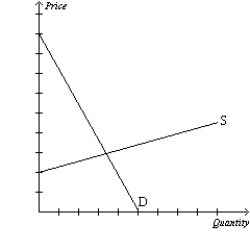
-Suppose researchers discover a new, lower cost method of producing calculators. As a result, will the supply of calculators increase or decrease?
-Suppose researchers discover a new, lower cost method of producing calculators. As a result, will the supply of calculators increase or decrease? (Short Answer)
4.9/5 (89)
(89) An increase in the price of ink will shift the supply curve for pens to the left.
(True/False)
4.8/5 (68)
(68) Figure 4-11
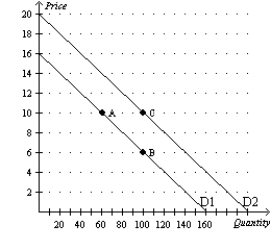
-Refer to Figure 4-28. Using the points on the figure, describe the change that would occur if the price of this good increases.
-Refer to Figure 4-28. Using the points on the figure, describe the change that would occur if the price of this good increases. (Short Answer)
4.8/5 (82)
(82) When a seller expects the price of its product to decrease in the future, the seller's supply curve shifts left now.
(True/False)
4.9/5 (74)
(74) In a market economy, supply and demand determine both the quantity of each good produced and the price at which it is sold.
(True/False)
4.7/5 (86)
(86) What would happen to the equilibrium price and quantity of lattés if coffee shops began using a machine that reduced the amount of labor necessary to produce them?
(Multiple Choice)
4.8/5 (81)
(81) If a seller in a competitive market chooses to charge more than the going price, then
(Multiple Choice)
4.8/5 (83)
(83) Which of the following events could cause an increase in the supply of ceiling fans?
(Multiple Choice)
4.9/5 (78)
(78) If a determinant of demand other than price changes, the demand curve shifts.
(True/False)
4.9/5 (81)
(81) The law of supply states that, other things equal, when the price of a good falls, the quantity supplied falls as well.
(True/False)
4.8/5 (86)
(86) When the market price is below the equilibrium price, suppliers are unable to sell all they want to sell.
(True/False)
4.8/5 (87)
(87) 
Filters
- Essay(0)
- Multiple Choice(0)
- Short Answer(0)
- True False(0)
- Matching(0)