



 Chat with AI
Exam 4: The Market Forces of Supply and Demand

Exam 1: Ten Principles of Economics220 Questions
Exam 2: Thinking Like an Economist284 Questions
Exam 3: Interdependence and the Gains From Trade192 Questions
Exam 4: The Market Forces of Supply and Demand277 Questions
Exam 5: Elasticity and Its Application222 Questions
Exam 6: Supply, Demand, and Government Policies321 Questions
Exam 7: Consumers, Producers, and the Efficiency of Markets218 Questions
Exam 8: Applications: The Costs of Taxation203 Questions
Exam 9: Application: International Trade214 Questions
Exam 10: Externalities204 Questions
Exam 11: Public Goods and Common Resources182 Questions
Exam 12: The Design of the Tax System225 Questions
Exam 13: The Costs of Production261 Questions
Exam 14: Firms in Competitive Markets243 Questions
Exam 15: Monopoly231 Questions
Exam 16: Monopolistic Competition246 Questions
Exam 17: Oligopoly204 Questions
Exam 18: The Markets for the Factors of Production232 Questions
Exam 19: Earnings and Discrimination230 Questions
Exam 20: Income Inequality and Poverty194 Questions
Exam 21: The Theory of Consumer Choice209 Questions
Exam 22: Frontiers in Microeconomics185 Questions
Exam 23: Measuring a Nations Income231 Questions
Exam 24: Measuring the Cost of Living214 Questions
Exam 25: Production and Growth187 Questions
Exam 26: Saving, Investment, and the Financial System225 Questions
Exam 27: Tools of Finance198 Questions
Exam 28: Unemployment and Its Natural Rate361 Questions
Exam 29: The Monetary System210 Questions
Exam 30: Money Growth and Inflation201 Questions
Exam 31: Open-Economy Macroeconomics: Basic Concepts194 Questions
Exam 32: A Macroeconomic Theory of the Open Economy188 Questions
Exam 33: Aggregate Demand and Aggregate Supply189 Questions
Exam 34: The Influence of Monetary and Fiscal Policy on Aggregate Demand207 Questions
Exam 35: The Short-Run Tradeoff Between Inflation and Unemployment223 Questions
Exam 36: Six Debates Over Macroeconomic Policy154 Questions
Select questions type


If the demand for a good falls when income falls, then the good is called
(Multiple Choice)
4.8/5  (71)
(71) A supply schedule is a table that shows the relationship between
(Multiple Choice)
4.7/5 (80)
(80) If a company making frozen orange juice expects the price of its product to be higher next month, it will supply more to the market this month.
(True/False)
4.8/5 (68)
(68) At the equilibrium price, the quantity of the good that buyers are willing and able to buy
(Multiple Choice)
4.8/5 (83)
(83) The equilibrium price is the same as the market-clearing price.
(True/False)
4.8/5 (85)
(85) Assume Kalene buys notebooks in a competitive market. It follows that
(Multiple Choice)
4.9/5 (81)
(81) What will happen to the equilibrium price and quantity of new cars if the price of gasoline rises, the price of steel rises, public transportation becomes cheaper and more comfortable, and auto-workers negotiate higher wages?
(Multiple Choice)
5.0/5 (81)
(81) At the equilibrium price, buyers have bought all they want to buy, but sellers have not sold all they want to sell.
(True/False)
4.9/5 (77)
(77) A group of buyers and sellers of a particular good or service is called
(Multiple Choice)
4.7/5 (73)
(73) Figure 4-10 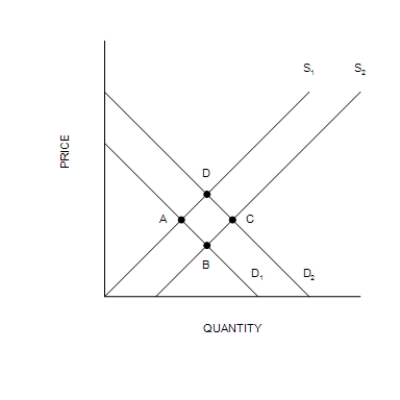 -Refer to Figure 4-10. Which of the following movements would illustrate the effect of an increase in the price of microprocessors, a material used to make laptops, on the market for laptops?
 (Multiple Choice)
4.9/5 (65)
(65) If income rises in the market for a normal good, will the demand curve for the normal good shift to the right or to the left?
(Short Answer)
4.9/5 (81)
(81) Most studies have found that tobacco and marijuana are substitutes rather than complements.
(True/False)
4.9/5 (73)
(73) Scenario 4-1
Suppose the demand schedule in a market can be represented by the equation QD = 500 - 10P, where QD is the quantity demanded and P is the price. Also, suppose the supply schedule can be represented by the equation QS = 200 + 10P, where QS is the quantity supplied.
-Refer to Scenario 4-1. Suppose the price is currently equal to 10 in this market. Is there a shortage or surplus in this market, and how large is the shortage/surplus?
(Short Answer)
4.8/5 (71)
(71) If a higher price means a greater quantity supplied, then the supply curve slopes upward.
(True/False)
4.8/5 (82)
(82) You lose your job and, as a result, you buy fewer iTunes music downloads. This shows that you consider iTunes music downloads to be
(Multiple Choice)
4.7/5 (81)
(81) Scenario 4-1
Suppose the demand schedule in a market can be represented by the equation QD = 500 - 10P, where QD is the quantity demanded and P is the price. Also, suppose the supply schedule can be represented by the equation QS = 200 + 10P, where QS is the quantity supplied.
-Refer to Scenario 4-1. What is the equilibrium price in this market?
(Short Answer)
4.8/5 (87)
(87) The law of demand states that, other things equal, when the price of a good
(Multiple Choice)
4.7/5 (93)
(93) Figure 4-7 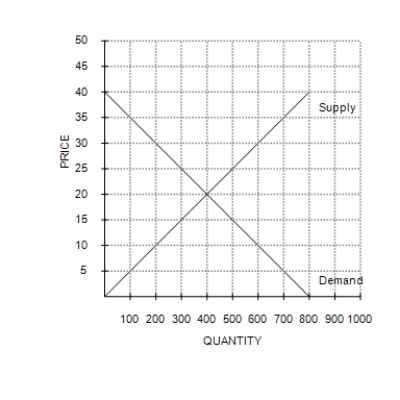
-Refer to Figure 4-7. At a price of $15, there would be a
-Refer to Figure 4-7. At a price of $15, there would be a (Multiple Choice)
4.9/5 (75)
(75) 
Filters
- Essay(0)
- Multiple Choice(0)
- Short Answer(0)
- True False(0)
- Matching(0)