



 Chat with AI
Exam 7: Consumers, Producers, and the Efficiency of Markets

Exam 1: Ten Principles of Economics220 Questions
Exam 2: Thinking Like an Economist284 Questions
Exam 3: Interdependence and the Gains From Trade192 Questions
Exam 4: The Market Forces of Supply and Demand277 Questions
Exam 5: Elasticity and Its Application222 Questions
Exam 6: Supply, Demand, and Government Policies321 Questions
Exam 7: Consumers, Producers, and the Efficiency of Markets218 Questions
Exam 8: Applications: The Costs of Taxation203 Questions
Exam 9: Application: International Trade214 Questions
Exam 10: Externalities204 Questions
Exam 11: Public Goods and Common Resources182 Questions
Exam 12: The Design of the Tax System225 Questions
Exam 13: The Costs of Production261 Questions
Exam 14: Firms in Competitive Markets243 Questions
Exam 15: Monopoly231 Questions
Exam 16: Monopolistic Competition246 Questions
Exam 17: Oligopoly204 Questions
Exam 18: The Markets for the Factors of Production232 Questions
Exam 19: Earnings and Discrimination230 Questions
Exam 20: Income Inequality and Poverty194 Questions
Exam 21: The Theory of Consumer Choice209 Questions
Exam 22: Frontiers in Microeconomics185 Questions
Exam 23: Measuring a Nations Income231 Questions
Exam 24: Measuring the Cost of Living214 Questions
Exam 25: Production and Growth187 Questions
Exam 26: Saving, Investment, and the Financial System225 Questions
Exam 27: Tools of Finance198 Questions
Exam 28: Unemployment and Its Natural Rate361 Questions
Exam 29: The Monetary System210 Questions
Exam 30: Money Growth and Inflation201 Questions
Exam 31: Open-Economy Macroeconomics: Basic Concepts194 Questions
Exam 32: A Macroeconomic Theory of the Open Economy188 Questions
Exam 33: Aggregate Demand and Aggregate Supply189 Questions
Exam 34: The Influence of Monetary and Fiscal Policy on Aggregate Demand207 Questions
Exam 35: The Short-Run Tradeoff Between Inflation and Unemployment223 Questions
Exam 36: Six Debates Over Macroeconomic Policy154 Questions
Select questions type


Figure 7-14
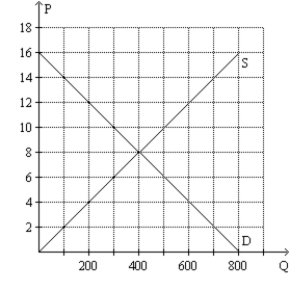
-Refer to Figure 7-14. Suppose there is initially a price ceiling set at $4 in this market. How much is total producer surplus with the price ceiling in place?
-Refer to Figure 7-14. Suppose there is initially a price ceiling set at $4 in this market. How much is total producer surplus with the price ceiling in place? (Essay)
4.8/5  (90)
(90) Table 7-13
The following table shows the cost of producing a good for the only four producers in a market.
Producer Cost W \ 40 X \ 30 Y \ 20 Z \ 10
-Refer to Table 7-13. If these four producers bid in an auction to supply one unit to a consumer, at what price will the good be sold?
(Essay)
4.7/5 (73)
(73) Table 7-2
Buyer Willingness to Pay (Dollars) Carlos 20 Keira 24 Ava 28 Biyu 36
-Refer to Table 7-2. If there is only one unit of the good and if the buyers bid against each other for the right to purchase it, then the good will sell for
(Multiple Choice)
4.8/5 (92)
(92) If the government imposes a binding price floor in a market, then the consumer surplus in that market will increase.
(True/False)
4.8/5 (73)
(73) 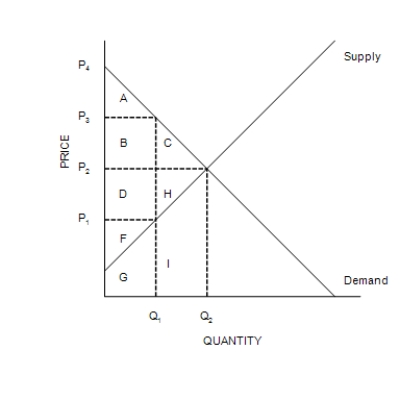 -Refer to Figure 7-9. The equilibrium price is
Figure 7-10

-Refer to Figure 7-10. If the market equilibrium price falls from $120 to $80, how much consumer surplus do consumers entering the market after the price drop receive?
-Refer to Figure 7-10. If the market equilibrium price falls from $120 to $80, how much consumer surplus do consumers entering the market after the price drop receive? (Essay)
4.8/5 (70)
(70) The lower the price, the lower the producer surplus, all else equal.
(True/False)
4.8/5 (79)
(79) Table 7-2
Buyer Willingness to Pay (Dollars) Carlos 20 Keira 24 Ava 28 Biyu 36
-Refer to Table 7-2. If the price is $22, then consumer surplus in the market is
(Multiple Choice)
4.8/5 (72)
(72) If John's willingness to pay for a good is $20 and the price of the good is $15, how much is John's consumer surplus from purchasing the good?
(Short Answer)
4.9/5 (68)
(68) Table 7-11
Price (Dollars per unit) Quantity Demanded (Units) Quantity Supplied (Units) 12.00 0 36 10.00 3 30 8.00 6 24 6.00 9 18 4.00 12 12 2.00 15 6 0.00 18 0
-Refer to Table 7-11. The equilibrium price is
(Multiple Choice)
4.8/5 (92)
(92) A buyer is willing to buy a product at a price greater than or equal to his willingness to pay, but would refuse to buy a product at a price less than his willingness to pay.
(True/False)
4.8/5 (79)
(79) A maximum amount that people have in mind while bidding in an auction is called
(Multiple Choice)
4.9/5 (73)
(73) Connie can clean windows in large office buildings at a cost of $1 per window. The market price for window-cleaning services is $3 per window. If Connie cleans 100 windows, her producer surplus is $100.
(True/False)
4.9/5 (83)
(83) Table 7-4
For each of the three potential buyers of apples, the table displays the willingness to pay for Bob, Sasha, and Eric, who are the only three buyers of apples. Assume that only three apples can be supplied per day.
First Apple Second Apple Third Apple Bob 2.00 1.50 0.75 Sasha 1.50 1.00 0.60 Eric 0.75 0.25 0.00
-Refer to Table 7-4. Which of the following statements is correct?
(Multiple Choice)
4.9/5 (75)
(75) At Mike's Bakery, the cost of making one croissant is $1.50. If Mike sells 20 croissants and gains producer surplus of $40.00, then Mike must be selling his croissants for
(Multiple Choice)
4.8/5 (76)
(76) You are offered a free ticket to see the Chicago Cubs play the Chicago White Sox at Wrigley Field. Assume the ticket has no resale value. Willie Nelson is performing on the same night, and his concert is your next-best alternative activity. Tickets to see Willie Nelson cost $40. On any given day, you would be willing to pay up to $50 to see and hear Willie Nelson perform. Assume there are no other costs of seeing either event. Based on this information, at a minimum, how much would you have to value seeing the Cubs play the White Sox to accept the ticket and go to the game?
(Multiple Choice)
4.9/5 (93)
(93) At any quantity, the price given by the supply curve shows the cost of the lowest-cost seller.
(True/False)
4.9/5 (77)
(77) Figure 7-5
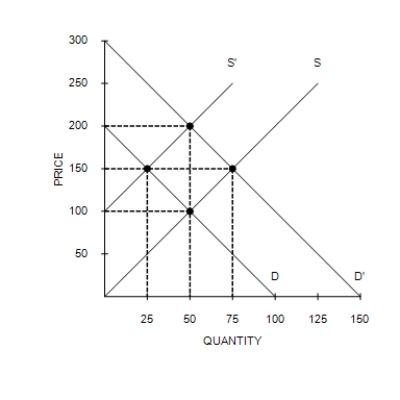 -Refer to Figure 7-5. If the demand curve is D and the supply curve shifts from S' to S, what is the change in producer surplus?
 (Multiple Choice)
4.8/5 (97)
(97) What do economists call the highest amount a consumer will pay to purchase a good?
(Short Answer)
4.8/5 (66)
(66) If the United States legally allowed for a market in transplant organs, it is estimated that one kidney would sell for at least $100,000.
(True/False)
4.8/5 (74)
(74) 
Filters
- Essay(0)
- Multiple Choice(0)
- Short Answer(0)
- True False(0)
- Matching(0)