



 Chat with AI
Exam 7: Consumers, Producers, and the Efficiency of Markets

Exam 1: Ten Principles of Economics220 Questions
Exam 2: Thinking Like an Economist284 Questions
Exam 3: Interdependence and the Gains From Trade192 Questions
Exam 4: The Market Forces of Supply and Demand277 Questions
Exam 5: Elasticity and Its Application222 Questions
Exam 6: Supply, Demand, and Government Policies321 Questions
Exam 7: Consumers, Producers, and the Efficiency of Markets218 Questions
Exam 8: Applications: The Costs of Taxation203 Questions
Exam 9: Application: International Trade214 Questions
Exam 10: Externalities204 Questions
Exam 11: Public Goods and Common Resources182 Questions
Exam 12: The Design of the Tax System225 Questions
Exam 13: The Costs of Production261 Questions
Exam 14: Firms in Competitive Markets243 Questions
Exam 15: Monopoly231 Questions
Exam 16: Monopolistic Competition246 Questions
Exam 17: Oligopoly204 Questions
Exam 18: The Markets for the Factors of Production232 Questions
Exam 19: Earnings and Discrimination230 Questions
Exam 20: Income Inequality and Poverty194 Questions
Exam 21: The Theory of Consumer Choice209 Questions
Exam 22: Frontiers in Microeconomics185 Questions
Exam 23: Measuring a Nations Income231 Questions
Exam 24: Measuring the Cost of Living214 Questions
Exam 25: Production and Growth187 Questions
Exam 26: Saving, Investment, and the Financial System225 Questions
Exam 27: Tools of Finance198 Questions
Exam 28: Unemployment and Its Natural Rate361 Questions
Exam 29: The Monetary System210 Questions
Exam 30: Money Growth and Inflation201 Questions
Exam 31: Open-Economy Macroeconomics: Basic Concepts194 Questions
Exam 32: A Macroeconomic Theory of the Open Economy188 Questions
Exam 33: Aggregate Demand and Aggregate Supply189 Questions
Exam 34: The Influence of Monetary and Fiscal Policy on Aggregate Demand207 Questions
Exam 35: The Short-Run Tradeoff Between Inflation and Unemployment223 Questions
Exam 36: Six Debates Over Macroeconomic Policy154 Questions
Select questions type


Table 7-6
During the last two days, Harry purchased a latte from two different stores. The table below shows Harry's willingness to pay on each day and his consumer surplus from each purchase.
Harry's Willingness to Pay (Dollars) Harry's Consumer Surplus (Dollars) First Day 5.50 2.00 Second Day 2.00 0.50
-Refer to Table 7-6. The price that Harry paid for a latte on the first day is
(Multiple Choice)
4.9/5  (84)
(84) Figure 7-11
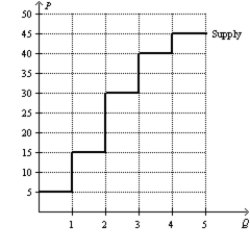
-Refer to Figure 7-11. If the market equilibrium price rises from $25 to $35, how much is the increase in producer surplus to the producers supplying units at the initial $25 price?
-Refer to Figure 7-11. If the market equilibrium price rises from $25 to $35, how much is the increase in producer surplus to the producers supplying units at the initial $25 price? (Essay)
4.9/5 (92)
(92) Scenario 7-2
Suppose market demand and market supply are given by the equations:
QD = 40 - P
QS = P - 4
-Refer to Scenario 7-2. How much is total surplus at the equilibrium price in this market?
(Essay)
4.8/5 (79)
(79) When markets fail, public policy can potentially remedy the problem and increase economic efficiency.
(True/False)
4.9/5 (73)
(73) Moving production from a high-cost producer to a low-cost producer will
(Multiple Choice)
4.9/5 (78)
(78) A supply curve can be used to measure producer surplus because it reflects
(Multiple Choice)
4.9/5 (73)
(73) All else equal, a decrease in demand will cause an increase in producer surplus.
(True/False)
4.8/5 (85)
(85) Suppose you buy an iPod for $100. If your consumer surplus is $30, your willingness to pay is $70.
(True/False)
5.0/5 (82)
(82) Figure 7-9
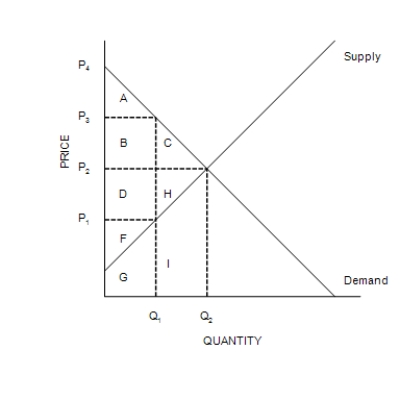 -Refer to Figure 7-9. At equilibrium, total surplus is represented by the area
 (Multiple Choice)
4.9/5 (74)
(74) Figure 7-9
-Refer to Figure 7-9. At equilibrium, producer surplus is represented by the area
-Refer to Figure 7-9. At equilibrium, producer surplus is represented by the area (Multiple Choice)
4.9/5 (74)
(74) If the government removes a binding price ceiling in a market, then the producer surplus in that market will increase.
(True/False)
4.9/5 (71)
(71) Table 7-3
Buyer Willingness to Pay for a Baseball Game Ticket (Dollars) Nancy 10 Tom 15 David 20 Alexa 25 Eric 30 Chen 35
-Refer to Table 7-3. If you have a ticket that you sell to the group in an auction, who will buy the ticket?
(Multiple Choice)
4.8/5 (77)
(77) Table 7-14
-Refer to Table 7-14. How much is total producer surplus at the equilibrium price in this market?
(Essay)
4.8/5 (80)
(80) 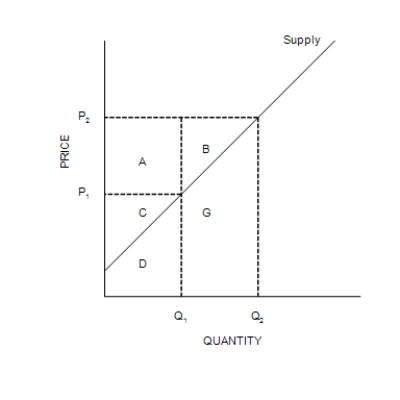 -Refer to Figure 7-6. Area A represents
Welfare economics implies that the equilibrium price of a product is considered to be the best price because it
(Multiple Choice)
4.8/5 (74)
(74) All else equal, an increase in supply will cause an increase in consumer surplus.
(True/False)
4.9/5 (77)
(77) If a consumer places a value of $13 on a particular good and if the price of the good is $16, then the
(Multiple Choice)
4.8/5 (75)
(75) In order to calculate consumer surplus in a market, we need to know willingness to pay and price.
(True/False)
4.7/5 (72)
(72) Figure 7-1
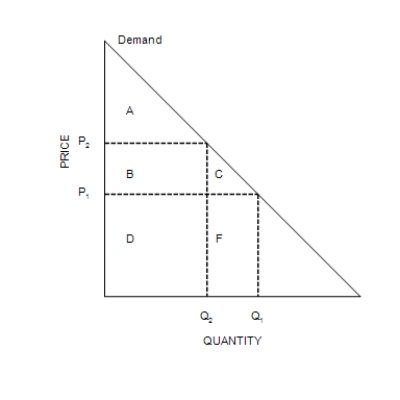 -Refer to Figure 7-1. When the price falls from P2 to P1, consumer surplus
 (Multiple Choice)
4.8/5 (65)
(65) Figure 7-13
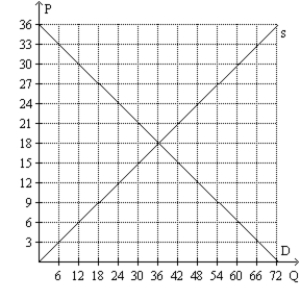
-Refer to Figure 7-13. Suppose demand shifts such that consumers wish to purchase 12 fewer units at every price. How much is total producer surplus in this market at the new equilibrium price?
-Refer to Figure 7-13. Suppose demand shifts such that consumers wish to purchase 12 fewer units at every price. How much is total producer surplus in this market at the new equilibrium price? (Essay)
4.9/5 (77)
(77) 
Filters
- Essay(0)
- Multiple Choice(0)
- Short Answer(0)
- True False(0)
- Matching(0)