



 Chat with AI
Exam 7: Consumers, Producers, and the Efficiency of Markets

Exam 1: Ten Principles of Economics220 Questions
Exam 2: Thinking Like an Economist284 Questions
Exam 3: Interdependence and the Gains From Trade192 Questions
Exam 4: The Market Forces of Supply and Demand277 Questions
Exam 5: Elasticity and Its Application222 Questions
Exam 6: Supply, Demand, and Government Policies321 Questions
Exam 7: Consumers, Producers, and the Efficiency of Markets218 Questions
Exam 8: Applications: The Costs of Taxation203 Questions
Exam 9: Application: International Trade214 Questions
Exam 10: Externalities204 Questions
Exam 11: Public Goods and Common Resources182 Questions
Exam 12: The Design of the Tax System225 Questions
Exam 13: The Costs of Production261 Questions
Exam 14: Firms in Competitive Markets243 Questions
Exam 15: Monopoly231 Questions
Exam 16: Monopolistic Competition246 Questions
Exam 17: Oligopoly204 Questions
Exam 18: The Markets for the Factors of Production232 Questions
Exam 19: Earnings and Discrimination230 Questions
Exam 20: Income Inequality and Poverty194 Questions
Exam 21: The Theory of Consumer Choice209 Questions
Exam 22: Frontiers in Microeconomics185 Questions
Exam 23: Measuring a Nations Income231 Questions
Exam 24: Measuring the Cost of Living214 Questions
Exam 25: Production and Growth187 Questions
Exam 26: Saving, Investment, and the Financial System225 Questions
Exam 27: Tools of Finance198 Questions
Exam 28: Unemployment and Its Natural Rate361 Questions
Exam 29: The Monetary System210 Questions
Exam 30: Money Growth and Inflation201 Questions
Exam 31: Open-Economy Macroeconomics: Basic Concepts194 Questions
Exam 32: A Macroeconomic Theory of the Open Economy188 Questions
Exam 33: Aggregate Demand and Aggregate Supply189 Questions
Exam 34: The Influence of Monetary and Fiscal Policy on Aggregate Demand207 Questions
Exam 35: The Short-Run Tradeoff Between Inflation and Unemployment223 Questions
Exam 36: Six Debates Over Macroeconomic Policy154 Questions
Select questions type


Table 7-3
Buyer Willingness to Pay for a Baseball Game Ticket (Dollars) Nancy 10 Tom 15 David 20 Alexa 25 Eric 30 Chen 35
-Refer to Table 7-3. If you have 3 (essentially) identical tickets that you sell to the group in an auction, assuming that each person can only buy one ticket, which of the following is closest to the selling price for each ticket?
(Multiple Choice)
4.8/5  (86)
(86) Producer surplus measures the benefit to sellers from receiving a price above their costs.
(True/False)
4.8/5 (75)
(75) Figure 7-7
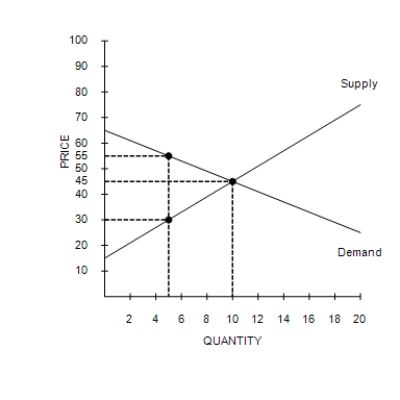 -Refer to Figure 7-7. If the government imposes a price ceiling of $55 in this market, then total surplus will be
 (Multiple Choice)
4.7/5 (78)
(78) Jim builds furniture for a living. Jim's out-of-pocket expenses (for wood, paint, etc.) plus the value that he places on his own time amount to his
(Multiple Choice)
5.0/5 (86)
(86) Economists generally believe that, although there may be advantages to society from ticket-scalping, the costs to society of this activity outweigh the benefits.
(True/False)
4.9/5 (59)
(59) If Darby values a soccer ball at $50, and she pays $40 for it, her consumer surplus is $90.
(True/False)
4.9/5 (84)
(84) We can say that the allocation of resources is efficient if
(Multiple Choice)
4.8/5 (77)
(77) The cost of production plus producer surplus is the price a seller is paid.
(True/False)
4.8/5 (79)
(79) Figure 7-4
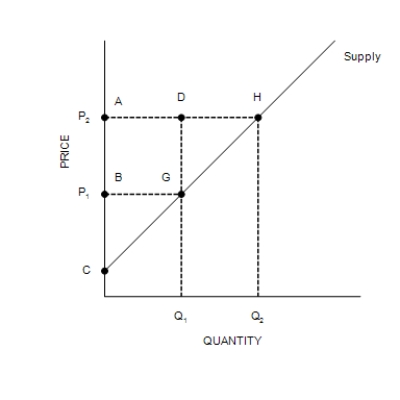 -Refer to Figure 7-4. Which area represents producer surplus when the price is P1?
 (Multiple Choice)
4.9/5 (67)
(67) The current policy on kidney donation effectively sets a price ceiling of zero.
(True/False)
4.9/5 (82)
(82) Even though participants in the economy are motivated by self-interest, the "invisible hand" of the marketplace guides this self-interest into promoting general economic well-being.
(True/False)
5.0/5 (76)
(76) Joel has a 1966 Mustang, which he sells to Susie, an avid car collector. Susie is pleased since she paid $8,000 for the car but would have been willing to pay $11,000 for the car. Susie's consumer surplus is $2,000.
(True/False)
5.0/5 (76)
(76) Tomato sauce and spaghetti noodles are complementary goods. A decrease in the price of tomatoes will
(Multiple Choice)
4.8/5 (87)
(87) Dawn's bridal boutique is having a sale on evening dresses. The increase in consumer surplus comes from the benefit of the lower prices to
(Multiple Choice)
4.7/5 (76)
(76) Table 7-9
Seller Opportunity Cost for Providing 10 Piano Lessons (Dollars) Marcia 200 Jan 250 Cindy 350 Greg 400 Peter 700 Bobby 800
-Refer to Table 7-9. The equilibrium market price for 10 piano lessons is $400. What is the total producer surplus in the market?
(Multiple Choice)
4.9/5 (67)
(67) For any given quantity, the price on a demand curve represents the marginal buyer's willingness to pay.
(True/False)
4.9/5 (72)
(72) The area below the price and above the supply curve measures the producer surplus in a market.
(True/False)
4.8/5 (85)
(85) Table 7-11
Price (Dollars per unit) Quantity Demanded (Units) Quantity Supplied (Units) 12.00 0 36 10.00 3 30 8.00 6 24 6.00 9 18 4.00 12 12 2.00 15 6 0.00 18 0
-Refer to Table 7-12. Both the demand curve and the supply curve are straight lines. At equilibrium, producer surplus is
(Multiple Choice)
4.7/5 (65)
(65) Table 7-10
Seller Cost (Dollars) LeBron 700 Kobe 600 Kevin 450 Steve 400
-Refer to Table 7-10. You want to hire a professional photographer to take pictures of your family. The table shows the costs of the four potential sellers in the local photography market. Which of the following graphs represents the market supply curve?
(Multiple Choice)
4.8/5 (78)
(78) Efficiency is related to the size of the economic pie, whereas equality is related to how the pie gets sliced and distributed.
(True/False)
5.0/5 (89)
(89) 
Filters
- Essay(0)
- Multiple Choice(0)
- Short Answer(0)
- True False(0)
- Matching(0)