



 Chat with AI
Exam 13: The Costs of Production

Exam 1: Ten Principles of Economics220 Questions
Exam 2: Thinking Like an Economist284 Questions
Exam 3: Interdependence and the Gains From Trade192 Questions
Exam 4: The Market Forces of Supply and Demand277 Questions
Exam 5: Elasticity and Its Application222 Questions
Exam 6: Supply, Demand, and Government Policies321 Questions
Exam 7: Consumers, Producers, and the Efficiency of Markets218 Questions
Exam 8: Applications: The Costs of Taxation203 Questions
Exam 9: Application: International Trade214 Questions
Exam 10: Externalities204 Questions
Exam 11: Public Goods and Common Resources182 Questions
Exam 12: The Design of the Tax System225 Questions
Exam 13: The Costs of Production261 Questions
Exam 14: Firms in Competitive Markets243 Questions
Exam 15: Monopoly231 Questions
Exam 16: Monopolistic Competition246 Questions
Exam 17: Oligopoly204 Questions
Exam 18: The Markets for the Factors of Production232 Questions
Exam 19: Earnings and Discrimination230 Questions
Exam 20: Income Inequality and Poverty194 Questions
Exam 21: The Theory of Consumer Choice209 Questions
Exam 22: Frontiers in Microeconomics185 Questions
Exam 23: Measuring a Nations Income231 Questions
Exam 24: Measuring the Cost of Living214 Questions
Exam 25: Production and Growth187 Questions
Exam 26: Saving, Investment, and the Financial System225 Questions
Exam 27: Tools of Finance198 Questions
Exam 28: Unemployment and Its Natural Rate361 Questions
Exam 29: The Monetary System210 Questions
Exam 30: Money Growth and Inflation201 Questions
Exam 31: Open-Economy Macroeconomics: Basic Concepts194 Questions
Exam 32: A Macroeconomic Theory of the Open Economy188 Questions
Exam 33: Aggregate Demand and Aggregate Supply189 Questions
Exam 34: The Influence of Monetary and Fiscal Policy on Aggregate Demand207 Questions
Exam 35: The Short-Run Tradeoff Between Inflation and Unemployment223 Questions
Exam 36: Six Debates Over Macroeconomic Policy154 Questions
Select questions type


Table 13-7
The following table shows the production costs for The Flying Elvis Copter Rides.
Output (Helicopter rides) Total Cost (Dollars) Fixed Cost (Dollars) Variable Cost (Dollars) Marginal Cost (Dollars) Average Fixed Cost (Dollars per ride) Average Variable Cost (Dollars per ride) Avera Total Cost (Dollars ride) 0 50 50 0 -- - - - 1 150 2 120 3 120
-Refer to Table 13-7. What is the value of A?
(Multiple Choice)
4.8/5  (73)
(73) Table 13-8
Output (Units) Fixed Cost (Dollars) Variable Cost (Dollars) 0 20 0 1 20 10 2 20 40 3 20 80 4 20 130 5 20 200 6 20 300
-Refer to Table 13-8. What is the average variable cost of producing 5 units of output?
(Multiple Choice)
4.9/5 (69)
(69) Table 13-13
Listed in the table are the long-run total costs for three different firms.
uantity Firm A 100 100 100 100 100 Firm B 100 200 300 400 500 Firm C 100 300 600 1,000 1,500
-Refer to Table 13-13. Firm B is experiencing constant returns to scale.
(True/False)
4.8/5 (73)
(73) Suppose that a "doggie day care" firm uses only two inputs: hourly workers (labor) and a building (capital). In the short run, the firm most likely considers
(Multiple Choice)
4.8/5 (71)
(71) Jane was a partner at a law firm earning $223,000 per year. She left the firm to open her own law practice. In the first year of business she generated revenues of $347,000 and incurred explicit costs of $163,000. Jane's economic profit from her first year in her own practice is
(Multiple Choice)
5.0/5 (75)
(75) Table 13-14
Labor Output Marginal Product Variable Cost Fixed Cost 0 0 - \ 0 \ 10 1 200 200 \ 20 \ 10 2 350 \ 40 \ 10 3 450 \ 60 \ 10 4 50 \ 80 \ 10 5 25 \ 100 \ 10 6 530 \ 120 \ 10
-Refer to Table 13-14. What is the total output of five workers?
(Essay)
4.9/5 (74)
(74) The minimum points of the average variable cost and average total cost curves occur where the
(Multiple Choice)
4.9/5 (77)
(77) In the long run, a factory is usually considered a fixed input.
(True/False)
4.8/5 (80)
(80) Scenario 13-4
If Farmer Brown plants no seeds on his farm, he gets no harvest. If he plants 1 bag of seeds, he gets 5 bushels of wheat. If he plants 2 bags, he gets 9 bushels. If he plants 3 bags, he gets 12 bushels. A bag of seeds costs $120, and seeds are his only cost.
-Refer to Scenario 13-4. Farmer Brown's total-cost curve is
(Multiple Choice)
4.8/5 (75)
(75) When a firm experiences economies of scale, long-run average total cost falls as the quantity of output increases.
(True/False)
4.9/5 (85)
(85) The average-total-cost curve reflects the shape of both the average-fixed-cost and average-variable-cost curves.
(True/False)
4.9/5 (73)
(73) Table 13-14
Labor Output Marginal Product Variable Cost Fixed Cost 0 0 - \ 0 \ 10 1 200 200 \ 20 \ 10 2 350 \ 40 \ 10 3 450 \ 60 \ 10 4 50 \ 80 \ 10 5 25 \ 100 \ 10 6 530 \ 120 \ 10
-Refer to Table 13-14. What is the marginal product of the third worker?
(Short Answer)
4.9/5 (64)
(64) Figure 13-2 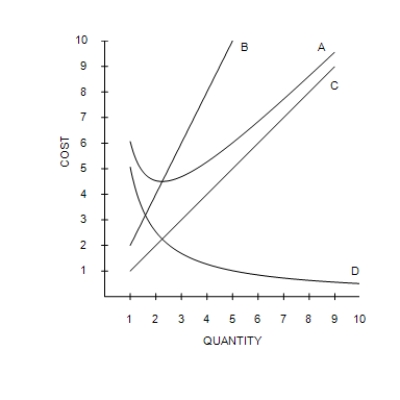
-Refer to Figure 13-2. Curve B is increasing because
-Refer to Figure 13-2. Curve B is increasing because (Multiple Choice)
4.9/5 (81)
(81) The production function depicts a relationship between which two variables? Also, draw a production function that exhibits diminishing marginal product.
(Essay)
4.9/5 (75)
(75) Ren's Tent Company has total fixed costs of $300,000 per year. The firm's average variable cost is $120 for 10,000 tents. At that level of output, the firm's average total costs equal
(Multiple Choice)
5.0/5 (82)
(82) When economists speak of a firm's costs, they are usually excluding the opportunity costs.
(True/False)
4.9/5 (80)
(80) Table 13-9
Labor (Number of w orkers) Output (Units) Fixed Cost (Dollars) Variable Cost (Dollars) 0 0 30 0 1 100 30 15 2 180 30 30 3 240 30 45 4 280 30 60 5 300 30 75
-Refer to Table 13-9. What is the marginal product of the third worker?
(Multiple Choice)
4.8/5 (68)
(68) Table 13-3
Labor (Number of workers) Output (Units) Fixed Cost (Dollars) Variable Cost (Dollars) Total Cost (Dollars) 0 0 50 0 50 1 90 50 20 70 2 170 50 40 90 3 230 50 60 110 4 240 50 80 130
-Refer to Table 13-3. At which number of workers does diminishing marginal product begin?
(Multiple Choice)
4.7/5 (73)
(73) 
Filters
- Essay(0)
- Multiple Choice(0)
- Short Answer(0)
- True False(0)
- Matching(0)