



 Chat with AI
Exam 13: The Costs of Production

Exam 1: Ten Principles of Economics220 Questions
Exam 2: Thinking Like an Economist284 Questions
Exam 3: Interdependence and the Gains From Trade192 Questions
Exam 4: The Market Forces of Supply and Demand277 Questions
Exam 5: Elasticity and Its Application222 Questions
Exam 6: Supply, Demand, and Government Policies321 Questions
Exam 7: Consumers, Producers, and the Efficiency of Markets218 Questions
Exam 8: Applications: The Costs of Taxation203 Questions
Exam 9: Application: International Trade214 Questions
Exam 10: Externalities204 Questions
Exam 11: Public Goods and Common Resources182 Questions
Exam 12: The Design of the Tax System225 Questions
Exam 13: The Costs of Production261 Questions
Exam 14: Firms in Competitive Markets243 Questions
Exam 15: Monopoly231 Questions
Exam 16: Monopolistic Competition246 Questions
Exam 17: Oligopoly204 Questions
Exam 18: The Markets for the Factors of Production232 Questions
Exam 19: Earnings and Discrimination230 Questions
Exam 20: Income Inequality and Poverty194 Questions
Exam 21: The Theory of Consumer Choice209 Questions
Exam 22: Frontiers in Microeconomics185 Questions
Exam 23: Measuring a Nations Income231 Questions
Exam 24: Measuring the Cost of Living214 Questions
Exam 25: Production and Growth187 Questions
Exam 26: Saving, Investment, and the Financial System225 Questions
Exam 27: Tools of Finance198 Questions
Exam 28: Unemployment and Its Natural Rate361 Questions
Exam 29: The Monetary System210 Questions
Exam 30: Money Growth and Inflation201 Questions
Exam 31: Open-Economy Macroeconomics: Basic Concepts194 Questions
Exam 32: A Macroeconomic Theory of the Open Economy188 Questions
Exam 33: Aggregate Demand and Aggregate Supply189 Questions
Exam 34: The Influence of Monetary and Fiscal Policy on Aggregate Demand207 Questions
Exam 35: The Short-Run Tradeoff Between Inflation and Unemployment223 Questions
Exam 36: Six Debates Over Macroeconomic Policy154 Questions
Select questions type


Suppose that a firm's long-run average total costs of producing televisions decreases as it produces between 70,000 and 80,000 televisions. For this range of output, the firm is experiencing
(Multiple Choice)
4.9/5  (86)
(86) Table 13-7
The following table shows the production costs for The Flying Elvis Copter Rides.
Output (Helicopter rides) Total Cost (Dollars) Fixed Cost (Dollars) Variable Cost (Dollars) Marginal Cost (Dollars) Average Fixed Cost (Dollars per ride) Average Variable Cost (Dollars per ride) Avera Total Cost (Dollars ride) 0 50 50 0 -- - - - 1 150 2 120 3 120
-Refer to Table 13-7. What is the value of E?
(Multiple Choice)
4.8/5 (78)
(78) Table 13-5
The following table shows the production and costs for the Wooden Chair Factory.
Labor (Number of workers) Capital (Number of machines) Output (Chairs produced per hour) Marginal Product of Labor (Chairs produced per hour) Cost of Workers (Dollars) Cost of Machines (Dollars Total Cost (Dollars) 1 2 5 2 2 10 3 2 20 4 2 35 5 2 55 6 2 70 7 2 80
-Refer to Table 13-5. The Wooden Chair Factory experiences diminishing marginal product of labor with the addition of which worker?
(Multiple Choice)
5.0/5 (83)
(83) Table 13-14
Labor Output Marginal Product Variable Cost Fixed Cost 0 0 - \ 0 \ 10 1 200 200 \ 20 \ 10 2 350 \ 40 \ 10 3 450 \ 60 \ 10 4 50 \ 80 \ 10 5 25 \ 100 \ 10 6 530 \ 120 \ 10
-Refer to Table 13-14. What is the shape of the average-total-cost curve?
(Essay)
5.0/5 (93)
(93) Table 13-14
Labor Output Marginal Product Variable Cost Fixed Cost 0 0 - \ 0 \ 10 1 200 200 \ 20 \ 10 2 350 \ 40 \ 10 3 450 \ 60 \ 10 4 50 \ 80 \ 10 5 25 \ 100 \ 10 6 530 \ 120 \ 10
-Refer to Table 13-14. What is the average total cost of producing 525 units of output?
(Short Answer)
5.0/5 (73)
(73) Average total cost reveals how much total cost will change as the firm alters its level of production.
(True/False)
4.9/5 (82)
(82) Suppose that for a particular firm the only variable input into the production process is labor and that output equals zero when no workers are hired. In addition, suppose that the average total cost when 5 units of output are produced is $80, and the marginal cost of the sixth unit of output is $160. What is the average total cost when six units are produced?
(Multiple Choice)
4.8/5 (82)
(82) Table 13-15
Labor Output Marginal Product Variable Cost Fixed Cost 0 0 - \ 0 \ 5 1 100 100 \ 5 \ 5 2 250 \ 10 \ 5 3 350 \ 15 \ 5 4 50 \ 20 \ 5 5 25 \ 25 \ 5 6 430 \ 30 \ 5
-Refer to Table 13-15. What is the marginal product of the second worker?
(Short Answer)
4.9/5 (83)
(83) Table 13-8
Output (Units) Fixed Cost (Dollars) Variable Cost (Dollars) 0 20 0 1 20 10 2 20 40 3 20 80 4 20 130 5 20 200 6 20 300
-Refer to Table 13-8. What is the marginal cost of producing the fifth unit of output?
(Multiple Choice)
4.8/5 (90)
(90) Kate is a florist. Kate can arrange 20 bouquets per day. She is considering hiring her husband William to work for her. William can arrange 18 bouquets per day. What would be the total daily output of Kate's firm if she hired her husband?
(Multiple Choice)
4.8/5 (78)
(78) Consider a small family wheat farm. List some examples of explicit costs of farming.
(Essay)
4.9/5 (95)
(95) Suppose a certain firm is able to produce 110 units of output per day when 12 workers are hired. The firm is able to produce 120 units of output per day when 13 workers are hired, holding other inputs fixed. The marginal product of the 13th worker is
(Multiple Choice)
4.9/5 (85)
(85) Scenario 13-3
Diamond is an organic brocolli farmer, but she also spends part of her day as a professional organizing consultant. As a consultant, Diamond helps people organize their houses. Due to the popularity of her home-organization services, Farmer Diamond has more clients requesting her services than she has time to help if she maintains her farming business. Farmer Diamond charges $45 an hour for her home-organization services. One spring day, Diamond spends 8 hours in her fields planting $130 worth of seeds on her farm. She expects that the seeds she planted will yield $300 worth of brocolli.
-Refer to Scenario 13-3. Diamond's economic profit from farming equals
(Multiple Choice)
4.8/5 (81)
(81) If an industry exhibits economies of scale, one larger firm may be able to produce goods at a lower long-run average cost than two smaller firms.
(True/False)
4.8/5 (71)
(71) Table 13-14
Labor Output Marginal Product Variable Cost Fixed Cost 0 0 - \ 0 \ 10 1 200 200 \ 20 \ 10 2 350 \ 40 \ 10 3 450 \ 60 \ 10 4 50 \ 80 \ 10 5 25 \ 100 \ 10 6 530 \ 120 \ 10
-Refer to Table 13-14. What is the average fixed cost of producing 450 units of output?
(Short Answer)
4.8/5 (86)
(86) Diminishing marginal product exists when the total cost curve becomes horizontal as outputs increases.
(True/False)
4.9/5 (80)
(80) Figure 13-1 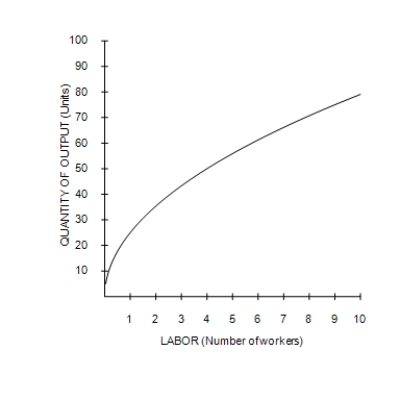
-Refer to Figure 13-1. The graph illustrates a typical
-Refer to Figure 13-1. The graph illustrates a typical (Multiple Choice)
4.9/5 (83)
(83) Figure 13-5 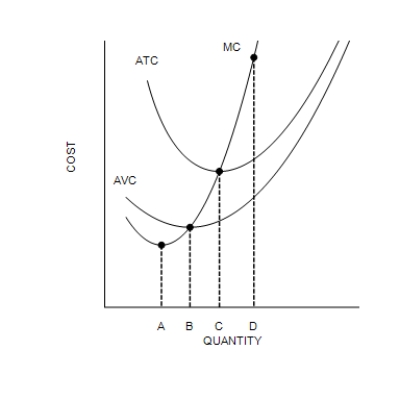 -Refer to Figure 13-5. Which of the following statements is correct?
 (Multiple Choice)
4.9/5 (84)
(84) 
Filters
- Essay(0)
- Multiple Choice(0)
- Short Answer(0)
- True False(0)
- Matching(0)