



 Chat with AI
Exam 13: The Costs of Production

Exam 1: Ten Principles of Economics220 Questions
Exam 2: Thinking Like an Economist284 Questions
Exam 3: Interdependence and the Gains From Trade192 Questions
Exam 4: The Market Forces of Supply and Demand277 Questions
Exam 5: Elasticity and Its Application222 Questions
Exam 6: Supply, Demand, and Government Policies321 Questions
Exam 7: Consumers, Producers, and the Efficiency of Markets218 Questions
Exam 8: Applications: The Costs of Taxation203 Questions
Exam 9: Application: International Trade214 Questions
Exam 10: Externalities204 Questions
Exam 11: Public Goods and Common Resources182 Questions
Exam 12: The Design of the Tax System225 Questions
Exam 13: The Costs of Production261 Questions
Exam 14: Firms in Competitive Markets243 Questions
Exam 15: Monopoly231 Questions
Exam 16: Monopolistic Competition246 Questions
Exam 17: Oligopoly204 Questions
Exam 18: The Markets for the Factors of Production232 Questions
Exam 19: Earnings and Discrimination230 Questions
Exam 20: Income Inequality and Poverty194 Questions
Exam 21: The Theory of Consumer Choice209 Questions
Exam 22: Frontiers in Microeconomics185 Questions
Exam 23: Measuring a Nations Income231 Questions
Exam 24: Measuring the Cost of Living214 Questions
Exam 25: Production and Growth187 Questions
Exam 26: Saving, Investment, and the Financial System225 Questions
Exam 27: Tools of Finance198 Questions
Exam 28: Unemployment and Its Natural Rate361 Questions
Exam 29: The Monetary System210 Questions
Exam 30: Money Growth and Inflation201 Questions
Exam 31: Open-Economy Macroeconomics: Basic Concepts194 Questions
Exam 32: A Macroeconomic Theory of the Open Economy188 Questions
Exam 33: Aggregate Demand and Aggregate Supply189 Questions
Exam 34: The Influence of Monetary and Fiscal Policy on Aggregate Demand207 Questions
Exam 35: The Short-Run Tradeoff Between Inflation and Unemployment223 Questions
Exam 36: Six Debates Over Macroeconomic Policy154 Questions
Select questions type


Table 13-9
Labor (Number of w orkers) Output (Units) Fixed Cost (Dollars) Variable Cost (Dollars) 0 0 30 0 1 100 30 15 2 180 30 30 3 240 30 45 4 280 30 60 5 300 30 75
-Refer to Table 13-9. The marginal products of hiring additional workers are
(Multiple Choice)
4.9/5  (76)
(76) Table 13-8
Output (Units) Fixed Cost (Dollars) Variable Cost (Dollars) 0 20 0 1 20 10 2 20 40 3 20 80 4 20 130 5 20 200 6 20 300
-Refer to Table 13-8. What is the average fixed cost of producing 5 units of output?
(Multiple Choice)
4.8/5 (83)
(83) Table 13-15
Labor Output Marginal Product Variable Cost Fixed Cost 0 0 - \ 0 \ 5 1 100 100 \ 5 \ 5 2 250 \ 10 \ 5 3 350 \ 15 \ 5 4 50 \ 20 \ 5 5 25 \ 25 \ 5 6 430 \ 30 \ 5
-Refer to Table 13-15. What is the total output of five workers?
(Essay)
4.8/5 (92)
(92) 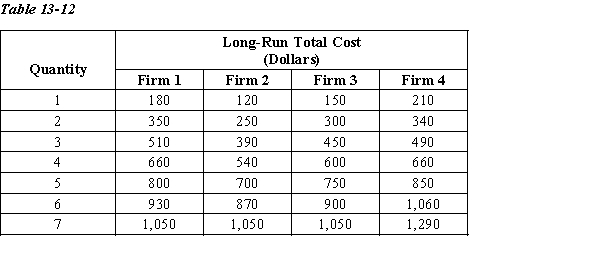 -Refer to Table 13-12. Which firm's long-run marginal cost decreases as output increases?
 (Multiple Choice)
5.0/5 (79)
(79) Table 13-3
Labor (Number of workers) Output (Units) Fixed Cost (Dollars) Variable Cost (Dollars) Total Cost (Dollars) 0 0 50 0 50 1 90 50 20 70 2 170 50 40 90 3 230 50 60 110 4 240 50 80 130
-Refer to Table 13-3. The marginal product of the second worker is
(Multiple Choice)
4.7/5 (74)
(74) If the marginal-cost curve is rising, then so is the average-total-cost curve.
(True/False)
4.8/5 (67)
(67)
-Refer to Table 13-12. Firm 4's efficient scale occurs at what quantity?
-Refer to Table 13-12. Firm 4's efficient scale occurs at what quantity? (Multiple Choice)
4.7/5 (67)
(67) Table 13-10
Teacher's Helper is a small company that has a subcontract to produce instructional materials for disabled children in public school districts. The owner rents several small rooms in an office building in the suburbs for $600 a month and has leased computer equipment that costs $480 a month.
Output (Instructional modules per month) Fixed Cost (Dollars) Variable Cost (Dollars) Total Cost (Dollars) Marginal Cost (Dollars) Average Fixed Cost (Dollars per unit) Average Variable Cost (Dollars per unit) Average Total Cost (Dollars per unit) 0 1,080 1 1,080 400 1480 400 2 450 965 3 1,350 2,430 4 1,900 475 5 2,500 216 6 4,280 700 7 4,100 8 5,400 135 9 7,300 10 10,880 980
-Refer to Table 13-10. What is the average fixed cost for the month if 9 instructional modules are produced?
(Multiple Choice)
4.8/5 (71)
(71) Cameron's Lamp Emporium produced 300 lamps but sold only 230 of the units it produced. The average cost of production for each unit of output produced was $100. The price for each of the 230 units sold was $90. Total profit for Cameron's Lamp Emporium would be
(Multiple Choice)
4.8/5 (76)
(76) Table 13-15
Labor Output Marginal Product Variable Cost Fixed Cost 0 0 - \ 0 \ 5 1 100 100 \ 5 \ 5 2 250 \ 10 \ 5 3 350 \ 15 \ 5 4 50 \ 20 \ 5 5 25 \ 25 \ 5 6 430 \ 30 \ 5
-Refer to Table 13-15. What is the shape of the average-total-cost curve?
(Essay)
4.8/5 (71)
(71) If the average-total-cost curve is falling, then the marginal-cost curve must also be falling.
(True/False)
4.8/5 (72)
(72) Table 13-14
Labor Output Marginal Product Variable Cost Fixed Cost 0 0 - \ 0 \ 10 1 200 200 \ 20 \ 10 2 350 \ 40 \ 10 3 450 \ 60 \ 10 4 50 \ 80 \ 10 5 25 \ 100 \ 10 6 530 \ 120 \ 10
-Refer to Table 13-14. What is the average variable cost of producing 500 units of output?
(Short Answer)
4.9/5 (76)
(76) Table 13-14
Labor Output Marginal Product Variable Cost Fixed Cost 0 0 - \ 0 \ 10 1 200 200 \ 20 \ 10 2 350 \ 40 \ 10 3 450 \ 60 \ 10 4 50 \ 80 \ 10 5 25 \ 100 \ 10 6 530 \ 120 \ 10
-Refer to Table 13-14. What is the total output of four workers?
(Short Answer)
4.9/5 (68)
(68) The difference between economic profit and accounting profit is that economic profit is calculated based on both implicit and explicit costs whereas accounting profit is calculated based on explicit costs only.
(True/False)
4.9/5 (84)
(84) Table 13-14
Labor Output Marginal Product Variable Cost Fixed Cost 0 0 - \ 0 \ 10 1 200 200 \ 20 \ 10 2 350 \ 40 \ 10 3 450 \ 60 \ 10 4 50 \ 80 \ 10 5 25 \ 100 \ 10 6 530 \ 120 \ 10
-Refer to Table 13-14. What is the shape of the average-fixed-cost curve?
(Essay)
4.9/5 (79)
(79) Scenario 13-1
Korie wants to start her own business making custom furniture. She can purchase a factory that costs $400,000. Korie currently has $500,000 in the bank earning 3 percent interest per year.
-Refer to Scenario 13-1. Suppose Korie purchases the factory using $200,000 of her own money and $200,000 borrowed from a bank at an interest rate of 6 percent. What is Korie's annual opportunity cost of purchasing the factory?
(Multiple Choice)
4.9/5 (80)
(80) Table 13-14
Labor Output Marginal Product Variable Cost Fixed Cost 0 0 - \ 0 \ 10 1 200 200 \ 20 \ 10 2 350 \ 40 \ 10 3 450 \ 60 \ 10 4 50 \ 80 \ 10 5 25 \ 100 \ 10 6 530 \ 120 \ 10
-Refer to Table 13-14. What is the shape of the marginal-cost curve?
(Essay)
4.7/5 (83)
(83) 
Filters
- Essay(0)
- Multiple Choice(0)
- Short Answer(0)
- True False(0)
- Matching(0)