



 Chat with AI
Exam 13: The Costs of Production

Exam 1: Ten Principles of Economics220 Questions
Exam 2: Thinking Like an Economist284 Questions
Exam 3: Interdependence and the Gains From Trade192 Questions
Exam 4: The Market Forces of Supply and Demand277 Questions
Exam 5: Elasticity and Its Application222 Questions
Exam 6: Supply, Demand, and Government Policies321 Questions
Exam 7: Consumers, Producers, and the Efficiency of Markets218 Questions
Exam 8: Applications: The Costs of Taxation203 Questions
Exam 9: Application: International Trade214 Questions
Exam 10: Externalities204 Questions
Exam 11: Public Goods and Common Resources182 Questions
Exam 12: The Design of the Tax System225 Questions
Exam 13: The Costs of Production261 Questions
Exam 14: Firms in Competitive Markets243 Questions
Exam 15: Monopoly231 Questions
Exam 16: Monopolistic Competition246 Questions
Exam 17: Oligopoly204 Questions
Exam 18: The Markets for the Factors of Production232 Questions
Exam 19: Earnings and Discrimination230 Questions
Exam 20: Income Inequality and Poverty194 Questions
Exam 21: The Theory of Consumer Choice209 Questions
Exam 22: Frontiers in Microeconomics185 Questions
Exam 23: Measuring a Nations Income231 Questions
Exam 24: Measuring the Cost of Living214 Questions
Exam 25: Production and Growth187 Questions
Exam 26: Saving, Investment, and the Financial System225 Questions
Exam 27: Tools of Finance198 Questions
Exam 28: Unemployment and Its Natural Rate361 Questions
Exam 29: The Monetary System210 Questions
Exam 30: Money Growth and Inflation201 Questions
Exam 31: Open-Economy Macroeconomics: Basic Concepts194 Questions
Exam 32: A Macroeconomic Theory of the Open Economy188 Questions
Exam 33: Aggregate Demand and Aggregate Supply189 Questions
Exam 34: The Influence of Monetary and Fiscal Policy on Aggregate Demand207 Questions
Exam 35: The Short-Run Tradeoff Between Inflation and Unemployment223 Questions
Exam 36: Six Debates Over Macroeconomic Policy154 Questions
Select questions type


What effect, if any, does diminishing marginal product have on the shape of the marginal cost curve?
(Essay)
4.9/5  (61)
(61) Economies of scale commonly arise because of coordination problems.
(True/False)
4.8/5 (79)
(79) Figure 13-2 
-Refer to Figure 13-2. Which of the curves is most likely to represent marginal cost?
-Refer to Figure 13-2. Which of the curves is most likely to represent marginal cost? (Multiple Choice)
4.9/5 (89)
(89) If the production function exhibits diminishing marginal product, the total cost function gets steeper as the quantity of output increases.
(True/False)
4.7/5 (72)
(72) Figure 13-5 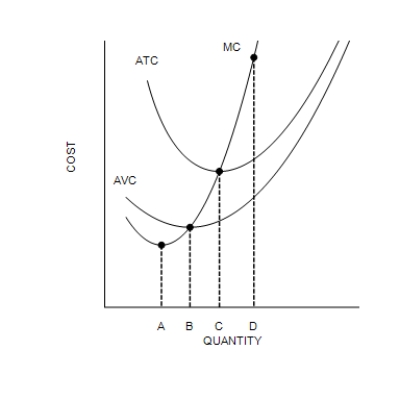 -Refer to Figure 13-5. The efficient scale of production occurs at which quantity?
 (Multiple Choice)
4.7/5 (82)
(82) Table 13-9
Labor (Number of w orkers) Output (Units) Fixed Cost (Dollars) Variable Cost (Dollars) 0 0 30 0 1 100 30 15 2 180 30 30 3 240 30 45 4 280 30 60 5 300 30 75
-Refer to Table 13-9. The average total cost of producing 240 units is
(Multiple Choice)
4.8/5 (84)
(84) Table 13-4
The following table shows the production possibilities for Charles' math tutoring company.
Labor (Number of tutors) Output (Number of students tutored per week) 0 0 1 20 2 45 3 60 4 70
-Refer to Table 13-4. Suppose that Charles's math tutoring company has a fixed cost of $50 per month for his cell phone. Each worker costs Charles $60 per day. As output increases from 45 to 70 students, Charles's total cost curve
(Multiple Choice)
4.7/5 (88)
(88) According to the mathematical laws that govern the relationship between average total cost and marginal cost, where must these two curves intersect?
(Essay)
4.9/5 (61)
(61) Bev is opening her own court-reporting business. She financed the business by withdrawing money from her personal savings account. When she closed the account, the bank representative mentioned that she would have earned $300 in interest next year. If Bev hadn't opened her own business, she would have earned a salary of $25,000. In her first year, Bev's revenues were $30,000, and she spent $1,000 on materials and supplies. Which of the following statements is correct?
(Multiple Choice)
4.9/5 (83)
(83) Average total cost and marginal cost express information that is already contained in a firm's total cost.
(True/False)
4.9/5 (68)
(68) Implicit costs are costs that do not require an outlay of money by the firm.
(True/False)
4.9/5 (80)
(80) Table 13-7
The following table shows the production costs for The Flying Elvis Copter Rides.
Output (Helicopter rides) Total Cost (Dollars) Fixed Cost (Dollars) Variable Cost (Dollars) Marginal Cost (Dollars) Average Fixed Cost (Dollars per ride) Average Variable Cost (Dollars per ride) Avera Total Cost (Dollars ride) 0 50 50 0 -- - - - 1 150 2 120 3 120
-Refer to Table 13-7. What is the value of F?
(Multiple Choice)
4.9/5 (79)
(79) For a typical firm, fixed costs increase in direct proportion to the increases in output.
(True/False)
4.9/5 (94)
(94) Table 13-7
The following table shows the production costs for The Flying Elvis Copter Rides.
Output (Helicopter rides) Total Cost (Dollars) Fixed Cost (Dollars) Variable Cost (Dollars) Marginal Cost (Dollars) Average Fixed Cost (Dollars per ride) Average Variable Cost (Dollars per ride) Avera Total Cost (Dollars ride) 0 50 50 0 -- - - - 1 150 2 120 3 120
-Refer to Table 13-7. What is the value of C?
(Multiple Choice)
4.8/5 (82)
(82) Although economists and accountants treat many costs differently, they both treat the cost of capital the same.
(True/False)
4.9/5 (76)
(76) 
Filters
- Essay(0)
- Multiple Choice(0)
- Short Answer(0)
- True False(0)
- Matching(0)