



 Chat with AI
Exam 20: Consumer Choice and Behavioral Economics

Exam 1: What Economics Is About174 Questions
Exam 2: Production Possibilities Frontier Framework156 Questions
Exam 3: Supply and Demand Theory224 Questions
Exam 4: Prices Free Controlled and Relative122 Questions
Exam 5: Supply Demand and Price Applications76 Questions
Exam 6: Macroeconomic Measurements Part I Prices and Unemployment151 Questions
Exam 7: Macroeconomic Measurements Part II Gdp and Real Gdp150 Questions
Exam 8: Aggregate Demand and Aggregate Supply204 Questions
Exam 9: Classical Macroeconomics and the Self Regulating Economy172 Questions
Exam 10: Keynesian Macroeconomics and Economic Instability a Critique of the Self Regulating Economy200 Questions
Exam 11: Fiscal Policy and the Federal Budget167 Questions
Exam 12: Money Banking and the Financial System150 Questions
Exam 13: The Federal Reserve System180 Questions
Exam 14: Money and the Economy150 Questions
Exam 15: Monetary Policy185 Questions
Exam 16: Expectations Theory and the Economy150 Questions
Exam 17: Economic Growth Resources Technology Ideas and Institutions103 Questions
Exam 18: Debates in Macroeconomics Over the Role and Effects of Government100 Questions
Exam 19: Elasticity204 Questions
Exam 20: Consumer Choice and Behavioral Economics179 Questions
Exam 21: Production and Costs245 Questions
Exam 22: Perfect Competition187 Questions
Exam 23: Monopoly195 Questions
Exam 24: Monopolistic Competition Oligopoly and Game Theory172 Questions
Exam 25: Government and Product Markets Antitrust and Regulation158 Questions
Exam 26: Factor Markets With Emphasis on the Labor Market184 Questions
Exam 27: Wages Unions and Labor138 Questions
Exam 28: The Distribution of Income and Poverty99 Questions
Exam 29: Interest Rent and Profit198 Questions
Exam 30: Market Failure Externalities Public Goods and Asymmetric Information187 Questions
Exam 31: Public Choice and Special Interest Group Politics135 Questions
Exam 32: Building Theories to Explain Everyday Life From Observations to Questions to Theories to Predictions62 Questions
Exam 33: International Trade152 Questions
Exam 34: International Finance122 Questions
Exam 35: The Economic Case for and Against Government Five Topics Considered87 Questions
Exam 36: Stocks Bonds Futures and Options110 Questions
Select questions type


Jones buys two goods, A and B. Currently, Jones receives marginal utility of 24 utils from good A and pays a price of $1.50 per unit. Jones receives a marginal utility of 43 utils from good B and pays a price of $1.99 per unit. Jones receives __________ per dollar from good B as he does from good A.
(Multiple Choice)
5.0/5  (74)
(74) It is possible for total utility to rise as marginal utility falls.
(True/False)
4.7/5 (93)
(93) Suppose for a consumer the marginal utility (MU) of bread is 20 utils and the MU of milk is 10 utils; the price of bread is $3 and the price of milk is $1. Given this,
(Multiple Choice)
4.7/5 (84)
(84) Research conducted by Nicholas Epley and his colleagues at Harvard showed that people will spend a _________________ percentage of money given to them if it is ________________ rather than
(Multiple Choice)
4.9/5 (73)
(73) In order for an individual to achieve consumer equilibrium through the consumption of two goods, A and B, that individual must fulfill the condition
(Multiple Choice)
4.8/5 (92)
(92) Suppose that the MU/P ratio for good X is the same as for good Y: 12 utils per dollar. If the price of good X then rises to $2 from $1, a consumer who seeks to maintain consumer equilibrium will buy more of good __________ until the marginal utility of that good falls to __________ utils.
(Multiple Choice)
4.9/5 (76)
(76) Exhibit 20-8
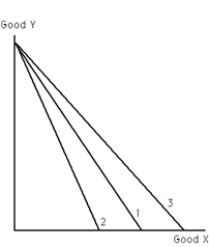 -Refer to Exhibit 20-8. A move of the budget constraint from 1 to 2 is caused by a
 (Multiple Choice)
4.7/5 (92)
(92) If the marginal utility of X is negative, then the last unit of X is
(Multiple Choice)
4.9/5 (81)
(81) Exhibit 20-7
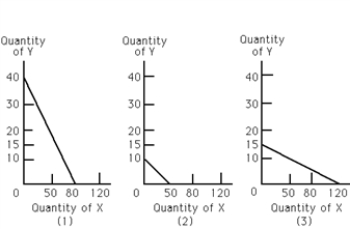 -Refer to Exhibit 20-7. For graph (1), if the price of X is $20, the price of Y is
 (Multiple Choice)
4.8/5 (81)
(81) If Smith will give up three units of Y to get one additional unit of X, then
(Multiple Choice)
4.8/5 (82)
(82) Exhibit 20-3
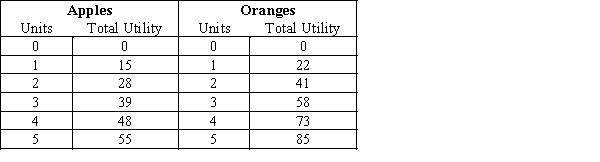 -Refer to Exhibit 20-3. Linda spends $5 a week on apples and oranges. If the price of both goods is $1 per unit, how many apples and oranges, respectively, does she purchase per week if she wants to maximize her utility?
 (Multiple Choice)
4.9/5 (81)
(81) Because there are so few diamonds in the world, the consumption of diamonds
(Multiple Choice)
4.8/5 (81)
(81) Given that MUX/PX < MUY/PY, consumers who spend all their income on these two goods
(Multiple Choice)
4.8/5 (92)
(92) As presented in the textbookbook, research by some economists has shown that even when there is no difference between options provided to people
(Multiple Choice)
4.9/5 (79)
(79) Suppose the marginal utility (MU) of a paperback books is 60 utils and each book costs $10, while the MU of a hamburger is 50 utils and each costs $7.50. If you consume one movie and buy one hamburger per week, are you attaining consumer equilibrium?
(Multiple Choice)
4.7/5 (87)
(87) Suppose you just finished your third plateful of Thanksgiving dinner and it yielded zero units of additional satisfaction. Should you go back for more?
(Multiple Choice)
4.8/5 (97)
(97) The MU/P ratio for good X is greater than the MU/P ratio for good Y as a result of a fall in the price of good X. To achieve consumer equilibrium, the consumer reallocates dollars from the purchase of good Y to the purchase of good X. In the process, she
(Multiple Choice)
4.7/5 (74)
(74) 
Filters
- Essay(0)
- Multiple Choice(0)
- Short Answer(0)
- True False(0)
- Matching(0)