



 Chat with AI
Exam 20: Consumer Choice and Behavioral Economics

Exam 1: What Economics Is About174 Questions
Exam 2: Production Possibilities Frontier Framework156 Questions
Exam 3: Supply and Demand Theory224 Questions
Exam 4: Prices Free Controlled and Relative122 Questions
Exam 5: Supply Demand and Price Applications76 Questions
Exam 6: Macroeconomic Measurements Part I Prices and Unemployment151 Questions
Exam 7: Macroeconomic Measurements Part II Gdp and Real Gdp150 Questions
Exam 8: Aggregate Demand and Aggregate Supply204 Questions
Exam 9: Classical Macroeconomics and the Self Regulating Economy172 Questions
Exam 10: Keynesian Macroeconomics and Economic Instability a Critique of the Self Regulating Economy200 Questions
Exam 11: Fiscal Policy and the Federal Budget167 Questions
Exam 12: Money Banking and the Financial System150 Questions
Exam 13: The Federal Reserve System180 Questions
Exam 14: Money and the Economy150 Questions
Exam 15: Monetary Policy185 Questions
Exam 16: Expectations Theory and the Economy150 Questions
Exam 17: Economic Growth Resources Technology Ideas and Institutions103 Questions
Exam 18: Debates in Macroeconomics Over the Role and Effects of Government100 Questions
Exam 19: Elasticity204 Questions
Exam 20: Consumer Choice and Behavioral Economics179 Questions
Exam 21: Production and Costs245 Questions
Exam 22: Perfect Competition187 Questions
Exam 23: Monopoly195 Questions
Exam 24: Monopolistic Competition Oligopoly and Game Theory172 Questions
Exam 25: Government and Product Markets Antitrust and Regulation158 Questions
Exam 26: Factor Markets With Emphasis on the Labor Market184 Questions
Exam 27: Wages Unions and Labor138 Questions
Exam 28: The Distribution of Income and Poverty99 Questions
Exam 29: Interest Rent and Profit198 Questions
Exam 30: Market Failure Externalities Public Goods and Asymmetric Information187 Questions
Exam 31: Public Choice and Special Interest Group Politics135 Questions
Exam 32: Building Theories to Explain Everyday Life From Observations to Questions to Theories to Predictions62 Questions
Exam 33: International Trade152 Questions
Exam 34: International Finance122 Questions
Exam 35: The Economic Case for and Against Government Five Topics Considered87 Questions
Exam 36: Stocks Bonds Futures and Options110 Questions
Select questions type


Implicit in the solution to the diamond-water paradox is the idea that prices reflect __________ utility instead of __________ utility.
(Multiple Choice)
4.8/5  (80)
(80) The marginal utility curve for units 1 through 5 of good Z lies above the horizontal axis. What does this imply must be true about the total utility curve for units 1 through 5 of good Z?
(Multiple Choice)
4.9/5 (76)
(76) Marginal utility is computed by dividing total utility by the quantity consumed of a good.
(True/False)
5.0/5 (81)
(81) Joe is currently in consumer equilibrium by consuming cheese and crackers, such that the last cracker consumed yielded 8 utils and the last piece of cheese consumed yielded 12 utils. Assume the price of crackers is two cents per cracker and the price of cheese is three cents per piece. If the price of crackers increases to four cents, Joe should __________ his consumption of crackers and his marginal utility from crackers will __________ and also __________ his consumption of cheese and his marginal utility from cheese will __________.
(Multiple Choice)
4.8/5 (71)
(71) Exhibit 20-3
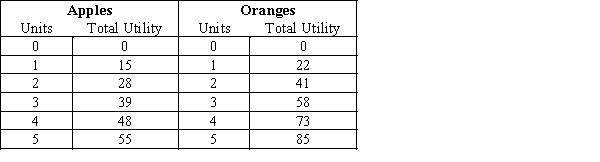 -Refer to Exhibit 20-3. Linda spends $5 a week on apples and oranges. If the price of both goods is $1 per unit, what is Linda's total utility from consuming the optimal bundle of goods?
 (Multiple Choice)
4.8/5 (79)
(79) If a person's income and the prices of both goods all rise by the same percentage, then her budget constraint
(Multiple Choice)
4.9/5 (72)
(72) Suppose Valerie is consuming lipstick (L) and eye shadow (E) and nothing else. MUL = 40 and MUE = 36. The price of eye shadow is $9, and the price of lipstick is $15. What should Valerie do?
(Multiple Choice)
4.9/5 (74)
(74) Exhibit 20-6
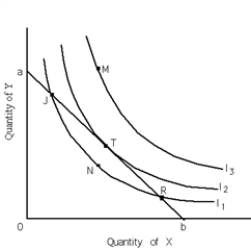 -Refer to Exhibit 20-6. I1, I2 and I3 are indifference curves and line ab is the relevant budget constraint. The equilibrium position for the consumer is at
 (Multiple Choice)
4.8/5 (85)
(85) Exhibit 20-7
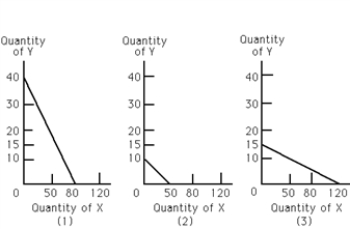 -Refer to Exhibit 20-7. Which of the following graphs represents a budget constraint of a consumer whose income is $120?
 (Multiple Choice)
4.8/5 (68)
(68) The point where the slope of the budget constraint equals the slope of the indifference curve is termed consumer equilibrium.
(True/False)
4.8/5 (62)
(62) Indifference curves are generally downward sloping, they are convex to the origin, and they do not cross.
(True/False)
4.7/5 (84)
(84) The theory of consumer choice assumes that consumers attempt to maximize
(Multiple Choice)
4.9/5 (79)
(79) Exhibit 20-4
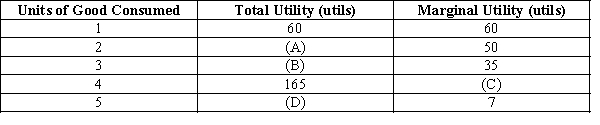 -Refer to Exhibit 20-4. What value goes in blank (A)?
 (Multiple Choice)
4.8/5 (64)
(64) A person is in consumer equilibrium, and then the price rises for one of the goods she purchases. If she wants to restore herself to consumer equilibrium, she will (most likely)
(Multiple Choice)
4.9/5 (67)
(67) This is the solution to the diamond-water paradox: Those things that have high value in use sometimes have low prices because they are consumed at low __________ utility; those things that have low value in use sometimes have high prices because they are consumed at high __________utility.
(Multiple Choice)
4.9/5 (78)
(78) Smith, who has $10,000, receives an extra dollar, as does Jones, who has $100,000. Smith receives more utility from the extra dollar than does Jones. This is an example of
(Multiple Choice)
4.9/5 (84)
(84) Exhibit 20-1
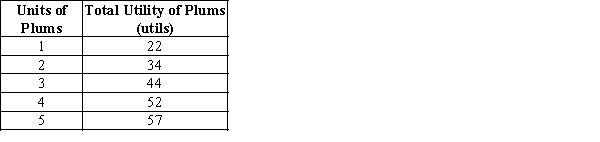 -Refer to Exhibit 20-1. The marginal utility of the third plum is
 (Multiple Choice)
4.9/5 (83)
(83) 
Filters
- Essay(0)
- Multiple Choice(0)
- Short Answer(0)
- True False(0)
- Matching(0)