



 Chat with AI
Exam 20: Consumer Choice and Behavioral Economics

Exam 1: What Economics Is About174 Questions
Exam 2: Production Possibilities Frontier Framework156 Questions
Exam 3: Supply and Demand Theory224 Questions
Exam 4: Prices Free Controlled and Relative122 Questions
Exam 5: Supply Demand and Price Applications76 Questions
Exam 6: Macroeconomic Measurements Part I Prices and Unemployment151 Questions
Exam 7: Macroeconomic Measurements Part II Gdp and Real Gdp150 Questions
Exam 8: Aggregate Demand and Aggregate Supply204 Questions
Exam 9: Classical Macroeconomics and the Self Regulating Economy172 Questions
Exam 10: Keynesian Macroeconomics and Economic Instability a Critique of the Self Regulating Economy200 Questions
Exam 11: Fiscal Policy and the Federal Budget167 Questions
Exam 12: Money Banking and the Financial System150 Questions
Exam 13: The Federal Reserve System180 Questions
Exam 14: Money and the Economy150 Questions
Exam 15: Monetary Policy185 Questions
Exam 16: Expectations Theory and the Economy150 Questions
Exam 17: Economic Growth Resources Technology Ideas and Institutions103 Questions
Exam 18: Debates in Macroeconomics Over the Role and Effects of Government100 Questions
Exam 19: Elasticity204 Questions
Exam 20: Consumer Choice and Behavioral Economics179 Questions
Exam 21: Production and Costs245 Questions
Exam 22: Perfect Competition187 Questions
Exam 23: Monopoly195 Questions
Exam 24: Monopolistic Competition Oligopoly and Game Theory172 Questions
Exam 25: Government and Product Markets Antitrust and Regulation158 Questions
Exam 26: Factor Markets With Emphasis on the Labor Market184 Questions
Exam 27: Wages Unions and Labor138 Questions
Exam 28: The Distribution of Income and Poverty99 Questions
Exam 29: Interest Rent and Profit198 Questions
Exam 30: Market Failure Externalities Public Goods and Asymmetric Information187 Questions
Exam 31: Public Choice and Special Interest Group Politics135 Questions
Exam 32: Building Theories to Explain Everyday Life From Observations to Questions to Theories to Predictions62 Questions
Exam 33: International Trade152 Questions
Exam 34: International Finance122 Questions
Exam 35: The Economic Case for and Against Government Five Topics Considered87 Questions
Exam 36: Stocks Bonds Futures and Options110 Questions
Select questions type


Which of the following best describes an interpersonal utility comparison?
(Multiple Choice)
4.8/5  (76)
(76) If, as a person consumes additional units of a good, total utility rises by a constant amount, it follows that
(Multiple Choice)
4.8/5 (77)
(77) Consider two options: (A) you receive a guaranteed payment of $100; (B) a coin is tossed and if heads comes up, you win nothing; if tails comes up, you win $200. The expected payoff for option B is:
(Multiple Choice)
4.7/5 (79)
(79) Behavioral economists contend that the traditional economic framework always accurately depicts human behavior.
(True/False)
4.7/5 (79)
(79) Exhibit 20-6
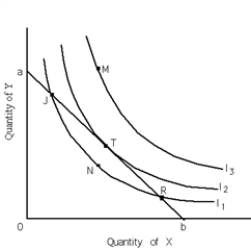 -Refer to Exhibit 20-6. I1, I2 and I3 are indifference curves and line ab is the relevant budget constraint. If the consumer is initially at point R, he should
 (Multiple Choice)
4.8/5 (87)
(87) The marginal utility curve for units 6 through 8 of good Z lies below the horizontal axis. What does this imply must be true about the total utility curve for units 6 through 8 of good Z?
(Multiple Choice)
4.8/5 (69)
(69) Suppose you are eating buffalo wings at a local happy hour. The total utils from doing so after the fourth, fifth, sixth, and seventh wings are 80, 116, 136, 146, respectively. The marginal utility of the seventh wing is __________ utils.
(Multiple Choice)
4.9/5 (94)
(94) Brain researchers think that the best reason the brain might weight the present high and the future low when faced with a present-future tradeoff is that:
(Multiple Choice)
4.9/5 (78)
(78) Suppose people are in consumer equilibrium buying 10,000 units of good X at a given price. Then the price of good X falls to $0. It follows that people will buy more of good X and that the marginal utility of the last additional unit they buy will be __________ the __________ of the 10,000th unit.
(Multiple Choice)
4.9/5 (83)
(83) We take one dollar from a pauper and give it to a millionaire. Assuming a diminishing marginal utility of money,
(Multiple Choice)
4.9/5 (89)
(89) A util is an artificial construct used as a means of measuring the
(Multiple Choice)
4.9/5 (77)
(77) Economists usually assume that money has __________ marginal utility.
(Multiple Choice)
4.9/5 (87)
(87) Suppose you could quantify the amount of satisfaction you receive from consuming ice cream in money terms. You might say, "I expect to get $3 worth of satisfaction from this ice cream cone." According to traditional economic theory, if the price of this ice cream cone were $3.25, would you buy one?
(Multiple Choice)
4.8/5 (82)
(82) We would expect the total utility of diamonds to be __________ than the total utility of water and the marginal utility of diamonds to be __________ than the marginal utility of water.
(Multiple Choice)
4.8/5 (84)
(84) Smith says she gets 5 utils from consuming the fifth unit of a good whereas Jones says he gets 10 utils from consuming the fifth unit of a good. It follows that
(Multiple Choice)
4.8/5 (62)
(62) 
Filters
- Essay(0)
- Multiple Choice(0)
- Short Answer(0)
- True False(0)
- Matching(0)