



 Chat with AI
Exam 20: Consumer Choice and Behavioral Economics

Exam 1: What Economics Is About174 Questions
Exam 2: Production Possibilities Frontier Framework156 Questions
Exam 3: Supply and Demand Theory224 Questions
Exam 4: Prices Free Controlled and Relative122 Questions
Exam 5: Supply Demand and Price Applications76 Questions
Exam 6: Macroeconomic Measurements Part I Prices and Unemployment151 Questions
Exam 7: Macroeconomic Measurements Part II Gdp and Real Gdp150 Questions
Exam 8: Aggregate Demand and Aggregate Supply204 Questions
Exam 9: Classical Macroeconomics and the Self Regulating Economy172 Questions
Exam 10: Keynesian Macroeconomics and Economic Instability a Critique of the Self Regulating Economy200 Questions
Exam 11: Fiscal Policy and the Federal Budget167 Questions
Exam 12: Money Banking and the Financial System150 Questions
Exam 13: The Federal Reserve System180 Questions
Exam 14: Money and the Economy150 Questions
Exam 15: Monetary Policy185 Questions
Exam 16: Expectations Theory and the Economy150 Questions
Exam 17: Economic Growth Resources Technology Ideas and Institutions103 Questions
Exam 18: Debates in Macroeconomics Over the Role and Effects of Government100 Questions
Exam 19: Elasticity204 Questions
Exam 20: Consumer Choice and Behavioral Economics179 Questions
Exam 21: Production and Costs245 Questions
Exam 22: Perfect Competition187 Questions
Exam 23: Monopoly195 Questions
Exam 24: Monopolistic Competition Oligopoly and Game Theory172 Questions
Exam 25: Government and Product Markets Antitrust and Regulation158 Questions
Exam 26: Factor Markets With Emphasis on the Labor Market184 Questions
Exam 27: Wages Unions and Labor138 Questions
Exam 28: The Distribution of Income and Poverty99 Questions
Exam 29: Interest Rent and Profit198 Questions
Exam 30: Market Failure Externalities Public Goods and Asymmetric Information187 Questions
Exam 31: Public Choice and Special Interest Group Politics135 Questions
Exam 32: Building Theories to Explain Everyday Life From Observations to Questions to Theories to Predictions62 Questions
Exam 33: International Trade152 Questions
Exam 34: International Finance122 Questions
Exam 35: The Economic Case for and Against Government Five Topics Considered87 Questions
Exam 36: Stocks Bonds Futures and Options110 Questions
Select questions type


Exhibit 20-4
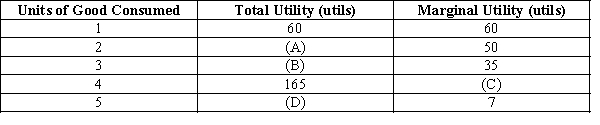 -Refer to Exhibit 20-4. What value goes in blank (B)?
 (Multiple Choice)
4.8/5  (81)
(81) Economists David Zizzo and Andrew Oswald found that the majority of their study participants made themselves worse off in order to make someone else worse off.
(True/False)
4.9/5 (70)
(70) Exhibit 20-1
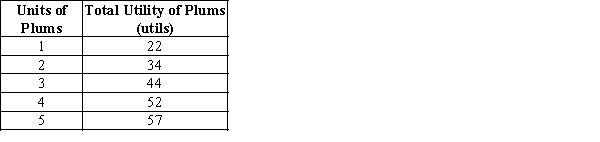 -Refer to Exhibit 20-1. In this example, marginal utility
 (Multiple Choice)
4.8/5 (69)
(69) The __________ one's income, the __________ one's budget constraint.
(Multiple Choice)
4.9/5 (90)
(90) Consider two options: (A) you receive a guaranteed payment of $100; (B) a coin is tossed and if heads comes up, you win nothing; if tails comes up, you win $200. The expected payoff for option A is:
(Multiple Choice)
4.9/5 (80)
(80) Suppose you are eating buffalo wings at a local happy hour. The total utils from doing so after the fourth, fifth, sixth, and seventh wings are 80, 116, 136, 150, respectively. The marginal utility of the sixth wing is __________ utils.
(Multiple Choice)
4.8/5 (86)
(86) Exhibit 20-8
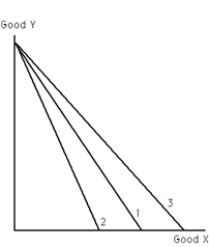 -Refer to Exhibit 20-8. If the price of good X rises, the budget constraint moves from budget constraint
 (Multiple Choice)
4.7/5 (78)
(78) The absolute value of the slope of the budget constraint is also known as the marginal rate of substitution.
(True/False)
5.0/5 (79)
(79) Indifference curves are generally downward sloping and concave to the origin.
(True/False)
4.7/5 (79)
(79) If total utility of a good is high while the price of the good is low, it is likely that the good
(Multiple Choice)
4.8/5 (73)
(73) Which of the following statements does not invoke interpersonal utility comparisons?
(Multiple Choice)
4.9/5 (72)
(72) The budget constraint cuts the horizontal axis at 12 units of good X and it cuts the vertical axis at 20 units of good Y. If the price of good X is $20 and the price of good Y is $12, then what does income equal?
(Multiple Choice)
4.9/5 (96)
(96) Adam Smith observed that often things that have the greatest value in use, or are the most useful, have a relatively low price, and things that have little or no value in use have a high price.
(True/False)
4.8/5 (88)
(88) Suppose that in the year 2050, one gallon of water is more expensive than a one-carat diamond. What could explain this?
(Multiple Choice)
5.0/5 (77)
(77) Exhibit 20-7
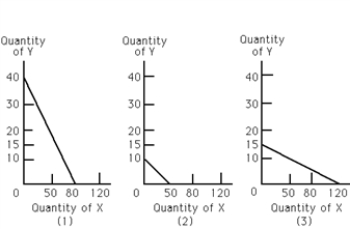 -Refer to Exhibit 20-7. The price of X is $40 and the price of Y is $80. Assuming that the consumer allocates all of his income to good X, how many units of X will he purchase? (Request: Do not ask the instructor to which graph the question is referring.)
 (Multiple Choice)
4.9/5 (65)
(65) Rich has $100,000 and Poore has $1,000. Which of these statements is most strongly supported by the theory of consumer choice?
(Multiple Choice)
4.9/5 (89)
(89) Exhibit 20-5
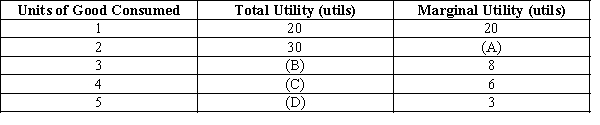 -Refer to Exhibit 20-5. What value goes in blank (C)?
 (Multiple Choice)
4.8/5 (72)
(72) Marginal utility analysis can be used to illustrate the law of demand.
(True/False)
4.8/5 (81)
(81) 
Filters
- Essay(0)
- Multiple Choice(0)
- Short Answer(0)
- True False(0)
- Matching(0)