



 Chat with AI
Exam 31: Public Choice and Special Interest Group Politics

Exam 1: What Economics Is About174 Questions
Exam 2: Production Possibilities Frontier Framework156 Questions
Exam 3: Supply and Demand Theory224 Questions
Exam 4: Prices Free Controlled and Relative122 Questions
Exam 5: Supply Demand and Price Applications76 Questions
Exam 6: Macroeconomic Measurements Part I Prices and Unemployment151 Questions
Exam 7: Macroeconomic Measurements Part II Gdp and Real Gdp150 Questions
Exam 8: Aggregate Demand and Aggregate Supply204 Questions
Exam 9: Classical Macroeconomics and the Self Regulating Economy172 Questions
Exam 10: Keynesian Macroeconomics and Economic Instability a Critique of the Self Regulating Economy200 Questions
Exam 11: Fiscal Policy and the Federal Budget167 Questions
Exam 12: Money Banking and the Financial System150 Questions
Exam 13: The Federal Reserve System180 Questions
Exam 14: Money and the Economy150 Questions
Exam 15: Monetary Policy185 Questions
Exam 16: Expectations Theory and the Economy150 Questions
Exam 17: Economic Growth Resources Technology Ideas and Institutions103 Questions
Exam 18: Debates in Macroeconomics Over the Role and Effects of Government100 Questions
Exam 19: Elasticity204 Questions
Exam 20: Consumer Choice and Behavioral Economics179 Questions
Exam 21: Production and Costs245 Questions
Exam 22: Perfect Competition187 Questions
Exam 23: Monopoly195 Questions
Exam 24: Monopolistic Competition Oligopoly and Game Theory172 Questions
Exam 25: Government and Product Markets Antitrust and Regulation158 Questions
Exam 26: Factor Markets With Emphasis on the Labor Market184 Questions
Exam 27: Wages Unions and Labor138 Questions
Exam 28: The Distribution of Income and Poverty99 Questions
Exam 29: Interest Rent and Profit198 Questions
Exam 30: Market Failure Externalities Public Goods and Asymmetric Information187 Questions
Exam 31: Public Choice and Special Interest Group Politics135 Questions
Exam 32: Building Theories to Explain Everyday Life From Observations to Questions to Theories to Predictions62 Questions
Exam 33: International Trade152 Questions
Exam 34: International Finance122 Questions
Exam 35: The Economic Case for and Against Government Five Topics Considered87 Questions
Exam 36: Stocks Bonds Futures and Options110 Questions
Select questions type


The voting outcome and the most preferred outcome of the median voter are the same in a simple majority vote where there are several options from which to choose.
(True/False)
4.8/5  (84)
(84) Which of the following persons is most likely to become informed on the National Endowment for the Arts?
(Multiple Choice)
4.8/5 (78)
(78) It has been suggested by some economists that rent seeking activity often occurs within families, particularly when an inheritance is involved.
(True/False)
4.9/5 (84)
(84) In his article Straight Talk About Economic Literacy, economist _______________________ said, "Citizens can vote even if they have no idea what they are doing. If enough voters fit that description, democratic governments are bound to make foolish decisions."
(Multiple Choice)
4.9/5 (77)
(77) Two candidates, Smith and Jones, are running for the same political office. Last night they were in a debate. It is generally accepted that Smith is perceived more to the left after the debate than before the debate. This is bad news for Jones if before the debate Smith was perceived
(Multiple Choice)
4.8/5 (72)
(72) During an election, a candidate who is not doing as well in the polls as his or her opponent will
(Multiple Choice)
4.8/5 (67)
(67) Exhibit 31-4
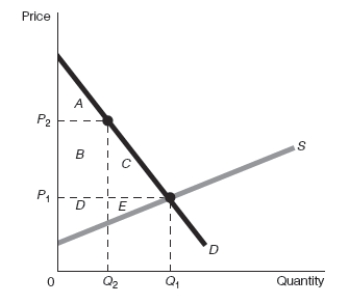 -Refer to Exhibit 31-4. Suppose that producers of this good engage in rent seeking which results in the government imposing a price floor of P2. The gain in producers' surplus that occurs due to the price floor is
 (Multiple Choice)
4.9/5 (84)
(84) Simple majority voting sometimes leads to projects being undertaken whose costs are greater than the benefits. How is this possible?
(Multiple Choice)
4.8/5 (82)
(82) Candidates in a two-person race express very similar positions a few weeks before the election. A voter complains that there is not much difference between the two candidates. What this voter misunderstands or ignores is that
(Multiple Choice)
4.8/5 (84)
(84) Which of the following is a prediction of the median voter model for a two person political race?
(Multiple Choice)
4.9/5 (67)
(67) Logrolling is the exchange of votes to gain support for legislation.
(True/False)
4.9/5 (87)
(87) Public choice theory is the branch of economics that deals with group economic decisions made through social media.
(True/False)
4.8/5 (67)
(67) The process whereby votes are exchanged to gain support for legislation is referred to as
(Multiple Choice)
4.8/5 (70)
(70) According to public choice theorists, people behave differently in the market sector than in the public sector because
(Multiple Choice)
4.9/5 (70)
(70) Exhibit 31-2
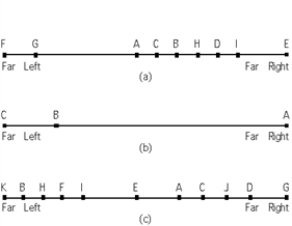 -Refer to Exhibit 31-2-(a). Two candidates are competing for an electorate consisting of 9 voters labeled A-I shown positioned with respect to their ideological stands on issues. The median voter theory would predict that candidates will assume the ideological position(s)
 (Multiple Choice)
4.9/5 (68)
(68) 
Filters
- Essay(0)
- Multiple Choice(0)
- Short Answer(0)
- True False(0)
- Matching(0)