



 Chat with AI
Exam 31: Public Choice and Special Interest Group Politics

Exam 1: What Economics Is About174 Questions
Exam 2: Production Possibilities Frontier Framework156 Questions
Exam 3: Supply and Demand Theory224 Questions
Exam 4: Prices Free Controlled and Relative122 Questions
Exam 5: Supply Demand and Price Applications76 Questions
Exam 6: Macroeconomic Measurements Part I Prices and Unemployment151 Questions
Exam 7: Macroeconomic Measurements Part II Gdp and Real Gdp150 Questions
Exam 8: Aggregate Demand and Aggregate Supply204 Questions
Exam 9: Classical Macroeconomics and the Self Regulating Economy172 Questions
Exam 10: Keynesian Macroeconomics and Economic Instability a Critique of the Self Regulating Economy200 Questions
Exam 11: Fiscal Policy and the Federal Budget167 Questions
Exam 12: Money Banking and the Financial System150 Questions
Exam 13: The Federal Reserve System180 Questions
Exam 14: Money and the Economy150 Questions
Exam 15: Monetary Policy185 Questions
Exam 16: Expectations Theory and the Economy150 Questions
Exam 17: Economic Growth Resources Technology Ideas and Institutions103 Questions
Exam 18: Debates in Macroeconomics Over the Role and Effects of Government100 Questions
Exam 19: Elasticity204 Questions
Exam 20: Consumer Choice and Behavioral Economics179 Questions
Exam 21: Production and Costs245 Questions
Exam 22: Perfect Competition187 Questions
Exam 23: Monopoly195 Questions
Exam 24: Monopolistic Competition Oligopoly and Game Theory172 Questions
Exam 25: Government and Product Markets Antitrust and Regulation158 Questions
Exam 26: Factor Markets With Emphasis on the Labor Market184 Questions
Exam 27: Wages Unions and Labor138 Questions
Exam 28: The Distribution of Income and Poverty99 Questions
Exam 29: Interest Rent and Profit198 Questions
Exam 30: Market Failure Externalities Public Goods and Asymmetric Information187 Questions
Exam 31: Public Choice and Special Interest Group Politics135 Questions
Exam 32: Building Theories to Explain Everyday Life From Observations to Questions to Theories to Predictions62 Questions
Exam 33: International Trade152 Questions
Exam 34: International Finance122 Questions
Exam 35: The Economic Case for and Against Government Five Topics Considered87 Questions
Exam 36: Stocks Bonds Futures and Options110 Questions
Select questions type


Simple majority voting will generate the same result whether taxes are equally divided or unequally divided.
(True/False)
5.0/5  (74)
(74) 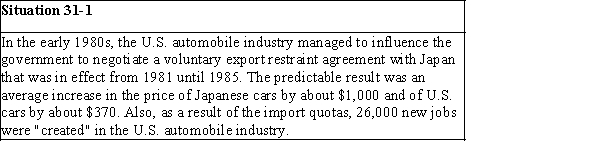 -Refer to Situation 31-l. This episode can be seen as an instance of
 (Multiple Choice)
4.7/5 (81)
(81) Often, candidates running for political office will speak in general terms instead of specific terms because voters agree more on __________ than __________.
(Multiple Choice)
5.0/5 (83)
(83) Suppose Congress passes a law that states that the federal government will pay $100 to any American citizen who can pass a (reasonably simple) current political events test. It follows that
(Multiple Choice)
4.8/5 (68)
(68) Ceteris paribus, economics predicts that voter turnout will be higher
(Multiple Choice)
4.8/5 (79)
(79) Exhibit 31-1
 -Refer to Exhibit 31-1. The exhibit shows the breakdown of benefits and costs for a four-person town considering the purchase of an additional $1,200 worth of books for the public library. If simple majority voting determines the outcome, the books will
 (Multiple Choice)
4.8/5 (77)
(77) Exhibit 31-4
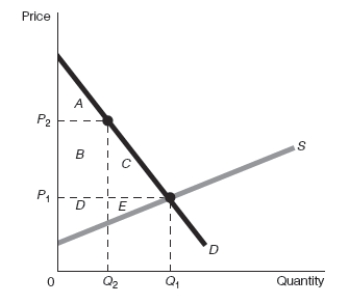 -Refer to Exhibit 31-4. At the market equilibrium price of the good, consumers' surplus is the area
 (Multiple Choice)
4.8/5 (68)
(68) People will be more likely to vote if they believe that their vote will determine the outcome of the election.
(True/False)
4.8/5 (90)
(90) Simple majority rule can generate inefficient outcomes because
(Multiple Choice)
4.9/5 (75)
(75) Most voters choose not to be informed about political and governmental issues because they are not smart enough to really understand the issues.
(True/False)
4.8/5 (68)
(68) Exhibit 31-4
-Refer to Exhibit 31-4. If producers of this good engage in rent seeking which results in the government imposing a price floor of P2, then consumers' surplus ends up being area
-Refer to Exhibit 31-4. If producers of this good engage in rent seeking which results in the government imposing a price floor of P2, then consumers' surplus ends up being area (Multiple Choice)
4.7/5 (79)
(79) Rent seeking is more likely to occur in a family when the parents make their inheritance plans clear by telling the children ahead of time that their estate will be divided equally among the children (and that under no circumstances will the parents change their minds) than when there is more uncertainty with regards to the parents' inheritance plans.
(True/False)
4.7/5 (84)
(84) Political candidates running for the same office tend to voice
(Multiple Choice)
4.9/5 (73)
(73) Exhibit 31-4
-Refer to Exhibit 31-4. Suppose that producers of this good engage in rent seeking which results in the government imposing a price floor of P2. The loss of consumers' surplus that occurs due to the price floor is
-Refer to Exhibit 31-4. Suppose that producers of this good engage in rent seeking which results in the government imposing a price floor of P2. The loss of consumers' surplus that occurs due to the price floor is (Multiple Choice)
4.7/5 (72)
(72) 
Filters
- Essay(0)
- Multiple Choice(0)
- Short Answer(0)
- True False(0)
- Matching(0)