



 Chat with AI
Exam 31: Public Choice and Special Interest Group Politics

Exam 1: What Economics Is About174 Questions
Exam 2: Production Possibilities Frontier Framework156 Questions
Exam 3: Supply and Demand Theory224 Questions
Exam 4: Prices Free Controlled and Relative122 Questions
Exam 5: Supply Demand and Price Applications76 Questions
Exam 6: Macroeconomic Measurements Part I Prices and Unemployment151 Questions
Exam 7: Macroeconomic Measurements Part II Gdp and Real Gdp150 Questions
Exam 8: Aggregate Demand and Aggregate Supply204 Questions
Exam 9: Classical Macroeconomics and the Self Regulating Economy172 Questions
Exam 10: Keynesian Macroeconomics and Economic Instability a Critique of the Self Regulating Economy200 Questions
Exam 11: Fiscal Policy and the Federal Budget167 Questions
Exam 12: Money Banking and the Financial System150 Questions
Exam 13: The Federal Reserve System180 Questions
Exam 14: Money and the Economy150 Questions
Exam 15: Monetary Policy185 Questions
Exam 16: Expectations Theory and the Economy150 Questions
Exam 17: Economic Growth Resources Technology Ideas and Institutions103 Questions
Exam 18: Debates in Macroeconomics Over the Role and Effects of Government100 Questions
Exam 19: Elasticity204 Questions
Exam 20: Consumer Choice and Behavioral Economics179 Questions
Exam 21: Production and Costs245 Questions
Exam 22: Perfect Competition187 Questions
Exam 23: Monopoly195 Questions
Exam 24: Monopolistic Competition Oligopoly and Game Theory172 Questions
Exam 25: Government and Product Markets Antitrust and Regulation158 Questions
Exam 26: Factor Markets With Emphasis on the Labor Market184 Questions
Exam 27: Wages Unions and Labor138 Questions
Exam 28: The Distribution of Income and Poverty99 Questions
Exam 29: Interest Rent and Profit198 Questions
Exam 30: Market Failure Externalities Public Goods and Asymmetric Information187 Questions
Exam 31: Public Choice and Special Interest Group Politics135 Questions
Exam 32: Building Theories to Explain Everyday Life From Observations to Questions to Theories to Predictions62 Questions
Exam 33: International Trade152 Questions
Exam 34: International Finance122 Questions
Exam 35: The Economic Case for and Against Government Five Topics Considered87 Questions
Exam 36: Stocks Bonds Futures and Options110 Questions
Select questions type


Suppose that a federal election is coming soon and the government has been running persistent large budget deficits. Constitutional economists would most likely urge ___________________ in order to eliminate future budget deficits.
(Multiple Choice)
4.9/5  (76)
(76) Public choice economists often explain low voter turnouts in terms of
(Multiple Choice)
4.8/5 (86)
(86) Candidate X and Candidate Y have a debate. X's advisers believe that one result of the debate is that Y will appear to the voters as further to the left than before. This is good news for X
(Multiple Choice)
4.9/5 (68)
(68) If it is assumed that people vote for the candidate who comes closer to matching their own views, to win votes in a two-person race
(Multiple Choice)
4.9/5 (85)
(85) Competition for votes between two political parties will cause those parties to
(Multiple Choice)
4.9/5 (87)
(87) Under certain circumstances, a congressional district may be a special interest group.
(True/False)
4.9/5 (82)
(82) Public choice theorists say that the greater the number of potential voters in an election, the __________ the perceived benefits of voting held by each voter, and so the __________ the likely percentage turnout of voters.
(Multiple Choice)
4.9/5 (82)
(82) Public choice theorists insist that when a person goes from public to private employment, his or her motivations __________ while the institutional arrangements shaping his or her actions __________.
(Multiple Choice)
4.9/5 (74)
(74) Simple majority rule will almost always generate efficient outcomes.
(True/False)
4.8/5 (69)
(69) Candidate A says, "Health care is too expensive in the United States. We need to do something-and quickly-to develop a better, more responsive, less expensive health care system." Candidate B, who is running against candidate A in a two-person race, says, "Health care is too expensive in the United States. We need to do something about it and quickly. I suggest that we have the federal government develop a centralized system for delivering health care in this country." If you know nothing else about the two candidates, it follows that
(Multiple Choice)
4.9/5 (74)
(74) According to public choice theorists, people in the market sector and people in the public sector have __________, and (but) sometimes act differently because of different __________ arrangements in the two sectors.
(Multiple Choice)
4.9/5 (79)
(79) According to public choice theory, low voter turnouts are the result of voters
(Multiple Choice)
4.9/5 (82)
(82) Public choice theory assumes that those involved in the public sector are generally motivated by
(Multiple Choice)
4.9/5 (73)
(73) Exhibit 31-4
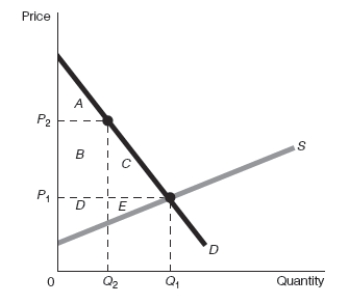 -Refer to Exhibit 31-4. At the market equilibrium price of the good, producers' surplus is the area
 (Multiple Choice)
4.8/5 (91)
(91) Exhibit 31-2
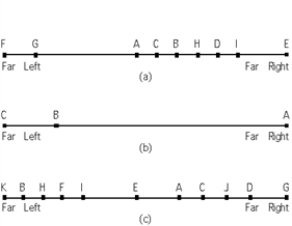 -Refer to Exhibit 31-2-(c). Two candidates are competing for an electorate consisting of 11 voters labeled A-K shown positioned with respect to their ideological stands on issues. The median voter theory would predict that candidates will assume the ideological position(s)
 (Multiple Choice)
4.9/5 (79)
(79) In the early 19th century, the main lobbyists behind passage of the Factory Acts were the women and children who were being exploited.
(True/False)
4.7/5 (77)
(77) There is evidence that __________ were the main lobbyists behind passage of the Factory Acts which put restrictions on women and children working in early 19th century England.
(Multiple Choice)
4.8/5 (69)
(69) 
Filters
- Essay(0)
- Multiple Choice(0)
- Short Answer(0)
- True False(0)
- Matching(0)