



 Chat with AI
Exam 31: Public Choice and Special Interest Group Politics

Exam 1: What Economics Is About174 Questions
Exam 2: Production Possibilities Frontier Framework156 Questions
Exam 3: Supply and Demand Theory224 Questions
Exam 4: Prices Free Controlled and Relative122 Questions
Exam 5: Supply Demand and Price Applications76 Questions
Exam 6: Macroeconomic Measurements Part I Prices and Unemployment151 Questions
Exam 7: Macroeconomic Measurements Part II Gdp and Real Gdp150 Questions
Exam 8: Aggregate Demand and Aggregate Supply204 Questions
Exam 9: Classical Macroeconomics and the Self Regulating Economy172 Questions
Exam 10: Keynesian Macroeconomics and Economic Instability a Critique of the Self Regulating Economy200 Questions
Exam 11: Fiscal Policy and the Federal Budget167 Questions
Exam 12: Money Banking and the Financial System150 Questions
Exam 13: The Federal Reserve System180 Questions
Exam 14: Money and the Economy150 Questions
Exam 15: Monetary Policy185 Questions
Exam 16: Expectations Theory and the Economy150 Questions
Exam 17: Economic Growth Resources Technology Ideas and Institutions103 Questions
Exam 18: Debates in Macroeconomics Over the Role and Effects of Government100 Questions
Exam 19: Elasticity204 Questions
Exam 20: Consumer Choice and Behavioral Economics179 Questions
Exam 21: Production and Costs245 Questions
Exam 22: Perfect Competition187 Questions
Exam 23: Monopoly195 Questions
Exam 24: Monopolistic Competition Oligopoly and Game Theory172 Questions
Exam 25: Government and Product Markets Antitrust and Regulation158 Questions
Exam 26: Factor Markets With Emphasis on the Labor Market184 Questions
Exam 27: Wages Unions and Labor138 Questions
Exam 28: The Distribution of Income and Poverty99 Questions
Exam 29: Interest Rent and Profit198 Questions
Exam 30: Market Failure Externalities Public Goods and Asymmetric Information187 Questions
Exam 31: Public Choice and Special Interest Group Politics135 Questions
Exam 32: Building Theories to Explain Everyday Life From Observations to Questions to Theories to Predictions62 Questions
Exam 33: International Trade152 Questions
Exam 34: International Finance122 Questions
Exam 35: The Economic Case for and Against Government Five Topics Considered87 Questions
Exam 36: Stocks Bonds Futures and Options110 Questions
Select questions type


Exhibit 31-1
 -Refer to Exhibit 31-l. The exhibit shows the breakdown of benefits and costs for a four-person town of a proposed $1,200 addition in books to the public library. The members of the community get to vote on the project at hand, and the majority rules. Given the data, the $1,200 will
 (Multiple Choice)
4.8/5  (75)
(75) When it comes to voting in a presidential election, we would expect, ceteris paribus,
(Multiple Choice)
4.9/5 (83)
(83) A politician running for political office does not speak in general terms, does not try to move to the middle of the political spectrum, and does not take polls, therefore it follows that
(Multiple Choice)
4.9/5 (65)
(65) One implication of the median voter model is that candidates running for political office take polls because
(Multiple Choice)
4.7/5 (75)
(75) 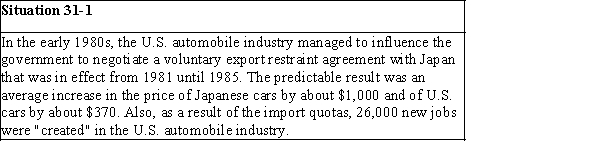 -Refer to Situation 31-l. At the time the total yearly salary (including all the benefits) of the average auto worker was no more than $50,000 per year, and the cost per job saved was estimated at $160,000 per worker per year. We can conclude that
 (Multiple Choice)
4.7/5 (65)
(65) Suppose candidate A is conservative and candidate B is liberal and both are currently positioned away from the "middle ground" toward their respective ends of the political spectrum. We would expect that as the campaign draws closer to election day,
(Multiple Choice)
4.8/5 (86)
(86) Public choice theorists assert that persons who change jobs from, say, a government position to a business position, sometimes alter their work behavior and attitudes because
(Multiple Choice)
4.7/5 (82)
(82) Three persons, A, B, and C, will use a simple majority vote to determine whether some good will be purchased. Each person's "tax share" of the purchase price of the good will be $25. Person A receives $30 worth of benefits from the good, person B receives $26 worth of benefits from the good, and person C receives $2 worth of benefits from the good. It follows that __________ person(s) will vote for the good, __________ person(s) will vote against it, and that the outcome is __________.
(Multiple Choice)
4.8/5 (82)
(82) It has often been remarked that Democratic candidates are more liberal in the Democratic primaries and Republican candidates are more conservative in the Republican primaries than either is in the general election. The explanation for this is most probably that
(Multiple Choice)
4.9/5 (77)
(77) Would we expect the "average" person to take more time to learn about the car he or she is considering purchasing or about the issues in the upcoming U.S. Senate race in his or her state?
(Multiple Choice)
4.8/5 (77)
(77) Special-interest groups often engage in rent-seeking, which tends to provide a net benefit to society.
(True/False)
4.8/5 (76)
(76) Which of the following predictions is consistent with public choice theory?
(Multiple Choice)
4.8/5 (68)
(68) Why do many prospective voters choose to watch sports on television rather than watching the news or political roundtables? In your answer, be sure to mention the role played by rational ignorance.
(Essay)
4.8/5 (82)
(82) Special interest groups are subsets of the general population that
(Multiple Choice)
4.9/5 (71)
(71) A subset of the general population that holds an intense preference with respect to a particular government activity is called a
(Multiple Choice)
4.7/5 (87)
(87) 
Filters
- Essay(0)
- Multiple Choice(0)
- Short Answer(0)
- True False(0)
- Matching(0)