



 Chat with AI
Exam 6: Cash and Receivables

Exam 1: The Demand for and Supply of Financial Accounting Information85 Questions
Exam 2: Financial Reporting: Its Conceptual Framework83 Questions
Exam 3: Review of a Company S Accounting System148 Questions
Exam 4: The Balance Sheet and the Statement of Shareholders Equity127 Questions
Exam 5: The Income Statement and the Statement of Cash Flows Time Value of Money Module136 Questions
Exam 6: Cash and Receivables172 Questions
Exam 7: Inventories: Cost Measurement and Flow Assumptions114 Questions
Exam 8: Inventories: Special Valuation Issues141 Questions
Exam 9: Current Liabilities and Contingent Obligations125 Questions
Exam 10: Property, Plant, and Equipment: Acquisition and Subsequent Investments111 Questions
Exam 11: Depreciation, Depletion, Impairment, and Disposal136 Questions
Exam 12: Intangibles136 Questions
Exam 13: Investments and Long-Term Receivables135 Questions
Exam 14: Financing Liabilities: Bonds and Long-Term Notes Payable192 Questions
Exam 15: Contributed Capital153 Questions
Exam 16: Retained Earnings and Earnings Per Share110 Questions
Exam 17: Advanced Issues in Revenue Recognition103 Questions
Exam 18: Accounting for Income Taxes113 Questions
Exam 19: Accounting for Post-Retirement Benefits94 Questions
Exam 20: Accounting for Leases116 Questions
Exam 21: The Statement of Cash Flows103 Questions
Exam 22: Accounting for Changes and Errors130 Questions
Exam 23: Understanding Time Value of Money Formulas and Concepts142 Questions
Select questions type


Which of the following would not be reported on the financial statements?
(Multiple Choice)
4.8/5  (84)
(84) Nontrade receivables, such as deposits with utility companies or advances to subsidiary companies, should be
(Multiple Choice)
4.9/5 (81)
(81) On April 7, Wilhelm, Inc. sold goods for $50,000 and accepted a 10%, 60-day note. On April 22, the company sold the note to a bank at a 13% discount rate.
Required:
Compute the amount of interest revenue and the loss on sale of the note.
(Essay)
4.7/5 (91)
(91) Which of the following is an example of a factoring agreement?
(Multiple Choice)
4.7/5 (80)
(80) Recording short-term noninterest-bearing notes receivable at their maturity value
(Multiple Choice)
4.9/5 (79)
(79) On August 2 Banger Mash Company sold merchandise to the Boise Potato Company in the amount of $6,500 with terms of 3/10 n/30,
f.o.b. shipping. An invoice in the amount of $180 was received by Boise Potato for the freight. On August 12 Banger Mash received the money due for the merchandise purchased.
Required:
1) Prepare the journal entries for the sale and subsequent collection from the customer for Banger Mash using the gross method.
2) Prepare the journal entries for the sale and subsequent collection from the customer for Banger Mash using the net method.
3) Prepare the journal entry to record payment using the net method and assuming Boise did not pay the invoice due until August 25.
(Essay)
4.9/5 (93)
(93) Under the allowance method of recording bad debts, which of the following entries, if any, would be made to write off actual uncollectible accounts of $5,500? 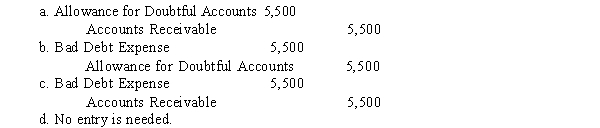
(Short Answer)
4.9/5 (78)
(78) To classify a receivable as a current asset it must be collected within one year or the normal operating cycle of the business, whichever is shorter.
(True/False)
4.7/5 (69)
(69) Below is a list of items. Classify each into one of the following balance sheet categories:
a. Cash
b. Receivables
c. Short-term Investments
d. Other
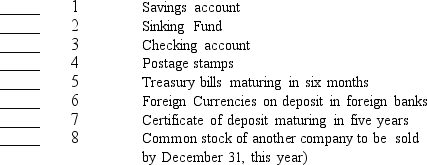 _____ 9 Compensating balances held in long-term
borrowing arrangements
_____ 10 Travel Advances
_____ 9 Compensating balances held in long-term
borrowing arrangements
_____ 10 Travel Advances (Essay)
4.7/5 (78)
(78) 
Filters
- Essay(0)
- Multiple Choice(0)
- Short Answer(0)
- True False(0)
- Matching(0)