



 Chat with AI
Exam 6: Cash and Receivables

Exam 1: The Demand for and Supply of Financial Accounting Information85 Questions
Exam 2: Financial Reporting: Its Conceptual Framework83 Questions
Exam 3: Review of a Company S Accounting System148 Questions
Exam 4: The Balance Sheet and the Statement of Shareholders Equity127 Questions
Exam 5: The Income Statement and the Statement of Cash Flows Time Value of Money Module136 Questions
Exam 6: Cash and Receivables172 Questions
Exam 7: Inventories: Cost Measurement and Flow Assumptions114 Questions
Exam 8: Inventories: Special Valuation Issues141 Questions
Exam 9: Current Liabilities and Contingent Obligations125 Questions
Exam 10: Property, Plant, and Equipment: Acquisition and Subsequent Investments111 Questions
Exam 11: Depreciation, Depletion, Impairment, and Disposal136 Questions
Exam 12: Intangibles136 Questions
Exam 13: Investments and Long-Term Receivables135 Questions
Exam 14: Financing Liabilities: Bonds and Long-Term Notes Payable192 Questions
Exam 15: Contributed Capital153 Questions
Exam 16: Retained Earnings and Earnings Per Share110 Questions
Exam 17: Advanced Issues in Revenue Recognition103 Questions
Exam 18: Accounting for Income Taxes113 Questions
Exam 19: Accounting for Post-Retirement Benefits94 Questions
Exam 20: Accounting for Leases116 Questions
Exam 21: The Statement of Cash Flows103 Questions
Exam 22: Accounting for Changes and Errors130 Questions
Exam 23: Understanding Time Value of Money Formulas and Concepts142 Questions
Select questions type


The gross price method highlights sales discounts taken and the net price method highlights sales discounts NOT taken.
(True/False)
4.9/5  (80)
(80) Which of the following statements concerning compensating balance agreements is not true?
(Multiple Choice)
4.8/5 (71)
(71) In certain circumstances a company may find it necessary to accelerate the cash inflows potentially generated from its accounts receivable. This can be accomplished through pledging, assigning, or factoring the accounts receivable.
Required:
Explain each of these three arrangements. Include in your discussion an explanation of each agreement, who retains the risks and benefits of ownership, whether or not the agreement is formally recorded in the company's accounting records, and how the agreement is disclosed in the company's financial statements.
(Essay)
4.8/5 (85)
(85) Which of the following is not a disadvantage of using the direct write-off method for recording uncollectible accounts?
(Multiple Choice)
4.9/5 (70)
(70) During 2016, Blueberry, Inc. recovered and collected $4,200 from an account that had been written off for over a year. At the end 2016, prior to the adjusting entry for bad debt expense, Blueberry, Inc.'s balances for Accounts Receivable and Allowances for Doubtful Accounts were $750,000 debit) and $5,500 credit), respectively. After the bad debt expense entry was posted, the net realizable value of accounts receivable was $675,000. Bad debt expense for the 2016 was
(Multiple Choice)
4.7/5 (82)
(82) Based on the following information: 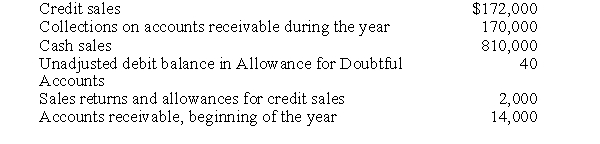 If expected bad debts are estimated to be 1 1/2% of ending accounts receivable, the adjusting entry to recognize bad debts will include a debit to Bad Debt Expense for
 (Multiple Choice)
4.7/5 (87)
(87) A compensating balance used to secure a short term loan should be recorded against its short term borrowing in current assets separate from cash.
(True/False)
4.9/5 (74)
(74) Which of the following methods is not an appropriate method for estimating bad debt expense for companies whose uncollectible accounts are material?
(Multiple Choice)
4.8/5 (75)
(75) Exhibit 6-1
O’Martin & Lowry, Inc. accepted a $150,000, 8%, 90-day note receivable for services rendered to a client. Thirty days later, O’Martin & Lowry discounted the note at a bank at 10%. Assume interest has not been recognized for the first month.
-Refer to Exhibit 6-1. The entry to record the proceeds from the sale of the note would include a
(Multiple Choice)
4.8/5 (97)
(97) The entry to replenish the petty cash fund for $250 of various minor expenses would include a
(Multiple Choice)
4.8/5 (97)
(97) Wholesale Stuff, Inc. sells to retailers on account. Sales for the year totaled $9,900,000. The company uses the aging method for determining bad debt expense. The aging report and related information includes: 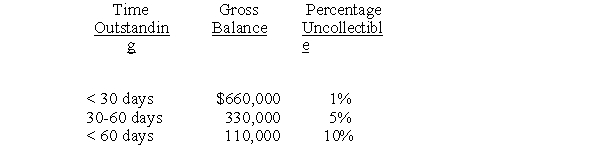 The unadjusted balance in the allowance account at year end is $1,700 credit. What is the estimated net realizable value of receivables at year end?
 (Multiple Choice)
4.8/5 (78)
(78) Describe the key elements for internal control of cash receipts and cash payments.
(Essay)
4.9/5 (90)
(90) Compensating balance agreements are held against short-term borrowings should
(Multiple Choice)
5.0/5 (74)
(74) A company may elect to use the fair value option for a single note receivable or for all notes receivable.
(True/False)
4.9/5 (75)
(75) What journal entry format is appropriate if sales returns and allowances occur on factored accounts? 
(Short Answer)
4.9/5 (78)
(78) 
Filters
- Essay(0)
- Multiple Choice(0)
- Short Answer(0)
- True False(0)
- Matching(0)