



 Chat with AI
Exam 6: Cash and Receivables

Exam 1: The Demand for and Supply of Financial Accounting Information85 Questions
Exam 2: Financial Reporting: Its Conceptual Framework83 Questions
Exam 3: Review of a Company S Accounting System148 Questions
Exam 4: The Balance Sheet and the Statement of Shareholders Equity127 Questions
Exam 5: The Income Statement and the Statement of Cash Flows Time Value of Money Module136 Questions
Exam 6: Cash and Receivables172 Questions
Exam 7: Inventories: Cost Measurement and Flow Assumptions114 Questions
Exam 8: Inventories: Special Valuation Issues141 Questions
Exam 9: Current Liabilities and Contingent Obligations125 Questions
Exam 10: Property, Plant, and Equipment: Acquisition and Subsequent Investments111 Questions
Exam 11: Depreciation, Depletion, Impairment, and Disposal136 Questions
Exam 12: Intangibles136 Questions
Exam 13: Investments and Long-Term Receivables135 Questions
Exam 14: Financing Liabilities: Bonds and Long-Term Notes Payable192 Questions
Exam 15: Contributed Capital153 Questions
Exam 16: Retained Earnings and Earnings Per Share110 Questions
Exam 17: Advanced Issues in Revenue Recognition103 Questions
Exam 18: Accounting for Income Taxes113 Questions
Exam 19: Accounting for Post-Retirement Benefits94 Questions
Exam 20: Accounting for Leases116 Questions
Exam 21: The Statement of Cash Flows103 Questions
Exam 22: Accounting for Changes and Errors130 Questions
Exam 23: Understanding Time Value of Money Formulas and Concepts142 Questions
Select questions type


When completing the bank reconciliation, deposits in transit would be
(Multiple Choice)
4.7/5  (75)
(75) An advantage of basing bad debt expense on the historical relationship between bad debts and net credit sales is that
(Multiple Choice)
4.8/5 (80)
(80) In accounting for sales transactions, which method isolates sales discounts not taken?
(Multiple Choice)
5.0/5 (80)
(80) Which item is not considered cash and cash equivalents on the balance sheet?
(Multiple Choice)
4.8/5 (78)
(78) Compensating balance agreements that do not legally restrict the amount of funds shown on the balance sheet should be reported in the
(Multiple Choice)
4.8/5 (85)
(85) Wholesale Stuff, Inc. sells to retailers on account. Sales for the year totaled $9,900,000. The company uses the aging method for determining bad debt expense. The aging report and related information includes: 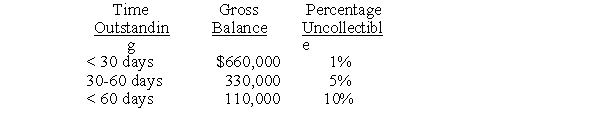 The unadjusted balance in the allowance account at year end is $1,700 credit. What is the amount of bad debt expense for the year?
 (Multiple Choice)
4.9/5 (74)
(74) Bailey's Manufacturing Company is looking at changing their method of reporting bad debts expense. In past years the company has been able to use the direct write off method but have experienced significant growth in recent years. The accountants have prepared the following aging schedule based upon their current accounts receivable volume
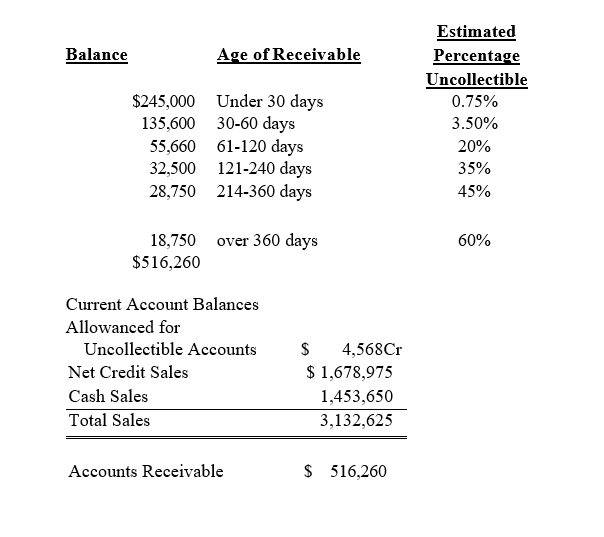 Required:
1) Using the above information compute the estimated amount of uncollectible receivables.
2) Prepare the journal entry to record the estimated uncollectibles.
3) Instead of the aging method compute the estimated bad debts to be:
a) 2.5% of net credit sales.
b) 3.5% of gross accounts receivable
Required:
1) Using the above information compute the estimated amount of uncollectible receivables.
2) Prepare the journal entry to record the estimated uncollectibles.
3) Instead of the aging method compute the estimated bad debts to be:
a) 2.5% of net credit sales.
b) 3.5% of gross accounts receivable (Essay)
4.8/5 (85)
(85) Movie Set Up Company's trial balance before adjustment included the following information: 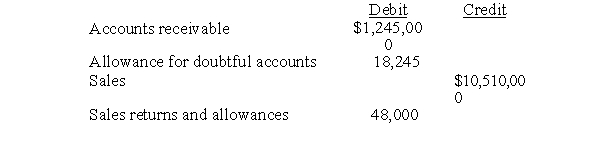 Prepare journal entries assuming that the estimate of uncollectibles is determined by taking:
1) 3.5% of gross accounts receivable
2) 0.5% of net sales.
Prepare journal entries assuming that the estimate of uncollectibles is determined by taking:
1) 3.5% of gross accounts receivable
2) 0.5% of net sales. (Essay)
4.8/5 (76)
(76) The Trey Co. sells $75,000 of accounts receivable to a factor and receives 90% of the value of the factored accounts less a 15% commission based on the gross amount of factored accounts receivable. After the journal entry to record this factoring transaction is made, Trey Co.'s total assets will be
(Multiple Choice)
4.8/5 (84)
(84) When a company extends credit to its customers, the company realizes it will not likely collect all of the related accounts receivable. As some accounts may prove to be uncollectible, a company must estimate its bad debt expense.
Required:
a. What is the purpose of estimating bad debt expense?
b. There are two relationships that can be used to estimate the bad debt expense for a company. Describe the two major relationships that can be used to estimate bad debts expense and the financial statement orientation of each.
(Essay)
4.8/5 (79)
(79) Which of the following statements about accounting for discounts is true?
(Multiple Choice)
4.8/5 (75)
(75) On June 11, Nathan, Inc. accepted a $8,000, 7%, 60-day note from a customer. On June 26, the company discounted the note at the bank at 10%. The proceeds amounted to
(Multiple Choice)
4.8/5 (87)
(87) Park Playground, Inc. has lost some of its accounting records regarding its July cash receipts and payments. It reconciled its June 30, 2015 bank statement on July 2 and made the related adjusting entries at that time. The company has not reconciled its July 31, 2015 bank statement. It provides you with the following information on August 3: 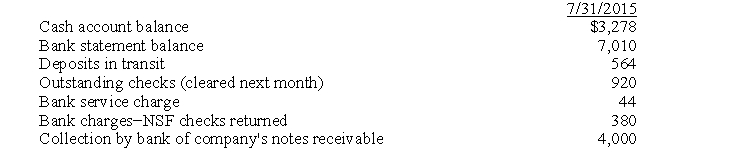 In addition, it was found that a July check for $320 included in the July 31 bank statement) to purchase office supplies was erroneously recorded in the checkbook for $120.
Required:
a. Prepare a bank reconciliation for the month ended July 31, 2015.
b. Prepare the correcting entry for the month ended July 31, 2015.
In addition, it was found that a July check for $320 included in the July 31 bank statement) to purchase office supplies was erroneously recorded in the checkbook for $120.
Required:
a. Prepare a bank reconciliation for the month ended July 31, 2015.
b. Prepare the correcting entry for the month ended July 31, 2015. (Essay)
4.9/5 (73)
(73) Check 21 is a law that allows merchants to scan digital copies of checks to the bank instead of remitting the actual check.
(True/False)
4.8/5 (77)
(77) Littlestown Corporation reports the following information: 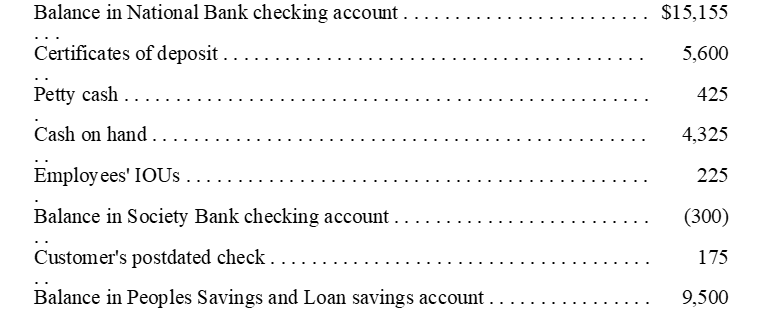 Required:
Compute the correct amount of cash that will appear as a current asset on Littlestown Corporation's balance sheet.
Required:
Compute the correct amount of cash that will appear as a current asset on Littlestown Corporation's balance sheet. (Short Answer)
4.8/5 (76)
(76) Cash control systems are the methods and procedures used to ensure
(Multiple Choice)
4.7/5 (77)
(77) Classify each into one of the balance sheet categories
Correct Answer: Verified
Premises:
Responses:
(Matching)
4.7/5 (76)
(76) Which method for estimating uncollectible accounts receivable is considered to be balance-sheet oriented?
(Multiple Choice)
4.7/5 (73)
(73) 
Filters
- Essay(0)
- Multiple Choice(0)
- Short Answer(0)
- True False(0)
- Matching(0)