



 Chat with AI
Exam 6: Cash and Receivables

Exam 1: The Demand for and Supply of Financial Accounting Information85 Questions
Exam 2: Financial Reporting: Its Conceptual Framework83 Questions
Exam 3: Review of a Company S Accounting System148 Questions
Exam 4: The Balance Sheet and the Statement of Shareholders Equity127 Questions
Exam 5: The Income Statement and the Statement of Cash Flows Time Value of Money Module136 Questions
Exam 6: Cash and Receivables172 Questions
Exam 7: Inventories: Cost Measurement and Flow Assumptions114 Questions
Exam 8: Inventories: Special Valuation Issues141 Questions
Exam 9: Current Liabilities and Contingent Obligations125 Questions
Exam 10: Property, Plant, and Equipment: Acquisition and Subsequent Investments111 Questions
Exam 11: Depreciation, Depletion, Impairment, and Disposal136 Questions
Exam 12: Intangibles136 Questions
Exam 13: Investments and Long-Term Receivables135 Questions
Exam 14: Financing Liabilities: Bonds and Long-Term Notes Payable192 Questions
Exam 15: Contributed Capital153 Questions
Exam 16: Retained Earnings and Earnings Per Share110 Questions
Exam 17: Advanced Issues in Revenue Recognition103 Questions
Exam 18: Accounting for Income Taxes113 Questions
Exam 19: Accounting for Post-Retirement Benefits94 Questions
Exam 20: Accounting for Leases116 Questions
Exam 21: The Statement of Cash Flows103 Questions
Exam 22: Accounting for Changes and Errors130 Questions
Exam 23: Understanding Time Value of Money Formulas and Concepts142 Questions
Select questions type


Splitter Corporation had total sales in the current year of $750,000 and credit sales of $650,000. The Accounts Receivable balance was $450,000 on the balance sheet date and the Allowance for Doubtful Accounts had a credit balance of $10,000 before adjusting entries. Bad debt expense is estimated as 2% of credit sales. The adjusting entry to record estimated bad debt expense would include a
(Multiple Choice)
4.9/5  (86)
(86) Under the allowance method, when an account is written off, total assets decrease
(True/False)
4.8/5 (65)
(65) Match each key term with its appropriate definition.
Correct Answer: Verified
Premises:
Responses:
(Matching)
4.8/5 (66)
(66) For a non-interest-bearing note, the maturity value of the note includes both principal and interest.
(True/False)
4.8/5 (63)
(63) What two types of financing agreements are available to companies who wish to obtain cash from their accounts receivables? Why is it important to note whether or not the receivables are transferred with or without recourse?
(Essay)
4.9/5 (92)
(92) For any given company, the amount of bad debt expense may be based on the historical relationships between actual bad debts incurred and 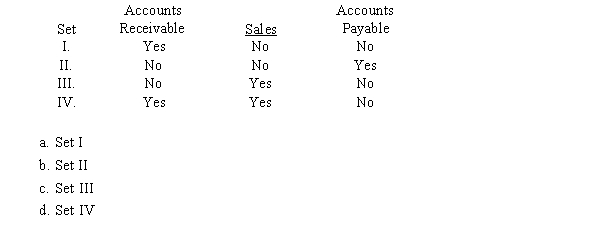
(Short Answer)
4.8/5 (89)
(89) In order to resolve its cash flow problems, Town Home Company assigned $420,000 of its accounts receivable to Wargo Finance Company on August 1. Town Home received 85% of the assigned accounts receivable less a service charge of 5% of the cash received. Town Home was also charged 14% interest annually on the outstanding loan balance. By August 31, Town Home had collected $276,000, and remitted this amount plus the interest to date on August 31 to Wargo Finance.
Required:
a. Prepare journal entries to record the above assignment transactions on Town Home's books.
b. If Town Home collected an additional $50,000 on outstanding accounts and remitted this to Wargo Finance on September 30, how much additional interest must be paid on September 30?
(Essay)
4.9/5 (66)
(66) On December 31, the Jacob, Inc. general ledger contained the following balances prior to write-offs and adjustments:  Before completing an aging analysis to determine the estimated amount uncollectible, Jacob decided to write off
$7,500 of an account past due over 360 days.
Aging of the accounts receivable balance after the write-off on December 31 indicated the following:
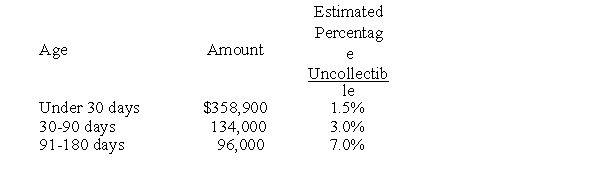
 Required:
a. Prepare the necessary journal entry to record the write-off.
b. Prepare the adjusting journal entry at December 31 to record Jacob, Inc.'s estimated bad debts assuming that the company uses the aging of accounts receivable method.
c. What is the net realizable value of accounts receivable on the December 31 balance sheet?
Before completing an aging analysis to determine the estimated amount uncollectible, Jacob decided to write off
$7,500 of an account past due over 360 days.
Aging of the accounts receivable balance after the write-off on December 31 indicated the following: Required:
a. Prepare the necessary journal entry to record the write-off.
b. Prepare the adjusting journal entry at December 31 to record Jacob, Inc.'s estimated bad debts assuming that the company uses the aging of accounts receivable method.
c. What is the net realizable value of accounts receivable on the December 31 balance sheet? (Essay)
4.8/5 (71)
(71) During 2016, a company wrote off $7,500 in uncollectible accounts receivable. At the end of the year, bad debt expense was estimated using a percent of gross sales. In 2017, the company collected $1,500 from an account that was written off in 2016. Recording this collection would include
(Multiple Choice)
4.9/5 (68)
(68) If the transferor of accounts receivable cannot meet all conditions for a sale, the transferor records the proceeds received as a debit to Cash and records a corresponding credit to an)
(Multiple Choice)
4.9/5 (74)
(74) In general, GAAP requires receivables to be recorded and reported at their present value, but excludes accounts receivables from this rule.
(True/False)
4.8/5 (77)
(77) February 1, Adams Company sold merchandise on credit with a list price of $8,400. Terms were 3/15, n/45. Which of the following entries correctly applies the indicated method to receive the appropriate customer payment on February 12? 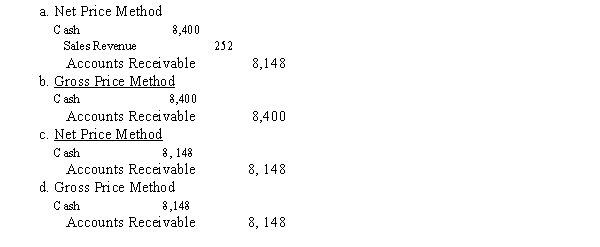
(Short Answer)
4.9/5 (88)
(88) Current accounts receivables are receivables that are expected to be collected within
(Multiple Choice)
4.8/5 (79)
(79) Bad debt expense is normally reported on the income statement as an)
(Multiple Choice)
4.9/5 (70)
(70) On May 17, Bruno Olive Co. accepted a $6,500, 8%, 90-day note from a customer. On June 11, the note was discounted at 10%. At maturity date, the note was dishonored and the bank charged a $25 protest fee. The amount that Bruno Olive Co. would debit to Notes Receivable Dishonored is
(Multiple Choice)
4.8/5 (66)
(66) A bank reconciliation is an analysis of the difference between the financial accounting records and the bank records to ensure the accurate ending cash balance.
(True/False)
4.8/5 (74)
(74) Increased use of automated technology for processing cash transfers decreases the need to rely on internal controls.
(True/False)
4.9/5 (83)
(83) After completing the bank reconciliation, which of the following reconciling items would require an adjusting journal entry on the company's books?
(Multiple Choice)
4.9/5 (88)
(88) Trade receivables are a sub classification of accounts receivable.
(True/False)
4.8/5 (62)
(62) When a company sells a customer's note to a bank, the discount period is the length of time
(Multiple Choice)
5.0/5 (96)
(96) 
Filters
- Essay(0)
- Multiple Choice(0)
- Short Answer(0)
- True False(0)
- Matching(0)