



 Chat with AI
Exam 30: Money Growth and Inflation

Exam 1: Ten Principles of Economics455 Questions
Exam 2: Thinking Like an Economist643 Questions
Exam 3: Interdependence and the Gains From Trade547 Questions
Exam 4: The Market Forces of Supply and Demand693 Questions
Exam 5: Elasticity and Its Application626 Questions
Exam 6: Supply, Demand, and Government Policies668 Questions
Exam 7: Consumers, Producers, and the Efficiency of Markets547 Questions
Exam 8: Applications: the Costs of Taxation509 Questions
Exam 9: Application: International Trade521 Questions
Exam 10: Externalities543 Questions
Exam 11: Public Goods and Common Resources452 Questions
Exam 12: The Design of the Tax System664 Questions
Exam 13: The Costs of Production649 Questions
Exam 14: Firms in Competitive Markets604 Questions
Exam 15: Monopoly662 Questions
Exam 16: Monopolistic Competition649 Questions
Exam 17: Oligopoly522 Questions
Exam 18: The Markets for the Factors of Production592 Questions
Exam 19: Earnings and Discrimination511 Questions
Exam 20: Income Inequality and Poverty478 Questions
Exam 21: The Theory of Consumer Choice570 Questions
Exam 22: Frontiers in Microeconomics461 Questions
Exam 23: Measuring a Nation S Income547 Questions
Exam 24: Measuring the Cost of Living565 Questions
Exam 25: Production and Growth527 Questions
Exam 26: Saving, Investment, and the Financial System637 Questions
Exam 27: Tools of Finance534 Questions
Exam 28: Unemployment and Its Natural Rate701 Questions
Exam 29: The Monetary System540 Questions
Exam 30: Money Growth and Inflation504 Questions
Exam 31: Open-Economy Macroeconomics: Basic Concepts540 Questions
Exam 32: A Macroeconomic Theory of the Open Economy511 Questions
Exam 33: Aggregate Demand and Aggregate Supply572 Questions
Exam 34: The Influence of Monetary and Fiscal Policy on Aggregate Demand523 Questions
Exam 35: The Short-Run Tradeoff Between Inflation and Unemployment536 Questions
Exam 36: Six Debates Over Macroeconomic Policy354 Questions
Select questions type


Suppose the United States unexpectedly decided to pay off its debt by printing new money. Which of the following would happen?
(Multiple Choice)
4.8/5  (74)
(74) If P denotes the price of goods and services measured in terms of money, then
(Multiple Choice)
4.8/5 (77)
(77) Suppose ice cream cones costs $3. Molly holds $60. What is the real value of the money she holds?
(Multiple Choice)
4.9/5 (80)
(80) U.S. tax laws allow taxpayers, in computing the amount of tax they owe, to use the real value, as opposed to the nominal value, of
(Multiple Choice)
4.9/5 (64)
(64) For a given real interest rate, an increase in the inflation rate reduces the after-tax real interest rate.
(True/False)
4.8/5 (81)
(81) A reduction in the inflation rate would make relative prices
(Multiple Choice)
4.8/5 (89)
(89) When the money market is drawn with the value of money on the vertical axis, as the price level decreases, the value of money
(Multiple Choice)
4.7/5 (73)
(73) In the long run an increase in the money supply causes the price level to __________. The price level moves in this direction because an increase in the money supply creates __________ in the money market that causes people to ________ spending.
(Short Answer)
4.9/5 (87)
(87) Given that firms change their prices infrequently, a business that has just raised its price will have a __________ relative price; over time as its price remains fixed its relative price __________.
(Short Answer)
4.9/5 (93)
(93) Even though monetary policy is neutral in the short run, it may have profound real effects in the long run.
(True/False)
4.8/5 (83)
(83) If Y and M are constant and V doubles, the quantity equation implies that the price level
(Multiple Choice)
4.7/5 (64)
(64) Suppose that monetary neutrality and the Fisher effect both hold. An increase in the money supply growth rate increases
(Multiple Choice)
4.8/5 (95)
(95) In the presence of inflation in the U.S., accountants incorrectly measure firms' earnings but the tax code correctly measures real incomes.
(True/False)
4.7/5 (70)
(70) When Haley states that inflation by itself always reduces the real return on her saving, she
(Multiple Choice)
5.0/5 (76)
(76) Based on the quantity equation, if M = 150, V = 4, and Y = 300, then P =
(Multiple Choice)
4.9/5 (81)
(81) According to the quantity theory of money, a 3 percent increase in the money supply
(Multiple Choice)
4.7/5 (76)
(76) Figure 30-2. On the graph, MS represents the money supply and MD represents money demand. The usual quantities are measured along the axes. 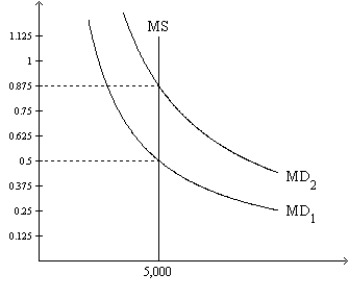 -Refer to Figure 30-2. If the relevant money-demand curve is the one labeled MD1, then
 (Multiple Choice)
4.8/5 (69)
(69) If the Fed conducts open market sales, the equilibrium value of money decreases and the equilibrium price level increases.
(True/False)
4.8/5 (84)
(84) 
Filters
- Essay(0)
- Multiple Choice(0)
- Short Answer(0)
- True False(0)
- Matching(0)