



 Chat with AI
Exam 30: Money Growth and Inflation

Exam 1: Ten Principles of Economics455 Questions
Exam 2: Thinking Like an Economist643 Questions
Exam 3: Interdependence and the Gains From Trade547 Questions
Exam 4: The Market Forces of Supply and Demand693 Questions
Exam 5: Elasticity and Its Application626 Questions
Exam 6: Supply, Demand, and Government Policies668 Questions
Exam 7: Consumers, Producers, and the Efficiency of Markets547 Questions
Exam 8: Applications: the Costs of Taxation509 Questions
Exam 9: Application: International Trade521 Questions
Exam 10: Externalities543 Questions
Exam 11: Public Goods and Common Resources452 Questions
Exam 12: The Design of the Tax System664 Questions
Exam 13: The Costs of Production649 Questions
Exam 14: Firms in Competitive Markets604 Questions
Exam 15: Monopoly662 Questions
Exam 16: Monopolistic Competition649 Questions
Exam 17: Oligopoly522 Questions
Exam 18: The Markets for the Factors of Production592 Questions
Exam 19: Earnings and Discrimination511 Questions
Exam 20: Income Inequality and Poverty478 Questions
Exam 21: The Theory of Consumer Choice570 Questions
Exam 22: Frontiers in Microeconomics461 Questions
Exam 23: Measuring a Nation S Income547 Questions
Exam 24: Measuring the Cost of Living565 Questions
Exam 25: Production and Growth527 Questions
Exam 26: Saving, Investment, and the Financial System637 Questions
Exam 27: Tools of Finance534 Questions
Exam 28: Unemployment and Its Natural Rate701 Questions
Exam 29: The Monetary System540 Questions
Exam 30: Money Growth and Inflation504 Questions
Exam 31: Open-Economy Macroeconomics: Basic Concepts540 Questions
Exam 32: A Macroeconomic Theory of the Open Economy511 Questions
Exam 33: Aggregate Demand and Aggregate Supply572 Questions
Exam 34: The Influence of Monetary and Fiscal Policy on Aggregate Demand523 Questions
Exam 35: The Short-Run Tradeoff Between Inflation and Unemployment536 Questions
Exam 36: Six Debates Over Macroeconomic Policy354 Questions
Select questions type


Based on the quantity equation, if Y = 3,000, P = 3, and V = 4, then M =
(Multiple Choice)
4.9/5  (92)
(92) The increase in the overall level of prices is known as _____.
(Short Answer)
4.9/5 (92)
(92) Which of the following did NOT happen during the late 19th century in the U.S.?
(Multiple Choice)
5.0/5 (70)
(70) The idea that firms incur actual costs when they change prices is known as _____. Firms in countries with lower inflation rates will change price _____ frequently compared to those countries where inflation is higher.
(Short Answer)
4.8/5 (91)
(91) If there is inflation, then a firm that has kept its price fixed for some time will have a
(Multiple Choice)
4.9/5 (78)
(78) What two key assumptions does the quantity theory make concerning variables in the equation of exchange?
(Short Answer)
4.9/5 (77)
(77) You bought some shares of stock and sell them one year later. At the end of the year, the price per share was 5 percent higher and the price level was 3 percent higher. Before taxes, you experienced
(Multiple Choice)
4.8/5 (70)
(70) If velocity is 6, real output is 10,000, and M is 20,000 what would the price level be? If M increases to 25,000 but V and Y do not change, what happens to the price level? Are the change in the money supply and the change in the price level proportional?
(Essay)
4.7/5 (82)
(82) The country of Robinya has a tax system identical to that of the United States. Suppose someone in Robinya bought a parcel of land for 10,000 deera (the local currency) in 1970 when the price index equaled 100. In 2010, the person sold the land for 100,000 deera, and the price index equaled 500. The tax rate on nominal capital gains was 20 percent. Compute the taxes the person paid on the nominal gain and the change in the real value of the land in terms of 2010 prices to find the after-tax real rate of capital gain.
(Multiple Choice)
4.8/5 (82)
(82) On a given morning, Franco sold 40 pairs of shoes for a total of $80 at his shoe store.
(Multiple Choice)
4.8/5 (73)
(73) Figure 30-2. On the graph, MS represents the money supply and MD represents money demand. The usual quantities are measured along the axes. 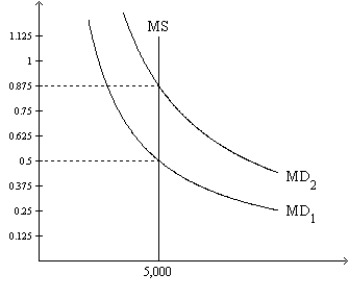 -Refer to Figure 30-2. What quantity is measured along the horizontal axis?
 (Multiple Choice)
4.8/5 (82)
(82) 
Filters
- Essay(0)
- Multiple Choice(0)
- Short Answer(0)
- True False(0)
- Matching(0)