



 Chat with AI
Exam 30: Money Growth and Inflation

Exam 1: Ten Principles of Economics455 Questions
Exam 2: Thinking Like an Economist643 Questions
Exam 3: Interdependence and the Gains From Trade547 Questions
Exam 4: The Market Forces of Supply and Demand693 Questions
Exam 5: Elasticity and Its Application626 Questions
Exam 6: Supply, Demand, and Government Policies668 Questions
Exam 7: Consumers, Producers, and the Efficiency of Markets547 Questions
Exam 8: Applications: the Costs of Taxation509 Questions
Exam 9: Application: International Trade521 Questions
Exam 10: Externalities543 Questions
Exam 11: Public Goods and Common Resources452 Questions
Exam 12: The Design of the Tax System664 Questions
Exam 13: The Costs of Production649 Questions
Exam 14: Firms in Competitive Markets604 Questions
Exam 15: Monopoly662 Questions
Exam 16: Monopolistic Competition649 Questions
Exam 17: Oligopoly522 Questions
Exam 18: The Markets for the Factors of Production592 Questions
Exam 19: Earnings and Discrimination511 Questions
Exam 20: Income Inequality and Poverty478 Questions
Exam 21: The Theory of Consumer Choice570 Questions
Exam 22: Frontiers in Microeconomics461 Questions
Exam 23: Measuring a Nation S Income547 Questions
Exam 24: Measuring the Cost of Living565 Questions
Exam 25: Production and Growth527 Questions
Exam 26: Saving, Investment, and the Financial System637 Questions
Exam 27: Tools of Finance534 Questions
Exam 28: Unemployment and Its Natural Rate701 Questions
Exam 29: The Monetary System540 Questions
Exam 30: Money Growth and Inflation504 Questions
Exam 31: Open-Economy Macroeconomics: Basic Concepts540 Questions
Exam 32: A Macroeconomic Theory of the Open Economy511 Questions
Exam 33: Aggregate Demand and Aggregate Supply572 Questions
Exam 34: The Influence of Monetary and Fiscal Policy on Aggregate Demand523 Questions
Exam 35: The Short-Run Tradeoff Between Inflation and Unemployment536 Questions
Exam 36: Six Debates Over Macroeconomic Policy354 Questions
Select questions type


According to the principle of monetary neutrality, a decrease in the money supply will not change
(Multiple Choice)
4.9/5  (80)
(80) Which of the following would decrease the value of money?
(Multiple Choice)
4.9/5 (81)
(81) If P = 2 and Y = 1000, then which of the following pairs of values are possible?
(Multiple Choice)
5.0/5 (78)
(78) Suppose that velocity rises while the money supply stays the same. It follows that
(Multiple Choice)
4.8/5 (82)
(82) When the money market is drawn with the value of money on the vertical axis,
(Multiple Choice)
4.8/5 (88)
(88) Suppose one year ago the price index was 120 and Maria purchased $20,000 worth of bonds. One year later the price index is 126. Maria redeems her bonds for $22,700 and is in a 40 percent tax bracket. What is Maria's real after-tax rate of interest to the nearest tenth of a percent?
(Multiple Choice)
4.8/5 (75)
(75) Figure 30-2. On the graph, MS represents the money supply and MD represents money demand. The usual quantities are measured along the axes. 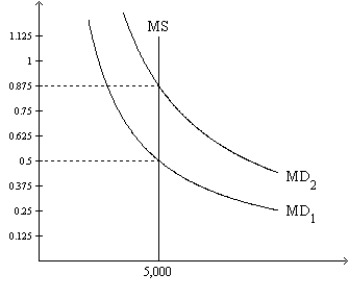 -Refer to Figure 30-2. Suppose the relevant money-demand curve is the one labeled MD1; also suppose the economy's real GDP is 20,000 for the year. If the money market is in equilibrium, then how many times per year is the typical dollar bill used to pay for a newly produced good or service?
 (Multiple Choice)
4.8/5 (78)
(78) Figure 30-3. On the graph, MS represents the money supply and MD represents money demand. The usual quantities are measured along the axes. 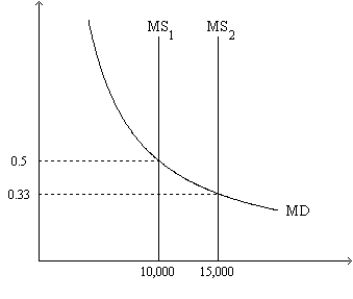 -Refer to Figure 30-3. Suppose the relevant money-supply curve is the one labeled MS1; also suppose the economy's real GDP is 30,000 for the year. If the money market is in equilibrium, then the velocity of money is approximately
 (Multiple Choice)
4.8/5 (90)
(90) Which movie is an allegory about late 19th century monetary policy?
(Multiple Choice)
4.9/5 (88)
(88) When shopping you notice that a pair of jeans costs $20 and that a tee-shirt costs $10. You compute the price of jeans relative to tee-shirts.
(Multiple Choice)
4.8/5 (87)
(87) In the U.S., taxes are paid on one's _____ gains/returns. Therefore, a _____ inflation rate encourages more saving.
(Short Answer)
4.9/5 (87)
(87) When the money market is drawn with the value of money on the vertical axis, the value of money decreases if
(Multiple Choice)
4.9/5 (75)
(75) An economy produces two goods, x and y. A year ago the price of x was $4 and the price of y was $6. Today the price of x is $8 and the price of y is $10. What happened to the nominal and the real value of good x? What happened to the nominal and real value of good y?
(Essay)
4.8/5 (77)
(77) Wealth is redistributed from debtors to creditors when inflation was expected to be
(Multiple Choice)
4.9/5 (71)
(71) Hyperinflations are associated with governments printing money to finance expenditures.
(True/False)
4.8/5 (85)
(85) When we assume that the supply of money is a variable that the central bank controls, we
(Multiple Choice)
4.8/5 (82)
(82) 
Filters
- Essay(0)
- Multiple Choice(0)
- Short Answer(0)
- True False(0)
- Matching(0)