



 Chat with AI
Exam 21: Electrochemistry: Chemical Change and Electrical Work

Exam 1: Keys to the Study of Chemistry68 Questions
Exam 2: The Components of Matter104 Questions
Exam 3: Stoichiometry of Formulas and Equations96 Questions
Exam 4: Three Major Classes of Chemical Reactions105 Questions
Exam 5: Gases and the Kinetic-Molecular Theory103 Questions
Exam 6: Thermochemistry: Energy Flow and Chemical Change79 Questions
Exam 7: Quantum Theory and Atomic Structure74 Questions
Exam 8: Electron Configuration and Chemical Periodicity81 Questions
Exam 9: Models of Chemical Bonding73 Questions
Exam 10: The Shapes of Molecules108 Questions
Exam 11: Theories of Covalent Bonding56 Questions
Exam 12: Intermolecular Forces: Liquids, Solids, and Phase Changes97 Questions
Exam 13: The Properties of Mixtures: Solutions and Colloids98 Questions
Exam 14: Periodic Patterns in the Main-Group Elements111 Questions
Exam 15: Organic Compounds and the Atomic Properties of Carbon113 Questions
Exam 16: Kinetics: Rates and Mechanisms of Chemical Reactions89 Questions
Exam 17: Equilibrium: the Extent of Chemical Reactions102 Questions
Exam 18: Acid-Base Equilibria106 Questions
Exam 19: Ionic Equilibria in Aqueous Systems115 Questions
Exam 20: Thermodynamics: Entropy, Free Energy, and the Direction of Chemical Reactions85 Questions
Exam 21: Electrochemistry: Chemical Change and Electrical Work102 Questions
Exam 22: The Elements in Nature and Industry56 Questions
Exam 23: The Transition Elements and Their Coordination Compounds92 Questions
Exam 24: Nuclear Reactions and Their Applications90 Questions
Select questions type


Calculate E cell and indicate whether the overall reaction shown is spontaneous or nonspontaneous.  Overall reaction: 2Cr(s) + 3I2(s) 2Cr3+(aq) + (aq) + 6I¯(aq)
 (Multiple Choice)
4.9/5  (70)
(70) A voltaic cell is prepared using copper and silver. Its cell notation is shown below.  Which of the following processes occurs at the cathode?
 (Multiple Choice)
4.8/5 (71)
(71) The value of the equilibrium constant for the reaction of nickel(II) ions with cadmium metal is 1.17 * 105. Calculate G or the reaction at 25 C.
(Multiple Choice)
4.8/5 (68)
(68) In the electrolysis of aqueous potassium nitrate using inert electrodes, which one of the following species is oxidized?
(Multiple Choice)
4.8/5 (72)
(72) A) Write a balanced equation to represent the overall reaction you would expect to occur in the electrolysis of molten KCl.
B) Write a balanced equation to represent the overall reaction you would expect to occur in the electrolysis of aqueous KCl.
C) Clearly explain why the products of the two processes are not the same.
(Essay)
4.8/5 (86)
(86) In the electrolysis of aqueous sodium sulfate at electrodes of platinum, predict the products of the cell reaction.
(Multiple Choice)
4.8/5 (92)
(92) Calculate G for the oxidation of 3 moles of copper by nitric acid. 
(Multiple Choice)
4.8/5 (87)
(87) In the absence of oxygen, iron will rust as long as moisture is present.
(True/False)
4.8/5 (80)
(80) When the following redox equation is balanced with smallest whole number coefficients, the coefficient for Sn(OH)3¯ will be _____. 
(Multiple Choice)
4.9/5 (76)
(76) A current of 250. A flows for 24.0 hours at an anode where the reaction occurring is Mn2+(aq) + 2H2O(l) MnO2(s) + 4H+(aq) + 2e¯
What mass of MnO2 is deposited at this anode?
(Multiple Choice)
4.7/5 (72)
(72) A voltaic cell prepared using aluminum and nickel has the following cell notation.  Which of the following reactions occurs at the anode?
 (Multiple Choice)
4.8/5 (97)
(97) Which one of the following statements about electrochemical cells is correct?
(Multiple Choice)
4.7/5 (66)
(66) A voltaic cell has a standard cell potential equal to 0.74 V. If the standard electrode (reduction) potential for the anode is -0.22 V, what is the standard electrode potential for the cathode?
(Multiple Choice)
4.9/5 (74)
(74) Examine the following half-reactions and select the strongest oxidizing agent among the species listed. 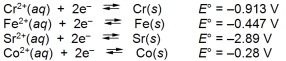
(Multiple Choice)
4.8/5 (76)
(76) A voltaic cell prepared using aluminum and nickel has the following cell notation.  Which of the following represents the correctly balanced spontaneous reaction equation for the cell?
 (Multiple Choice)
5.0/5 (95)
(95) When the following redox equation is balanced with smallest whole number coefficients, the coefficient for nitrogen dioxide will be _____. 
(Multiple Choice)
4.9/5 (70)
(70) Consider the following redox equation  When the equation is balanced with smallest whole number coefficients, what is the coefficient for OH¯(aq) and on which side of the equation is OH¯(aq) present?
 (Multiple Choice)
4.9/5 (78)
(78) Calculate E cell and indicate whether the overall reaction shown is spontaneous or nonspontaneous.  Overall reaction:

Overall reaction: (Multiple Choice)
4.9/5 (74)
(74) Which of the following solids is commonly used as an inactive electrode in electrochemical cells?
(Multiple Choice)
4.8/5 (68)
(68) 
Filters
- Essay(0)
- Multiple Choice(0)
- Short Answer(0)
- True False(0)
- Matching(0)