



 Chat with AI
Exam 4: The Market Forces of Supply and Demand

Exam 1: Ten Principles of Economics455 Questions
Exam 2: Thinking Like an Economist645 Questions
Exam 3: Interdependence and the Gains From Trade550 Questions
Exam 4: The Market Forces of Supply and Demand693 Questions
Exam 5: Elasticity and Its Application625 Questions
Exam 6: Supply, Demand, and Government Policies671 Questions
Exam 7: Consumers, Producers, and the Efficiency of Markets547 Questions
Exam 8: Application: The Costs of Taxation507 Questions
Exam 9: Application: International Trade521 Questions
Exam 10: Externalities543 Questions
Exam 11: Public Goods and Common Resources453 Questions
Exam 12: The Design of the Tax System563 Questions
Exam 13: The Costs of Production649 Questions
Exam 14: Firms in Competitive Markets608 Questions
Exam 15: Monopoly662 Questions
Exam 16: Monopolistic Competition649 Questions
Exam 17: Oligopoly522 Questions
Exam 18: The Markets for the Factors of Production592 Questions
Exam 19: Earnings and Discrimination511 Questions
Exam 20: Income Inequality and Poverty478 Questions
Exam 21: The Theory of Consumer Choice568 Questions
Exam 22: Frontiers in Microeconomics461 Questions
Select questions type


Suppose the demand for calendars increases in November. At the same time, the price of the ink used in the production of calendars increases. In the market for calendars, the equilibrium price rises, but the effect on the equilibrium quantity is ambiguous.
(True/False)
4.8/5  (85)
(85) Assume Leo buys coffee beans in a competitive market. It follows that
(Multiple Choice)
4.8/5 (80)
(80) Price cannot fall so low that some sellers choose to supply a quantity of zero.
(True/False)
4.8/5 (71)
(71) A decrease in the price of baseball bats will decrease the demand for baseballs.
(True/False)
4.9/5 (85)
(85) In a perfectly competitive market, buyers and sellers are price setters.
(True/False)
4.9/5 (69)
(69) A market supply curve shows how the total quantity supplied of a good varies as
(Multiple Choice)
4.8/5 (78)
(78) Figure 4-10 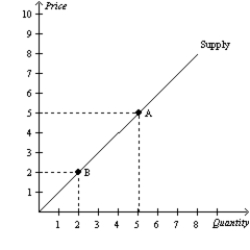 -Refer to Figure 4-10. The movement from Point A to Point B represents a(n)
 (Multiple Choice)
4.9/5 (81)
(81) Scenario 4-1
Suppose the demand schedule in a market can be represented by the equation 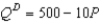 , where
 is the quantity demanded and
 is the price. Also, suppose the supply schedule can be represented by the equation
 , where
 is the quantity supplied.
-Refer to Scenario 4-1. What is the equilibrium quantity in this market?
, where is the quantity demanded and is the price. Also, suppose the supply schedule can be represented by the equation , where is the quantity supplied.
-Refer to Scenario 4-1. What is the equilibrium quantity in this market? (Short Answer)
4.8/5 (81)
(81) An increase in the price of blueberries would lead to a(n)
(Multiple Choice)
4.9/5 (88)
(88) A demand schedule is a table that shows the relationship between
(Multiple Choice)
4.9/5 (77)
(77) An example of a perfectly competitive market would be the market for
(Multiple Choice)
4.9/5 (73)
(73) If income rises in the market for a normal good, will the demand curve for the normal good shift to the right or to the left?
(Short Answer)
4.8/5 (69)
(69) If a higher price means a greater quantity supplied, then the supply curve slopes upward.
(True/False)
4.8/5 (67)
(67) A likely example of complementary goods for most people would be
(Multiple Choice)
4.9/5 (82)
(82) Which of the following would increase in response to a decrease in the price of ironing boards?
(Multiple Choice)
4.9/5 (91)
(91) Today, people changed their expectations about the future. This change
(Multiple Choice)
4.9/5 (70)
(70) If mayonnaise and Miracle Whip are substitutes, then which of the following would increase the demand for Miracle Whip?
(Multiple Choice)
4.7/5 (78)
(78) Which of the following events must cause equilibrium quantity to fall?
(Multiple Choice)
4.7/5 (81)
(81) 
Filters
- Essay(0)
- Multiple Choice(0)
- Short Answer(0)
- True False(0)
- Matching(0)