



 Chat with AI
Exam 4: The Market Forces of Supply and Demand

Exam 1: Ten Principles of Economics455 Questions
Exam 2: Thinking Like an Economist645 Questions
Exam 3: Interdependence and the Gains From Trade550 Questions
Exam 4: The Market Forces of Supply and Demand693 Questions
Exam 5: Elasticity and Its Application625 Questions
Exam 6: Supply, Demand, and Government Policies671 Questions
Exam 7: Consumers, Producers, and the Efficiency of Markets547 Questions
Exam 8: Application: The Costs of Taxation507 Questions
Exam 9: Application: International Trade521 Questions
Exam 10: Externalities543 Questions
Exam 11: Public Goods and Common Resources453 Questions
Exam 12: The Design of the Tax System563 Questions
Exam 13: The Costs of Production649 Questions
Exam 14: Firms in Competitive Markets608 Questions
Exam 15: Monopoly662 Questions
Exam 16: Monopolistic Competition649 Questions
Exam 17: Oligopoly522 Questions
Exam 18: The Markets for the Factors of Production592 Questions
Exam 19: Earnings and Discrimination511 Questions
Exam 20: Income Inequality and Poverty478 Questions
Exam 21: The Theory of Consumer Choice568 Questions
Exam 22: Frontiers in Microeconomics461 Questions
Select questions type


For a market for a good or service to exist, there must be a
(Multiple Choice)
4.8/5  (92)
(92) Demand refers to the amount buyers wish to buy, whereas the quantity demanded refers to the position of the demand curve.
(True/False)
4.9/5 (83)
(83) It is not possible for demand and supply to shift at the same time.
(True/False)
4.8/5 (71)
(71) If toast and butter are complements, then which of the following would increase the demand for toast?
(Multiple Choice)
4.9/5 (75)
(75) Suppose there are six bait and tackle shops that sell worms in a lakeside resort town in Minnesota. If we add the respective quantities that each shop would produce and sell at each of the six bait and tackle shops when the price of worms is $2 per bucket, $2.50 per bucket, and $3 per bucket, and so forth, we have found the
(Multiple Choice)
4.8/5 (73)
(73) Figure 4-18 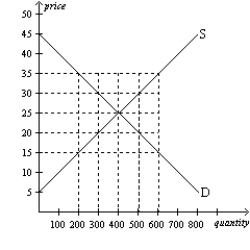 -Refer to Figure 4-18. At the equilibrium price,
 (Multiple Choice)
4.8/5 (78)
(78) Figure 4-31
Consider the market for 2-packs of light bulbs below.
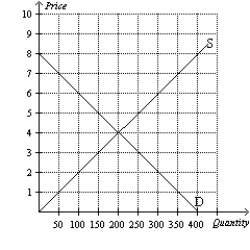 -Refer to Figure 4-31. At a price of $3, is there a shortage or surplus, and how large is the shortage/surplus?
 (Short Answer)
4.8/5 (68)
(68) Figure 4-8 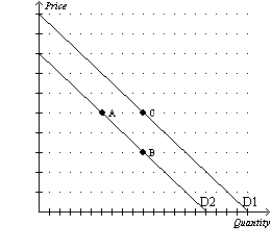 -Refer to Figure 4-8. Suppose the figure shows the market demand for coffee. Suppose the price of tea, a substitute good, increases. Which of the following changes would occur?
 (Multiple Choice)
4.8/5 (68)
(68) If something happens to alter the quantity demanded at any given price, then
(Multiple Choice)
4.9/5 (78)
(78) When quantity demanded decreases at every possible price, the demand curve has
(Multiple Choice)
4.9/5 (94)
(94) When quantity demanded has increased at every price, it might be because
(Multiple Choice)
4.9/5 (77)
(77) If something happens to alter the quantity demanded at any given price, then the demand curve shifts.
(True/False)
5.0/5 (83)
(83) A decrease in input costs to firms in a market will result in a(n)
(Multiple Choice)
4.8/5 (75)
(75) Table 4-16
The following table shows the supply and demand schedules in a market. 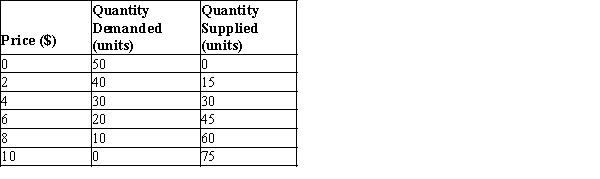 -Refer to Table 4-16. What is the equilibrium price in this market?
 (Short Answer)
4.9/5 (83)
(83) Which of the following events could shift the demand curve for gasoline to the left?
(Multiple Choice)
4.8/5 (83)
(83) Supply and demand together determine the price and quantity of a good sold in a market.
(True/False)
4.9/5 (70)
(70) 
Filters
- Essay(0)
- Multiple Choice(0)
- Short Answer(0)
- True False(0)
- Matching(0)