



 Chat with AI
Exam 35: Endocrine Control

Exam 1: Invitation to Biology75 Questions
Exam 2: Lifes Chemical Basis66 Questions
Exam 3: Molecules of Life85 Questions
Exam 4: Cell Structure and Function72 Questions
Exam 5: A Closer Look at Cell Membranes50 Questions
Exam 6: Ground Rules of Metabolism54 Questions
Exam 7: Where It Startsphotosynthesis69 Questions
Exam 8: Energy-Releasing Pathways86 Questions
Exam 9: How Cells Reproduce53 Questions
Exam 10: Meiosis and Sexual Reproduction50 Questions
Exam 11: Observing Patterns in Inherited Traits123 Questions
Exam 12: Chromosomes and Human Inheritance66 Questions
Exam 13: Dna Structure and Function42 Questions
Exam 14: From Dna to Protein63 Questions
Exam 15: Controls Over Genes47 Questions
Exam 16: Recombinant Dna and Genetic Engineering59 Questions
Exam 17: The Macroevolutionary Puzzle47 Questions
Exam 18: Emergence of Evolutionary Thought108 Questions
Exam 19: Organizing Information About Species30 Questions
Exam 20: The Origin and Evolution of Life52 Questions
Exam 21: Viruses and Prokaryotes66 Questions
Exam 22: Protists the Simplest Eukaryotes74 Questions
Exam 23: Plants67 Questions
Exam 24: Fungi52 Questions
Exam 25: Animals: the Invertebrates143 Questions
Exam 26: Animal Evolution the Chordates105 Questions
Exam 27: Human Evolution: a Case Study44 Questions
Exam 28: Plant Tissues90 Questions
Exam 29: Plant Nutrition and Transport71 Questions
Exam 30: Plant Reproduction67 Questions
Exam 31: Plant Growth and Development77 Questions
Exam 32: Animal Tissues and Organ Systems58 Questions
Exam 33: Neural Control123 Questions
Exam 34: Sensory Perception95 Questions
Exam 35: Endocrine Control100 Questions
Exam 36: Protection, Support, and Movement65 Questions
Exam 37: Circulation96 Questions
Exam 38: Immunity99 Questions
Exam 39: Respiration71 Questions
Exam 40: Digestion and Human Nutrition49 Questions
Exam 41: Maintaining the Internal Environment40 Questions
Exam 42: Animal Reproductive Systems37 Questions
Exam 43: Animal Development27 Questions
Exam 44: Animal Behavior35 Questions
Exam 45: Population Ecology62 Questions
Exam 46: Community Structure and Biodiversity52 Questions
Exam 47: Ecosystems33 Questions
Exam 48: The Biosphere51 Questions
Exam 49: Human Impacts on the Biosphere36 Questions
Select questions type


Use the figure above to answer questions
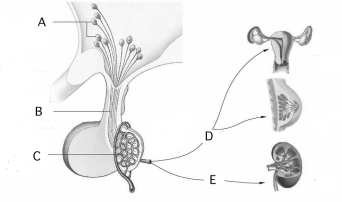 -The hormone __________ is indicated at "D."
 (Multiple Choice)
4.7/5  (81)
(81) When blood levels of cortisol rise above the set point, secretion(s) of __________ is (are) slowed.
(Multiple Choice)
4.8/5 (87)
(87) Molecular evidence points to __________ as an explanation for the great diversity of hormones and hormone receptors in vertebrates.
(Multiple Choice)
4.8/5 (76)
(76) A friend tells you that her husband has been feeling anxious for the past month.He has also felt fatigued most of the time, and his face is puffy.Doctors have already checked for ulcers, cancer, blood pressure changes, and other blood irregularities, but have found everything to be normal.You are an endocrinologist, so you suggest that he be tested for the most likely endocrine malfunction, which would be __________ levels.
(Multiple Choice)
4.8/5 (76)
(76) Steroid hormones and thyroid hormones do not require a membrane receptor because they
(Multiple Choice)
4.8/5 (76)
(76) The reason that some individual hormones have so many different effects is that
(Multiple Choice)
4.8/5 (90)
(90) The hormone whose levels remain high when the body is suffering from inflammation and stress is
(Multiple Choice)
5.0/5 (87)
(87) In cases of the "winter blues" treatment with a bright artificial light can reduce the effects by
(Multiple Choice)
4.9/5 (80)
(80) Use the figure above to answer questions
-The synthesis site for the hormones of this figure is indicated by
-The synthesis site for the hormones of this figure is indicated by (Multiple Choice)
4.9/5 (78)
(78) The only endocrine gland whose secretory function is under direct control by sympathetic neurons is the
(Multiple Choice)
4.9/5 (78)
(78) 
Filters
- Essay(0)
- Multiple Choice(0)
- Short Answer(0)
- True False(0)
- Matching(0)