



 Chat with AI
Exam 35: Endocrine Control

Exam 1: Invitation to Biology75 Questions
Exam 2: Lifes Chemical Basis66 Questions
Exam 3: Molecules of Life85 Questions
Exam 4: Cell Structure and Function72 Questions
Exam 5: A Closer Look at Cell Membranes50 Questions
Exam 6: Ground Rules of Metabolism54 Questions
Exam 7: Where It Startsphotosynthesis69 Questions
Exam 8: Energy-Releasing Pathways86 Questions
Exam 9: How Cells Reproduce53 Questions
Exam 10: Meiosis and Sexual Reproduction50 Questions
Exam 11: Observing Patterns in Inherited Traits123 Questions
Exam 12: Chromosomes and Human Inheritance66 Questions
Exam 13: Dna Structure and Function42 Questions
Exam 14: From Dna to Protein63 Questions
Exam 15: Controls Over Genes47 Questions
Exam 16: Recombinant Dna and Genetic Engineering59 Questions
Exam 17: The Macroevolutionary Puzzle47 Questions
Exam 18: Emergence of Evolutionary Thought108 Questions
Exam 19: Organizing Information About Species30 Questions
Exam 20: The Origin and Evolution of Life52 Questions
Exam 21: Viruses and Prokaryotes66 Questions
Exam 22: Protists the Simplest Eukaryotes74 Questions
Exam 23: Plants67 Questions
Exam 24: Fungi52 Questions
Exam 25: Animals: the Invertebrates143 Questions
Exam 26: Animal Evolution the Chordates105 Questions
Exam 27: Human Evolution: a Case Study44 Questions
Exam 28: Plant Tissues90 Questions
Exam 29: Plant Nutrition and Transport71 Questions
Exam 30: Plant Reproduction67 Questions
Exam 31: Plant Growth and Development77 Questions
Exam 32: Animal Tissues and Organ Systems58 Questions
Exam 33: Neural Control123 Questions
Exam 34: Sensory Perception95 Questions
Exam 35: Endocrine Control100 Questions
Exam 36: Protection, Support, and Movement65 Questions
Exam 37: Circulation96 Questions
Exam 38: Immunity99 Questions
Exam 39: Respiration71 Questions
Exam 40: Digestion and Human Nutrition49 Questions
Exam 41: Maintaining the Internal Environment40 Questions
Exam 42: Animal Reproductive Systems37 Questions
Exam 43: Animal Development27 Questions
Exam 44: Animal Behavior35 Questions
Exam 45: Population Ecology62 Questions
Exam 46: Community Structure and Biodiversity52 Questions
Exam 47: Ecosystems33 Questions
Exam 48: The Biosphere51 Questions
Exam 49: Human Impacts on the Biosphere36 Questions
Select questions type


Which of the following does NOT affect blood glucose levels?
(Multiple Choice)
4.8/5  (89)
(89) Bayliss and Starling first demonstrated the existence of hormones when they were studying which of the following?
(Multiple Choice)
4.7/5 (73)
(73) Which of the following is an example of an organ that is nervous in origin, structure, and function but releases substances into the bloodstream?
(Multiple Choice)
4.8/5 (76)
(76) Use the figure above to answer questions
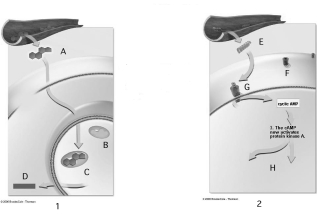 -The cause of androgen insensitivity syndrome is indicated by a defective
 (Multiple Choice)
5.0/5 (79)
(79) Which of the following substances is NOT secreted by secretory neurons?
(Multiple Choice)
4.8/5 (75)
(75) Use the figure above to answer questions
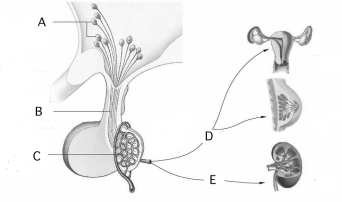 -The hormone __________ is indicated at "E."
 (Multiple Choice)
4.9/5 (74)
(74) The most general of the pituitary hormones, in that it may affect almost any cell in the body, is
(Multiple Choice)
4.7/5 (91)
(91) Use the figure above to answer questions
-Signals that stimulate the release of hormone molecules are carried along
-Signals that stimulate the release of hormone molecules are carried along (Multiple Choice)
4.9/5 (84)
(84) Which hormone(s) directly prepare(s) and maintain(s) the uterine lining for pregnancy?
(Multiple Choice)
4.9/5 (88)
(88) 
Filters
- Essay(0)
- Multiple Choice(0)
- Short Answer(0)
- True False(0)
- Matching(0)