



 Chat with AI
Exam 12: Infrared Spectroscopy

Exam 1: Covalent Bonding and Shapes of Molecules95 Questions
Exam 2: Alkanes and Cycloalkanes77 Questions
Exam 3: Stereoisomerism and Chirality75 Questions
Exam 4: Acids and Bases75 Questions
Exam 5: Alkenes: Bonding, Nomenclature, and Properties70 Questions
Exam 6: Reactions of Alkenes79 Questions
Exam 7: Alkynes80 Questions
Exam 8: Haloalkanes, Halogenation, and Radical Reactions58 Questions
Exam 9: Nucleophilic Substitution and Beta-Elimination89 Questions
Exam 10: Alcohols78 Questions
Exam 11: Ethers, Epoxides, and Sulfides71 Questions
Exam 12: Infrared Spectroscopy44 Questions
Exam 13: Nuclear Magnetic Resonance Spectroscopy73 Questions
Exam 14: Mass Spectrometry39 Questions
Exam 15: An Introduction to Organometallic Compounds45 Questions
Exam 16: Aldehydes and Ketones94 Questions
Exam 17: Carboxylic Acids51 Questions
Exam 18: Functional Derivatives of Carboxylic Acids88 Questions
Exam 19: Enolate Anions and Enamines70 Questions
Exam 20: Dienes, Conjugated Systems, and Pericyclic Reactions44 Questions
Exam 21: Benzene and the Concept of Aromaticity59 Questions
Exam 22: Reactions of Benzene and Its Derivatives83 Questions
Select questions type


Which of the following bonds gives rise to an absorbance at approximately 2700-3300 cm-1 in the infrared spectrum?
(Multiple Choice)
4.7/5  (94)
(94) Which of the following functional groups is likely to be present in a molecule that has peaks in the infrared spectrum at 3200-3650 cm-1 (strong), but does not have peaks at 1630-1820 or 1000-1250 cm-1
(Multiple Choice)
4.8/5 (80)
(80) Which of the following relationships is not valid as applied to infrared spectroscopy?
(Multiple Choice)
4.7/5 (80)
(80) Which of the following compounds does not give an infrared spectrum with peak at ~1750 cm-1? 
(Multiple Choice)
4.9/5 (91)
(91) Which of the following compounds gives an infrared spectrum with peaks at 1000-1250 cm-1 (strong), but does not have peaks at 3200-3650 or 1630-1820 cm-1 (sharp, weak peak)? 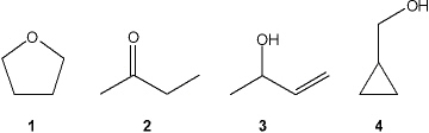
(Multiple Choice)
4.8/5 (72)
(72) Which of the following bonds undergoes stretching at the highest frequency?
(Multiple Choice)
4.8/5 (74)
(74) Which of the following bonds (circled) gives the weakest absorbance in the infrared spectrum? 
(Multiple Choice)
4.8/5 (66)
(66) Which of the following compounds gives an infrared spectrum with peaks in the ranges of 3200-3650 (strong, broad), but does not have peaks at 1630-1820 (strong) or 1600-1640 cm-1 (medium)? 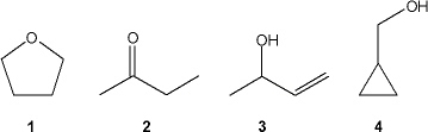
(Multiple Choice)
4.9/5 (82)
(82) Which of the following compounds gives a carbonyl bond absorption at the highest frequency? 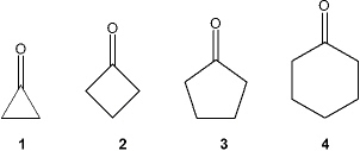
(Multiple Choice)
4.9/5 (82)
(82) Provide the structure of four compounds with the molecular formula C5H10O which give a strong absorption peak at 1700-1740 cm-1 in the infrared spectrum, but no significant peaks at 1600-1640 cm-1 .
(Essay)
4.9/5 (96)
(96) Which of the following bonds undergoes stretching at the highest frequency?
(Multiple Choice)
4.8/5 (86)
(86) Which of the following bonds (circled) vibrates at the highest frequency? 
(Multiple Choice)
4.8/5 (72)
(72) Which of the following compounds gives an infrared spectrum with a peak at ~1750 cm-1, but no significant peaks at 3000-3500 cm-1 or 1050-1250 cm-1? 
(Multiple Choice)
4.7/5 (81)
(81) How could you distinguish between methyl butanoate and pentanoic acid by infrared spectroscopy? 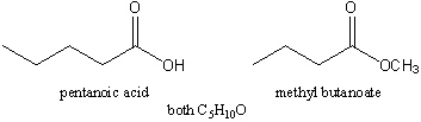
(Essay)
4.9/5 (75)
(75) Which of the following compounds gives a carbonyl bond absorption at the highest frequency? 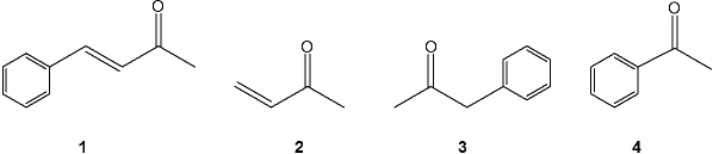
(Multiple Choice)
4.9/5 (81)
(81) Which of the following regions in the electromagnetic spectrum corresponds to the radiation with the highest energy?
(Multiple Choice)
4.9/5 (70)
(70) Which of the following bonds gives rise to a strong absorbance at approximately 1630-1820 cm-1 in the infrared spectrum?
(Multiple Choice)
4.8/5 (83)
(83) Which of the following functional groups is likely to be present in a molecule that has peaks in the infrared spectrum at 1630-1820 cm-1 (strong, broad), but does not have peaks at 3200-3650 or 1000-1250 cm-1
(Multiple Choice)
4.9/5 (72)
(72) Which of the following bonds (circled) gives a very weak or no stretching absorption in the infrared spectrum? 
(Multiple Choice)
4.8/5 (69)
(69) Which of the following compounds gives an infrared spectrum with a peak in the range of 1630-1820 cm-1 (strong peak), but does not have peaks at 3200-3650 or 1000-1250 cm-1? 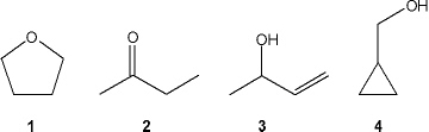
(Multiple Choice)
4.9/5 (77)
(77) 
Filters
- Essay(0)
- Multiple Choice(0)
- Short Answer(0)
- True False(0)
- Matching(0)