



 Chat with AI
Exam 6: Reactions of Alkenes

Exam 1: Covalent Bonding and Shapes of Molecules95 Questions
Exam 2: Alkanes and Cycloalkanes77 Questions
Exam 3: Stereoisomerism and Chirality75 Questions
Exam 4: Acids and Bases75 Questions
Exam 5: Alkenes: Bonding, Nomenclature, and Properties70 Questions
Exam 6: Reactions of Alkenes79 Questions
Exam 7: Alkynes80 Questions
Exam 8: Haloalkanes, Halogenation, and Radical Reactions58 Questions
Exam 9: Nucleophilic Substitution and Beta-Elimination89 Questions
Exam 10: Alcohols78 Questions
Exam 11: Ethers, Epoxides, and Sulfides71 Questions
Exam 12: Infrared Spectroscopy44 Questions
Exam 13: Nuclear Magnetic Resonance Spectroscopy73 Questions
Exam 14: Mass Spectrometry39 Questions
Exam 15: An Introduction to Organometallic Compounds45 Questions
Exam 16: Aldehydes and Ketones94 Questions
Exam 17: Carboxylic Acids51 Questions
Exam 18: Functional Derivatives of Carboxylic Acids88 Questions
Exam 19: Enolate Anions and Enamines70 Questions
Exam 20: Dienes, Conjugated Systems, and Pericyclic Reactions44 Questions
Exam 21: Benzene and the Concept of Aromaticity59 Questions
Exam 22: Reactions of Benzene and Its Derivatives83 Questions
Select questions type


What is the correct order of stability of the following carbocations (more stable > less stable)? 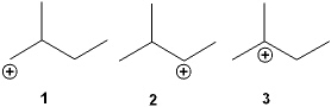

Free
(Multiple Choice)
4.9/5  (91)
(91) Correct Answer: Verified
D
What is the major organic product obtained from the following reaction?
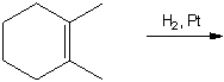
Free
(Essay)
4.9/5 (70)
(70) Correct Answer:Verified
Verified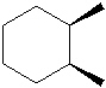
What is the major organic product obtained from the following reaction?
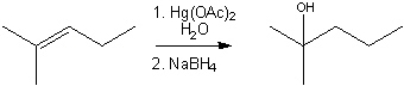
Free
(Essay)
4.9/5 (72)
(72) Correct Answer:Verified
Verified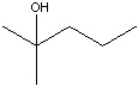
What is the major organic product obtained from the following reaction? 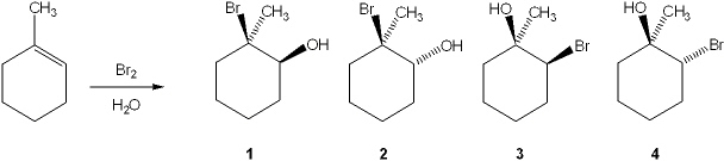
(Multiple Choice)
4.9/5 (81)
(81) What is the major organic product obtained from the following reaction?
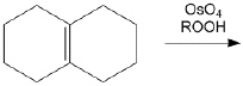
(Essay)
4.8/5 (85)
(85) What is the major organic product obtained from the following reaction?
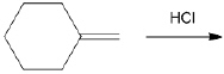
(Essay)
5.0/5 (74)
(74) Which of the following concepts explains why tertiary carbocations are more stable than primary and secondary carbocations?
(Multiple Choice)
4.8/5 (74)
(74) Which of the following alkenes undergoes the most exothermic hydrogenation upon treatment with H2/Pd? 
(Multiple Choice)
4.9/5 (74)
(74) What is the major organic product obtained from the following reaction? 
(Multiple Choice)
4.9/5 (85)
(85) What is (are) the major organic product(s) obtained from the following reaction? 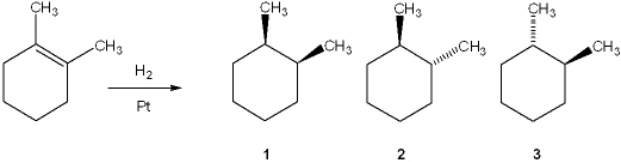
(Multiple Choice)
4.8/5 (72)
(72) What is (are) the major organic product(s) obtained from the following reaction? 
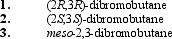
(Multiple Choice)
4.9/5 (78)
(78) Provide a neatly drawn mechanism for the following reaction, including curved arrows to show the movement of paris of electrons and the structure of reactive intermediates. 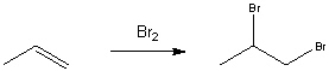 The reaction proceeds in two steps:
1. Addition of bromine to propene to afford a cyclic bromonium ion
2. Nucleophilic ring-opening addition of bromide anion
The reaction proceeds in two steps:
1. Addition of bromine to propene to afford a cyclic bromonium ion
2. Nucleophilic ring-opening addition of bromide anion (Essay)
4.8/5 (71)
(71) Which of the following alkenes is most likely to undergo rearrangement upon acid-catalyzed hydration (treatment with aqueous H2SO4)? 
(Multiple Choice)
4.9/5 (80)
(80) Which of the following alkenes is most likely to undergo rearrangement upon acid-catalyzed hydration (treatment with aqueous H2SO4)? 
(Multiple Choice)
4.8/5 (85)
(85) What is the major organic product obtained from the following reaction?
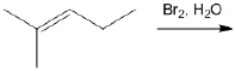
(Essay)
4.9/5 (64)
(64) What is (are) the major organic product(s) obtained from the following reaction? 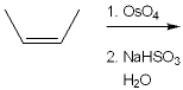
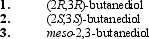
(Multiple Choice)
4.8/5 (77)
(77) What is the best choice of reagent(s) to perform the following transformation?
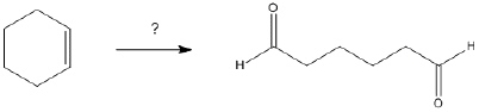
(Short Answer)
4.9/5 (86)
(86) What is the major organic product obtained from the following reaction? 
(Multiple Choice)
4.7/5 (80)
(80) Provide a neatly drawn mechanism for the following reaction, including curved arrows to show the movement of paris of electrons and the structure of reactive intermediates. 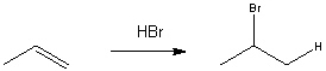 The reaction proceeds in two steps:
1. Protonation of propene to form the 2-propyl cation
2. Nucleophilic addition of bromide anion to the 2-propyl cation
The reaction proceeds in two steps:
1. Protonation of propene to form the 2-propyl cation
2. Nucleophilic addition of bromide anion to the 2-propyl cation (Essay)
4.8/5 (81)
(81) What is the best choice of reagent(s) to perform the following transformation?
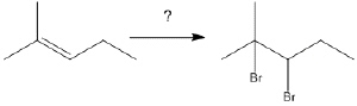
(Short Answer)
5.0/5 (80)
(80) 
Filters
- Essay(0)
- Multiple Choice(0)
- Short Answer(0)
- True False(0)
- Matching(0)