



 Chat with AI
Exam 12: Infrared Spectroscopy

Exam 1: Covalent Bonding and Shapes of Molecules95 Questions
Exam 2: Alkanes and Cycloalkanes77 Questions
Exam 3: Stereoisomerism and Chirality75 Questions
Exam 4: Acids and Bases75 Questions
Exam 5: Alkenes: Bonding, Nomenclature, and Properties70 Questions
Exam 6: Reactions of Alkenes79 Questions
Exam 7: Alkynes80 Questions
Exam 8: Haloalkanes, Halogenation, and Radical Reactions58 Questions
Exam 9: Nucleophilic Substitution and Beta-Elimination89 Questions
Exam 10: Alcohols78 Questions
Exam 11: Ethers, Epoxides, and Sulfides71 Questions
Exam 12: Infrared Spectroscopy44 Questions
Exam 13: Nuclear Magnetic Resonance Spectroscopy73 Questions
Exam 14: Mass Spectrometry39 Questions
Exam 15: An Introduction to Organometallic Compounds45 Questions
Exam 16: Aldehydes and Ketones94 Questions
Exam 17: Carboxylic Acids51 Questions
Exam 18: Functional Derivatives of Carboxylic Acids88 Questions
Exam 19: Enolate Anions and Enamines70 Questions
Exam 20: Dienes, Conjugated Systems, and Pericyclic Reactions44 Questions
Exam 21: Benzene and the Concept of Aromaticity59 Questions
Exam 22: Reactions of Benzene and Its Derivatives83 Questions
Select questions type


Which of the following functional groups is likely to be present in a molecule that has peaks in the infrared spectrum at 1630-1820 cm-1 (strong, broad) and 1000-1250 cm-1; but does not have peaks at 3200-3650 cm-1?

Free
(Multiple Choice)
5.0/5  (81)
(81) Correct Answer: Verified
D
Provide a brief explanation to account for the observation that the frequency of the C=O stretching absorption in the infrared spectrum of N,N-dimethylacetamide, CH3CON(CH3)2, is higher than that of methyl acetate, CH3CO2CH3.
Free
(Essay)
4.9/5 (71)
(71) Correct Answer:Verified
VerifiedThe C=O bond of the amide is weaker than that of the ester. Nitrogen is less electronegative than oxygen, and therefore a better electron pair donor. Accordingly, the resonance contributor in which the nitrogen has donated a pair of electrons to the carbonyl carbon atom is an important contributor to the structure. 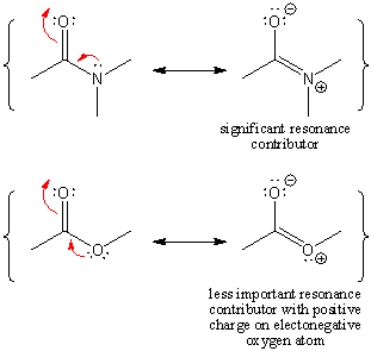
Which of the following compounds gives an infrared spectrum with no significant peaks at ~3300 cm-1 or 1600-1680 cm-1? 
Free
(Multiple Choice)
4.8/5 (82)
(82) Correct Answer:Verified
VerifiedB
Which of the following compounds gives a carbonyl bond absorption at the lowest frequency? 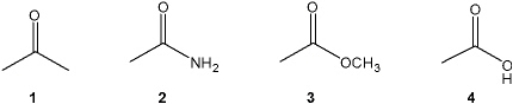
(Multiple Choice)
4.9/5 (87)
(87) Which of the following compounds gives an infrared spectrum with peaks at 3000-3500 cm-1 and ~1750 cm-1? 
(Multiple Choice)
4.7/5 (88)
(88) Which of the following regions in the electromagnetic spectrum corresponds to the radiation with the longest wavelength?
(Multiple Choice)
4.7/5 (74)
(74) Which of the following processes takes place upon absorption of infrared radiation?
(Multiple Choice)
4.8/5 (83)
(83) What range of wavelengths corresponds to the infrared region of the electromagnetic spectrum?
(Multiple Choice)
4.8/5 (84)
(84) Which of the following compounds gives an infrared spectrum with peaks in the ranges of 3200-3650 (strong, broad) and 1600-1640 cm-1 (medium); but does not have peaks at 1630-1820 (strong)? 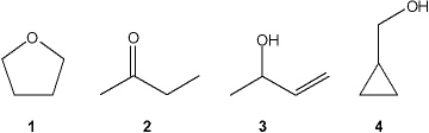
(Multiple Choice)
4.8/5 (77)
(77) Which of the following functional groups is likely to be present in a molecule that has peaks in the infrared spectrum at 1000-1250 cm-1 (strong), but does not have peaks 3200-3650 at 1630-1820 or cm-1?
(Multiple Choice)
4.8/5 (65)
(65) Label three peaks in the following spectrum with the bond that gives rise to them, and identify the functional group that is present in the compound (the compound has a formula of C5H10O2)?
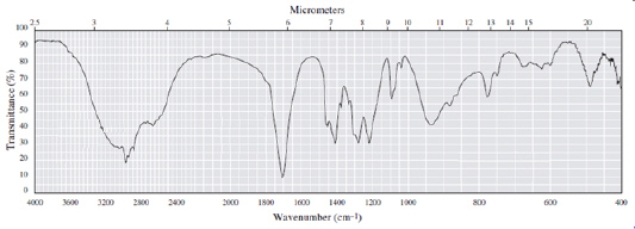
(Essay)
4.8/5 (72)
(72) Which of the following bonds gives rise to a strong, broad, absorbance at approximately 3200-3650 cm-1 in the infrared spectrum?
(Multiple Choice)
4.7/5 (84)
(84) Label three peaks in the following spectrum with the bond that gives rise to them, and identify the functional group that is present in the compound (the compound has a formula of C6H14O)? 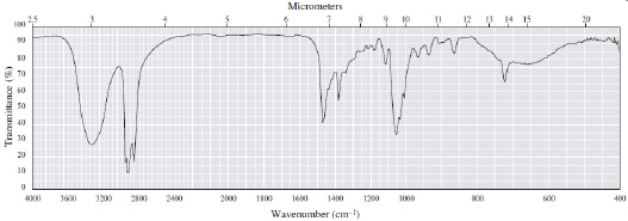
(Essay)
4.9/5 (67)
(67) What are the units of wavenumber,  , in infrared spectroscopy?
 (Multiple Choice)
4.7/5 (73)
(73) Which of the following bonds gives the weakest peak in the infrared spectrum for a stretching vibration? 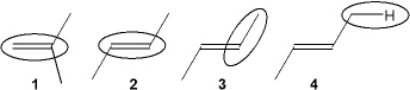
(Multiple Choice)
4.7/5 (77)
(77) Label three peaks in the following spectrum with the bond that gives rise to them, and identify the functional group that is present in the compound (the compound has a formula of C4H9NO)?
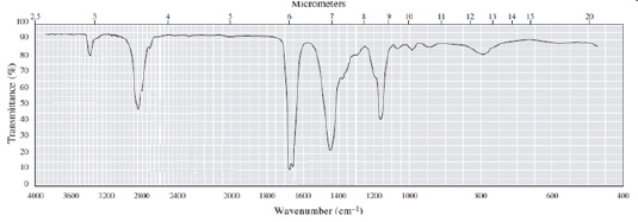
(Essay)
4.7/5 (85)
(85) Which of the following carbon-carbon bonds undergoes stretching at the highest frequency?
(Multiple Choice)
4.9/5 (69)
(69) Provide a brief explanation to account for the observation that the frequency of the C=O stretching absorption in the infrared spectrum of 2-butanone is higher than that of 3-buten-2-one.
(Essay)
4.8/5 (84)
(84) Which of the following compounds gives an infrared spectrum with peaks at 3300 cm-1 (sharp peak) and 2150 cm-1 (sharp peak)? 
(Multiple Choice)
4.9/5 (79)
(79) Provide the structure of three compounds with the molecular formula C4H8O that give an absorption peak at 1600-1640 cm-1 in the infrared spectrum, but no significant peaks at 3000-3600 cm-1 or at 1650-1750 cm-1.
(Essay)
4.8/5 (76)
(76) 
Filters
- Essay(0)
- Multiple Choice(0)
- Short Answer(0)
- True False(0)
- Matching(0)