



 Chat with AI
Exam 3: Stereoisomerism and Chirality

Exam 1: Covalent Bonding and Shapes of Molecules95 Questions
Exam 2: Alkanes and Cycloalkanes77 Questions
Exam 3: Stereoisomerism and Chirality75 Questions
Exam 4: Acids and Bases75 Questions
Exam 5: Alkenes: Bonding, Nomenclature, and Properties70 Questions
Exam 6: Reactions of Alkenes79 Questions
Exam 7: Alkynes80 Questions
Exam 8: Haloalkanes, Halogenation, and Radical Reactions58 Questions
Exam 9: Nucleophilic Substitution and Beta-Elimination89 Questions
Exam 10: Alcohols78 Questions
Exam 11: Ethers, Epoxides, and Sulfides71 Questions
Exam 12: Infrared Spectroscopy44 Questions
Exam 13: Nuclear Magnetic Resonance Spectroscopy73 Questions
Exam 14: Mass Spectrometry39 Questions
Exam 15: An Introduction to Organometallic Compounds45 Questions
Exam 16: Aldehydes and Ketones94 Questions
Exam 17: Carboxylic Acids51 Questions
Exam 18: Functional Derivatives of Carboxylic Acids88 Questions
Exam 19: Enolate Anions and Enamines70 Questions
Exam 20: Dienes, Conjugated Systems, and Pericyclic Reactions44 Questions
Exam 21: Benzene and the Concept of Aromaticity59 Questions
Exam 22: Reactions of Benzene and Its Derivatives83 Questions
Select questions type


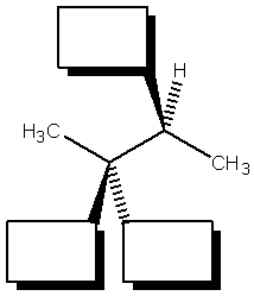
Complete the following zig-zag structure so that it represents (2S,3R)-2,3-dibromobutane.

Free
(Essay)
4.8/5  (83)
(83) Correct Answer: Verified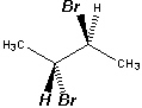
Which of the following is the definition of a pair of diastereomers?
Free
(Multiple Choice)
4.9/5 (74)
(74) Correct Answer:Verified
VerifiedC
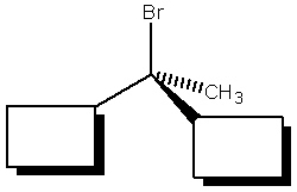
Complete the following diagram so that it represents (R)-2-bromobutane.
Free
(Essay)
5.0/5 (78)
(78) Correct Answer:Verified
Verified 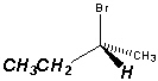
The specific rotation of the S-enantiomer of a compound is -120 . A student determines that a sample of the compound has a specific rotation of +60 . What mass of the S-enantiomer is present in 10 g of the sample
(Short Answer)
4.9/5 (80)
(80) How many stereoisomers of 2,4-dimethylpentane, (CH3)2CHCH2CH(CH3)2, exist?
(Multiple Choice)
5.0/5 (92)
(92) A solution containing 0.2 g/mL of a pure R enantiomer in a 1 dm polarimeter rotates plane polarized light by +3 . What is the specific rotation of the R isomer?
(Multiple Choice)
4.8/5 (85)
(85) What is the configuration of the two chiral centers in the following molecule? 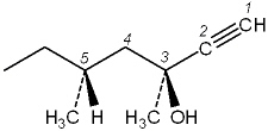
(Multiple Choice)
5.0/5 (80)
(80) Complete the following diagram so that it represents (R)-2-bromobutane.
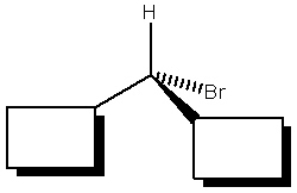
(Essay)
4.9/5 (80)
(80) Complete the following Newman projection so that it represents (2R,3S)-2,3-butanediol.
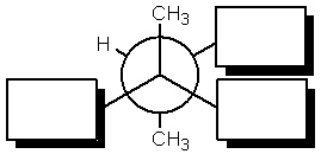
(Essay)
5.0/5 (92)
(92) Which of the following statements is not true regarding pairs of enantiomers?
(Multiple Choice)
4.8/5 (73)
(73) Which of the following substituents has the highest priority according to the Cahn-Ingold-Prelog system used in assigning R and S configurations?
(Multiple Choice)
4.9/5 (71)
(71) 
How much of the R enantiomer is present in 10 g of a mixture which has an enantiomeric excess of 20% of the S isomer?
(Multiple Choice)
4.8/5 (82)
(82) Complete the following Newman projection so that it represents (2S,3S)-2,3-butanediol.
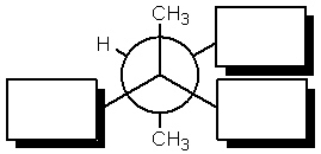
(Essay)
5.0/5 (80)
(80) How many stereoisomers of 3-chloro-2-methylbutane, (CH3)2CHCHClCH3, exist?
(Multiple Choice)
4.8/5 (78)
(78) What is the correct order of the Cahn-Ingold-Prelog ranking of the following substituents as used in assigning R and S configurations of chiral centers? (higher ranking > lower ranking) 
(Multiple Choice)
4.8/5 (75)
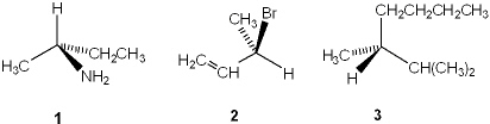
(75) Which of the following structures represent the same stereoisomer? 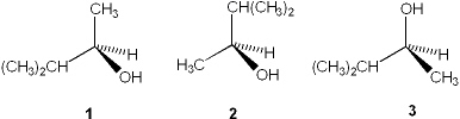
(Multiple Choice)
4.8/5 (93)
(93) Complete the following Fischer diagram so that it represents (2R,3R)-butane-2,3-diol.
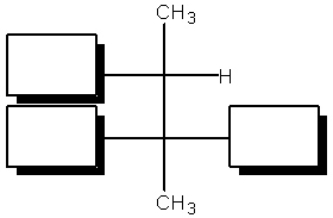
(Essay)
4.8/5 (83)
(83) A pure sample of the R enantiomer of a compound has a specific rotation, [a], of -15 . A solution containing 0.6 g/mL of a mixture of enantiomers rotates plane polarized light by -3 in a 1 dm polarimeter. What is the enantiomeric excess (%ee) of the mixture?
(Multiple Choice)
4.8/5 (72)
(72) 
Filters
- Essay(0)
- Multiple Choice(0)
- Short Answer(0)
- True False(0)
- Matching(0)