



 Chat with AI
Exam 22: Reactions of Benzene and Its Derivatives

Exam 1: Covalent Bonding and Shapes of Molecules95 Questions
Exam 2: Alkanes and Cycloalkanes77 Questions
Exam 3: Stereoisomerism and Chirality75 Questions
Exam 4: Acids and Bases75 Questions
Exam 5: Alkenes: Bonding, Nomenclature, and Properties70 Questions
Exam 6: Reactions of Alkenes79 Questions
Exam 7: Alkynes80 Questions
Exam 8: Haloalkanes, Halogenation, and Radical Reactions58 Questions
Exam 9: Nucleophilic Substitution and Beta-Elimination89 Questions
Exam 10: Alcohols78 Questions
Exam 11: Ethers, Epoxides, and Sulfides71 Questions
Exam 12: Infrared Spectroscopy44 Questions
Exam 13: Nuclear Magnetic Resonance Spectroscopy73 Questions
Exam 14: Mass Spectrometry39 Questions
Exam 15: An Introduction to Organometallic Compounds45 Questions
Exam 16: Aldehydes and Ketones94 Questions
Exam 17: Carboxylic Acids51 Questions
Exam 18: Functional Derivatives of Carboxylic Acids88 Questions
Exam 19: Enolate Anions and Enamines70 Questions
Exam 20: Dienes, Conjugated Systems, and Pericyclic Reactions44 Questions
Exam 21: Benzene and the Concept of Aromaticity59 Questions
Exam 22: Reactions of Benzene and Its Derivatives83 Questions
Select questions type


Which mechanism accounts for the reaction of 4-bromotoluene with sodium amide to form a mixture of 3- and 4-aminotoluene?

Free
(Multiple Choice)
4.9/5  (82)
(82) Correct Answer: Verified
B
What is the major organic product obtained from the following reaction? 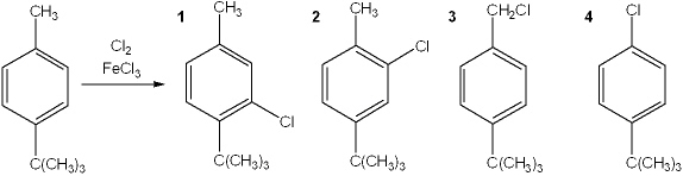
Free
(Multiple Choice)
4.7/5 (86)
(86) Correct Answer:Verified
VerifiedB
What is the electrophile in the reaction of benzene with acetyl chloride, CH3COCl, and AlCl3?
Free
(Multiple Choice)
4.8/5 (95)
(95) Correct Answer:Verified
VerifiedA
Which of the following undergoes the most rapid sulfonation upon treatment with fuming sulfuric acid?
(Multiple Choice)
4.7/5 (80)
(80) What is the major organic product obtained from the following reaction? 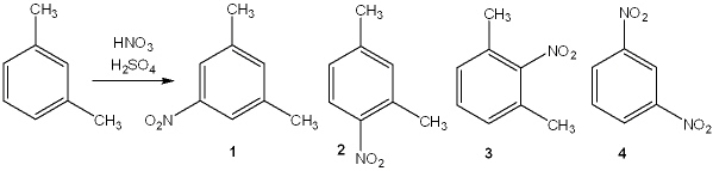
(Multiple Choice)
4.9/5 (80)
(80) Which of the following chlorobenzenes does not undergo nucleophilic aromatic substitution upon treatment with NaNH2? 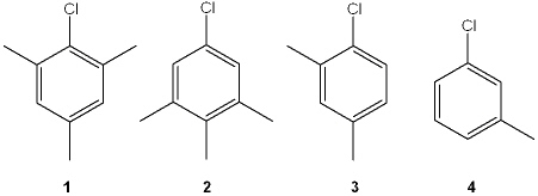
(Multiple Choice)
4.9/5 (65)
(65) What is the major organic product obtained from the following reaction? 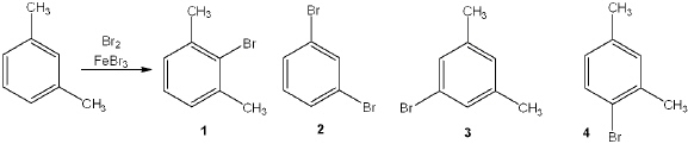
(Multiple Choice)
4.8/5 (81)
(81) What is the major organic product obtained from the following sequence of reactions? 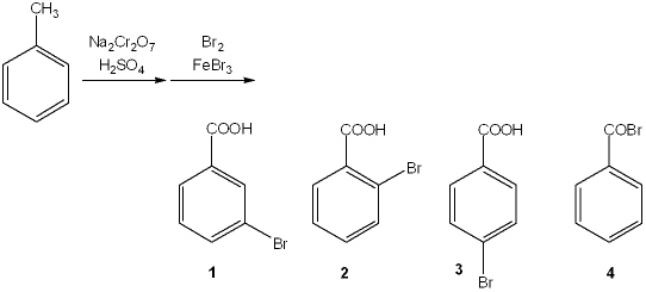
(Multiple Choice)
4.8/5 (88)
(88) What is the role of FeBr3 in electrophilic aromatic bromination of benzene using Br2?
(Multiple Choice)
4.7/5 (77)
(77) Which of the following is the reactive intermediate in the nucleophilic substitution of 4-bromo-1-toluene with sodium amide? 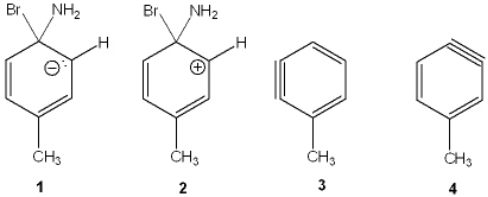
(Multiple Choice)
4.8/5 (85)
(85) Which of the following sets of substituents are all deactivating groups in electrophilic aromatic substitution reactions?
(Multiple Choice)
4.8/5 (93)
(93) What is the major organic product obtained from the following reaction? 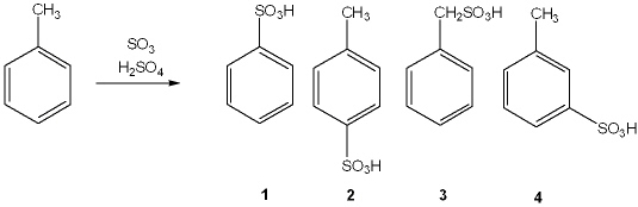
(Multiple Choice)
4.8/5 (83)
(83) What is the major organic product obtained from the following reaction? 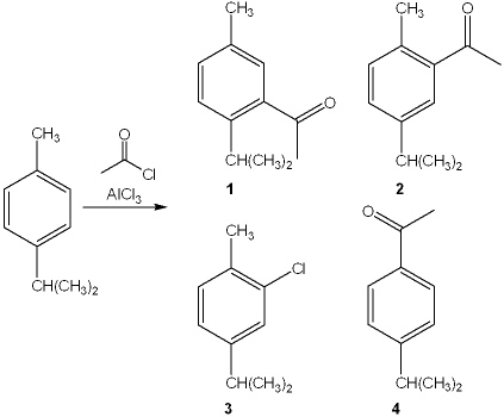
(Multiple Choice)
4.8/5 (74)
(74) What type of intermediate is formed in the reaction between bromobenzene and sodium amide to give aniline?
(Multiple Choice)
4.8/5 (71)
(71) Which of the following is the reactive intermediate formed in the electrophilic Friedel-Crafts acylation of toluene with CH3COCl and AlCl3? 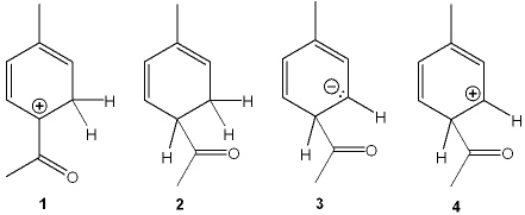
(Multiple Choice)
4.8/5 (83)
(83) Provide the structure (a single resonance contributor) of the key intermediate in the following reaction. 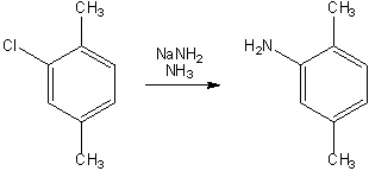
(Essay)
4.7/5 (77)
(77) Which of the following compounds undergoes the most rapid nucleophilic substitution with hydroxide ion? 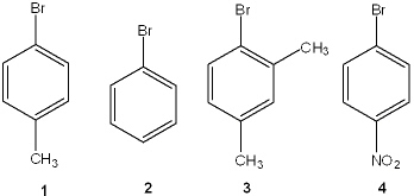
(Multiple Choice)
5.0/5 (82)
(82) Which of the following substituents is ortho/para directing and deactivating in electrophilic aromatic substitution reactions?
(Multiple Choice)
4.9/5 (88)
(88) Which of the following reactions or sequences will provide 1-propylbenzene as the major product?
(Multiple Choice)
4.7/5 (77)
(77) What type of intermediate is formed in the reaction between chlorobenzene and tert-butyl chloride and AlCl3 to give 4-chloro-1-tert-butylbenzene?
(Multiple Choice)
4.8/5 (83)
(83) 
Filters
- Essay(0)
- Multiple Choice(0)
- Short Answer(0)
- True False(0)
- Matching(0)