



 Chat with AI
Exam 22: Reactions of Benzene and Its Derivatives

Exam 1: Covalent Bonding and Shapes of Molecules95 Questions
Exam 2: Alkanes and Cycloalkanes77 Questions
Exam 3: Stereoisomerism and Chirality75 Questions
Exam 4: Acids and Bases75 Questions
Exam 5: Alkenes: Bonding, Nomenclature, and Properties70 Questions
Exam 6: Reactions of Alkenes79 Questions
Exam 7: Alkynes80 Questions
Exam 8: Haloalkanes, Halogenation, and Radical Reactions58 Questions
Exam 9: Nucleophilic Substitution and Beta-Elimination89 Questions
Exam 10: Alcohols78 Questions
Exam 11: Ethers, Epoxides, and Sulfides71 Questions
Exam 12: Infrared Spectroscopy44 Questions
Exam 13: Nuclear Magnetic Resonance Spectroscopy73 Questions
Exam 14: Mass Spectrometry39 Questions
Exam 15: An Introduction to Organometallic Compounds45 Questions
Exam 16: Aldehydes and Ketones94 Questions
Exam 17: Carboxylic Acids51 Questions
Exam 18: Functional Derivatives of Carboxylic Acids88 Questions
Exam 19: Enolate Anions and Enamines70 Questions
Exam 20: Dienes, Conjugated Systems, and Pericyclic Reactions44 Questions
Exam 21: Benzene and the Concept of Aromaticity59 Questions
Exam 22: Reactions of Benzene and Its Derivatives83 Questions
Select questions type


Why does anisole undergo bromination with Br2 in the absence of FeBr3 whereas bromination of benzene requires the presence of FeBr3?
(Multiple Choice)
4.8/5  (70)
(70) Which mechanism accounts for the reaction of chlorobenzene with acetyl chloride and AlCl3 to form 4-chloroacetophenone?
(Multiple Choice)
4.8/5 (97)
(97) Which of the following undergoes the most rapid acylation upon treatment with acetyl chloride and AlCl3?
(Multiple Choice)
4.7/5 (82)
(82) What is the major organic product obtained from the following reaction (assume that mixtures of ortho and para disubstituted compounds can be separated; continue the synthesis with either one)? 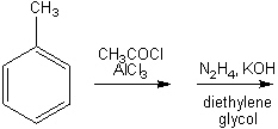
(Essay)
4.8/5 (90)
(90) What is the major organic product obtained from the following reaction? 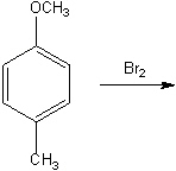
(Essay)
4.8/5 (79)
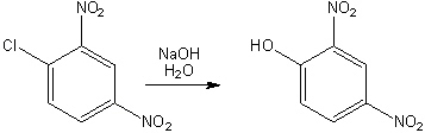
(79) Provide the structure (a single resonance contributor) of the key intermediate in the following reaction
. 
(Essay)
4.9/5 (70)
(70) Which of the following is the reactive intermediate formed in the electrophilic bromination of toluene with Br2, FeBr3? 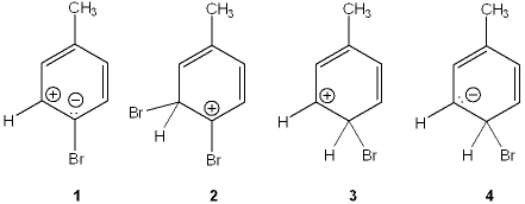
(Multiple Choice)
4.8/5 (91)
(91) What is the major organic product obtained from the following reaction? 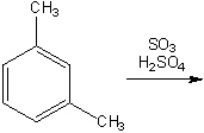
(Essay)
4.8/5 (89)
(89) Which mechanism accounts for the reaction of benzyl chloride with sodium cyanide to form cyanomethylbenzene (phenylacetonitrile, PhCH2CN)?
(Multiple Choice)
4.9/5 (83)
(83) Why does nitrobenzene fail to undergo Fieldel-Crafts alkylation with tert-butyl chloride and AlCl3?
(Multiple Choice)
4.9/5 (89)
(89) Which of the following undergoes the most rapid nitration upon treatment with HNO3/H2SO4?
(Multiple Choice)
4.9/5 (83)
(83) Which of the following sets of substituents are all deactivating groups in electrophilic aromatic substitution reactions?
(Multiple Choice)
4.8/5 (69)
(69) What type of intermediate is formed in upon irradiation of a mixture of toluene and chlorine to give benzyl chloride?
(Multiple Choice)
4.7/5 (76)
(76) Which of the following cannot be prepared from benzene in two synthetic steps? 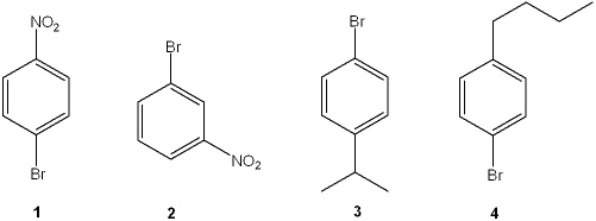
(Multiple Choice)
4.7/5 (82)
(82) What is the major organic product obtained from the following sequence of reactions (if a reaction is likely to give you a mixture of ortho and para disubstituted compounds you should assume that they can be separated; continue the synthesis with either one)? 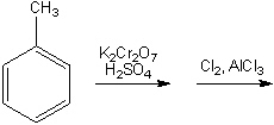
(Essay)
4.9/5 (77)
(77) Which of the following sets of substituents are all meta directing in electrophilic aromatic substitution reactions?
(Multiple Choice)
4.8/5 (87)
(87) Which of the following is not true about Meissenheimer complexes?
(Multiple Choice)
5.0/5 (80)
(80) Which of the following chlorobenzenes produces a single isomer upon treatment with NaNH2? 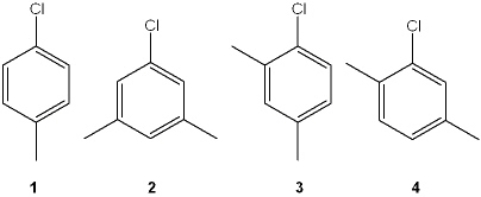
(Multiple Choice)
4.9/5 (81)
(81) What is the major organic product obtained from the following sequence of reactions? 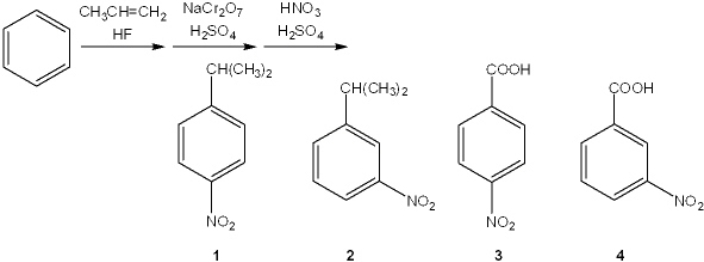
(Multiple Choice)
4.8/5 (59)
(59) 
Filters
- Essay(0)
- Multiple Choice(0)
- Short Answer(0)
- True False(0)
- Matching(0)