



 Chat with AI
Exam 13: Nuclear Magnetic Resonance Spectroscopy

Exam 1: Covalent Bonding and Shapes of Molecules95 Questions
Exam 2: Alkanes and Cycloalkanes77 Questions
Exam 3: Stereoisomerism and Chirality75 Questions
Exam 4: Acids and Bases75 Questions
Exam 5: Alkenes: Bonding, Nomenclature, and Properties70 Questions
Exam 6: Reactions of Alkenes79 Questions
Exam 7: Alkynes80 Questions
Exam 8: Haloalkanes, Halogenation, and Radical Reactions58 Questions
Exam 9: Nucleophilic Substitution and Beta-Elimination89 Questions
Exam 10: Alcohols78 Questions
Exam 11: Ethers, Epoxides, and Sulfides71 Questions
Exam 12: Infrared Spectroscopy44 Questions
Exam 13: Nuclear Magnetic Resonance Spectroscopy73 Questions
Exam 14: Mass Spectrometry39 Questions
Exam 15: An Introduction to Organometallic Compounds45 Questions
Exam 16: Aldehydes and Ketones94 Questions
Exam 17: Carboxylic Acids51 Questions
Exam 18: Functional Derivatives of Carboxylic Acids88 Questions
Exam 19: Enolate Anions and Enamines70 Questions
Exam 20: Dienes, Conjugated Systems, and Pericyclic Reactions44 Questions
Exam 21: Benzene and the Concept of Aromaticity59 Questions
Exam 22: Reactions of Benzene and Its Derivatives83 Questions
Select questions type


What is the hydrogen deficiency index for a compound with a molecular formula of C6H11N?

Free
(Multiple Choice)
4.8/5  (81)
(81) Correct Answer: Verified
B
Which C9H10O compound gives the following 1H NMR spectrum? 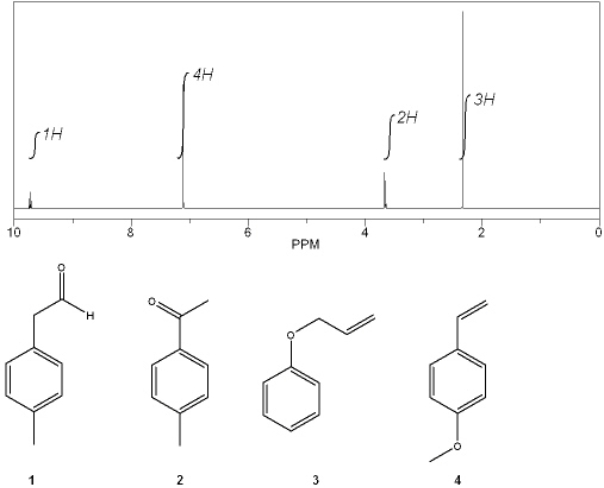
Free
(Multiple Choice)
4.9/5 (71)
(71) Correct Answer:Verified
VerifiedA
Which of the following combinations of peaks appears in the 1H NMR spectrum of 2,3-dimethylbutane?
Free
(Multiple Choice)
4.9/5 (61)
(61) Correct Answer:Verified
VerifiedA
Which of the protons in the following molecule appear furthest downfield in the 1H NMR spectrum? 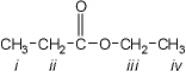
(Multiple Choice)
4.9/5 (78)
(78) What is the splitting of the signal in the 1H NMR spectrum for the methyl protons of propane?
(Multiple Choice)
4.8/5 (84)
(84) Which C4H9Br compound(s) gives a 13C NMR spectrum consisting of two signals? 
(Multiple Choice)
4.8/5 (91)
(91) Identify the compound (C8H10) that gives the following 1H NMR spectrum. 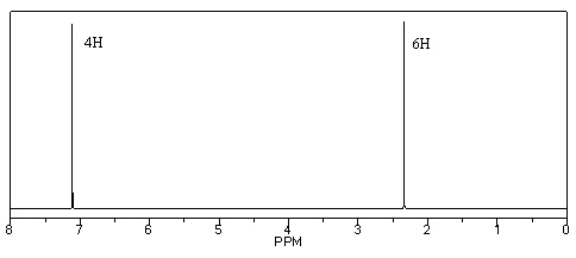
(Short Answer)
4.8/5 (85)
(85) Which of the following is not true regarding 1H NMR spectroscopy?
(Multiple Choice)
4.8/5 (78)
(78) Which of the protons in the following molecule appear at the highest d-value in the 1H NMR spectrum? 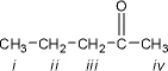
(Multiple Choice)
4.8/5 (72)
(72) Which of the following compounds gives a 1H NMR spectrum consisting of two singlets and a 13C NMR consisting of consisting of three signals? 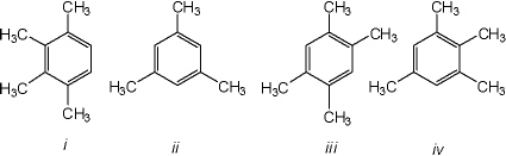
(Multiple Choice)
4.7/5 (90)
(90) What is the relative area of the six peaks in a sexet in an 1H NMR spectrum?
(Multiple Choice)
4.8/5 (88)
(88) How many signals appear in the proton-decoupled 13C NMR spectrum of 1,2-dibromobenzene?
(Multiple Choice)
4.7/5 (70)
(70) How many sets of equivalent protons are there in 3-methylhexane?
(Multiple Choice)
4.9/5 (92)
(92) Which C4H9Br compound gives a doublet at approximately 3.3 ppm in the 1H NMR spectrum? 
(Multiple Choice)
4.9/5 (76)
(76) How many signals appear in the proton-decoupled 13C NMR spectrum of 1,3-dibromobenzene?
(Multiple Choice)
4.9/5 (68)
(68) Which of the following compounds have homotopic protons?
1.propane
2.butane
3.2-methylpropane
(Multiple Choice)
4.8/5 (87)
(87) Which of the following compounds gives a 1H NMR spectrum consisting of only a singlet, triplet and quintet?
(Multiple Choice)
5.0/5 (94)
(94) How many signals appear in the proton-decoupled 13C NMR spectrum of the following compound? 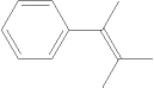
(Multiple Choice)
4.9/5 (89)
(89) What is the hydrogen deficiency index for a compound with a molecular formula of C10H16O2?
(Multiple Choice)
4.8/5 (76)
(76) How many signals appear in proton-decoupled 13C NMR spectrum of 3,4-dimethylhexane?
(Multiple Choice)
4.9/5 (64)
(64) 
Filters
- Essay(0)
- Multiple Choice(0)
- Short Answer(0)
- True False(0)
- Matching(0)