



 Chat with AI
Exam 13: Nuclear Magnetic Resonance Spectroscopy

Exam 1: Covalent Bonding and Shapes of Molecules95 Questions
Exam 2: Alkanes and Cycloalkanes77 Questions
Exam 3: Stereoisomerism and Chirality75 Questions
Exam 4: Acids and Bases75 Questions
Exam 5: Alkenes: Bonding, Nomenclature, and Properties70 Questions
Exam 6: Reactions of Alkenes79 Questions
Exam 7: Alkynes80 Questions
Exam 8: Haloalkanes, Halogenation, and Radical Reactions58 Questions
Exam 9: Nucleophilic Substitution and Beta-Elimination89 Questions
Exam 10: Alcohols78 Questions
Exam 11: Ethers, Epoxides, and Sulfides71 Questions
Exam 12: Infrared Spectroscopy44 Questions
Exam 13: Nuclear Magnetic Resonance Spectroscopy73 Questions
Exam 14: Mass Spectrometry39 Questions
Exam 15: An Introduction to Organometallic Compounds45 Questions
Exam 16: Aldehydes and Ketones94 Questions
Exam 17: Carboxylic Acids51 Questions
Exam 18: Functional Derivatives of Carboxylic Acids88 Questions
Exam 19: Enolate Anions and Enamines70 Questions
Exam 20: Dienes, Conjugated Systems, and Pericyclic Reactions44 Questions
Exam 21: Benzene and the Concept of Aromaticity59 Questions
Exam 22: Reactions of Benzene and Its Derivatives83 Questions
Select questions type


Which C6H12O2 compound gives the following 1H NMR spectrum? 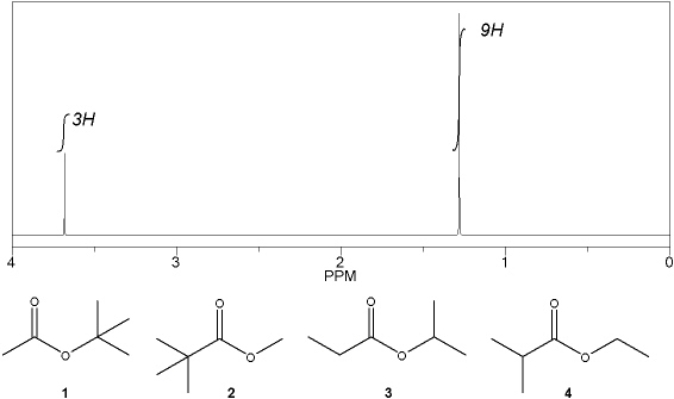
(Multiple Choice)
4.8/5  (79)
(79) Which feature in the 1H NMR spectrum provides information about the number of neighboring protons of each proton in the compound?
(Multiple Choice)
4.8/5 (82)
(82) Which of the following combinations of peaks appears in the 1H NMR spectrum of 1,4-dimethyoxyethane, CH3OCH2CH2CH2CH2OCH3?
(Multiple Choice)
4.8/5 (89)
(89) Which of the following is true for pair of diastereotopic protons?
1.They will appear at the same chemical shift in an achiral (i.e., nonchiral) environment
2.They will appear at the same chemical shifts in a chiral environment
(Multiple Choice)
4.9/5 (92)
(92) What is the splitting of the signal in the 1H NMR spectrum for the methyl protons of 1-bomo-2-methylpropane?
(Multiple Choice)
4.8/5 (93)
(93) The coupling constant, J, between the protons of chloroethane is 7 Hz when the spectrum is obtained at 250 MHz. What is the coupling constant between these protons when the spectrum is acquired at 500 MHz?
(Multiple Choice)
4.9/5 (89)
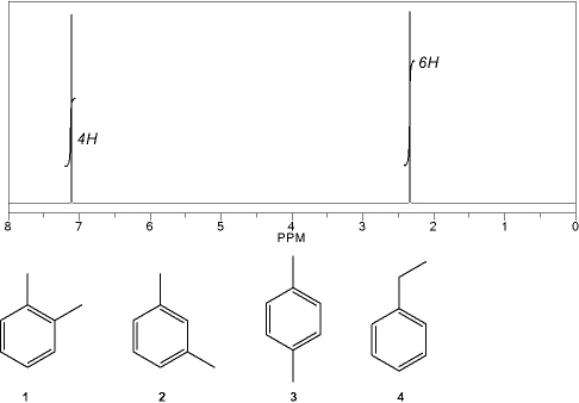
(89) Identify the compound (C8H10) that gives the following 1H NMR spectrum. 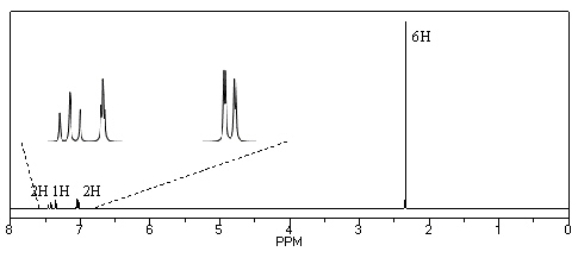
(Short Answer)
4.8/5 (76)
(76) Which of the protons in the following molecule appear at the highest d-value in the 1H NMR spectrum? 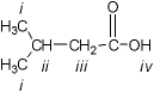
(Multiple Choice)
4.8/5 (84)
(84) Which of the following is true for pair of homotropic protons?
1.They will appear at the same chemical shift in an achiral (i.e., nonchiral) environment
2.They will appear at the same chemical shifts in a chiral environment
(Multiple Choice)
4.9/5 (72)
(72) Which of the protons in the following molecule appear at the highest d-value in the 1H NMR spectrum? 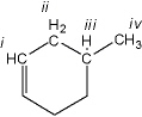
(Multiple Choice)
4.9/5 (85)
(85) How many signals appear in the proton-decoupled 13C NMR spectrum of 4-bromotoluene?
(Multiple Choice)
4.9/5 (91)
(91) 
Which of the following is true for pair of enantiotopic protons?
1.They will appear at the same chemical shift in an achiral (i.e., nonchiral) environment
2.They will appear at the same chemical shifts in a chiral environment
(Multiple Choice)
4.9/5 (73)
(73) Identify the compound (C4H8O) that gives the following 1H NMR spectrum. 
(Short Answer)
4.8/5 (62)
(62) Which of the following combinations of peaks appears in the 1H NMR spectrum of 1,2-dimethyoxyethane, CH3OCH2CH2OCH3?
(Multiple Choice)
4.9/5 (81)
(81) Which of the following compounds gives a 1H NMR spectrum consisting of only two singlets?
(Multiple Choice)
4.7/5 (85)
(85) How many signals appear in the proton-decoupled 13C NMR spectrum of 2-bromotoluene?
(Multiple Choice)
4.8/5 (71)
(71) Which of the carbon atoms in the following molecule appears furthest downfield in the 13C NMR spectrum? 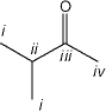
(Multiple Choice)
4.8/5 (80)
(80) How many signals appear in the proton-decoupled 13C NMR spectrum of 3-bromotoluene?
(Multiple Choice)
4.8/5 (75)
(75) 
Filters
- Essay(0)
- Multiple Choice(0)
- Short Answer(0)
- True False(0)
- Matching(0)