



 Chat with AI
Exam 8: Haloalkanes, Halogenation, and Radical Reactions

Exam 1: Covalent Bonding and Shapes of Molecules95 Questions
Exam 2: Alkanes and Cycloalkanes77 Questions
Exam 3: Stereoisomerism and Chirality75 Questions
Exam 4: Acids and Bases75 Questions
Exam 5: Alkenes: Bonding, Nomenclature, and Properties70 Questions
Exam 6: Reactions of Alkenes79 Questions
Exam 7: Alkynes80 Questions
Exam 8: Haloalkanes, Halogenation, and Radical Reactions58 Questions
Exam 9: Nucleophilic Substitution and Beta-Elimination89 Questions
Exam 10: Alcohols78 Questions
Exam 11: Ethers, Epoxides, and Sulfides71 Questions
Exam 12: Infrared Spectroscopy44 Questions
Exam 13: Nuclear Magnetic Resonance Spectroscopy73 Questions
Exam 14: Mass Spectrometry39 Questions
Exam 15: An Introduction to Organometallic Compounds45 Questions
Exam 16: Aldehydes and Ketones94 Questions
Exam 17: Carboxylic Acids51 Questions
Exam 18: Functional Derivatives of Carboxylic Acids88 Questions
Exam 19: Enolate Anions and Enamines70 Questions
Exam 20: Dienes, Conjugated Systems, and Pericyclic Reactions44 Questions
Exam 21: Benzene and the Concept of Aromaticity59 Questions
Exam 22: Reactions of Benzene and Its Derivatives83 Questions
Select questions type


What is the major product formed upon radical bromination of (S) 3-methylhexane?
(Multiple Choice)
4.8/5  (84)
(84) Which of the following has the list of compounds in the correct order of decreasing boiling point (higher boiling point > lower boiling point)?
(Multiple Choice)
4.9/5 (70)
(70) What is the geometry of the central carbon atom of a tert-butyl radical?
(Multiple Choice)
4.8/5 (84)
(84) Which of the following compounds is most susceptible to autooxidation?
(Multiple Choice)
4.9/5 (76)
(76) 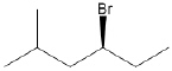
What is the major product obtained from the reaction of 2-methyl-2-butene with hydrogen bromide in the presence of peroxides?
(Multiple Choice)
5.0/5 (94)
(94) 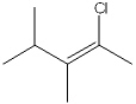
What is the major organic product obtained from the following reaction? 
(Multiple Choice)
4.9/5 (80)
(80) What are the major products formed upon treatment of (E) 3-methyl-2-hexene with HBr in the absence of peroxides? 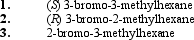
(Multiple Choice)
4.8/5 (86)
(86) Which of the following has the list of compounds in the correct order of decreasing boiling point (higher boiling point > lower boiling point)?
(Multiple Choice)
4.8/5 (78)
(78) What is the major organic product obtained from the following reaction? 
(Multiple Choice)
4.8/5 (70)
(70) Which of the following alkanes does not undergo monobromination to form a single bromoalkane as the major product? 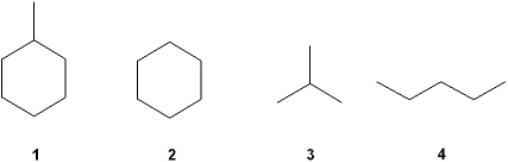
(Multiple Choice)
4.9/5 (77)
(77) What type of reactive intermediate is formed in the reaction of propene with hydrogen bromide in the presence of peroxides to give 1-bromopropane?
(Multiple Choice)
5.0/5 (80)
(80) Which of the following is an accurate statement of Hammond's postulate?
(Multiple Choice)
4.7/5 (81)
(81) What is the characteristic of a radical chain propagation step?
(Multiple Choice)
4.8/5 (81)
(81) Which of the following bonds has the lowest bond dissociation enthalpy?
(Multiple Choice)
4.8/5 (68)
(68) What is the correct order of stability of the following radicals (more stable > less stable)? 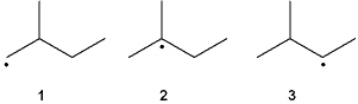
(Multiple Choice)
4.7/5 (79)
(79) What type of orbitals overlap to provide stability to the tert-butyl radical by hyperconjugation?
(Multiple Choice)
4.9/5 (86)
(86) What type of reactive intermediate is formed upon irradiation of a solution of toluene (Ph-CH3) and bromine?
(Multiple Choice)
4.9/5 (73)
(73) What is the major organic product obtained from the following reaction? 
(Multiple Choice)
4.8/5 (78)
(78) 
Filters
- Essay(0)
- Multiple Choice(0)
- Short Answer(0)
- True False(0)
- Matching(0)