



 Chat with AI
Exam 16: Dilutive Securities and Earnings Per Share

Exam 1: Financial Accounting and Accounting Standards103 Questions
Exam 2: Conceptual Framework for Financial Reporting155 Questions
Exam 3: The Accounting Information System144 Questions
Exam 4: Income Statement and Related Information139 Questions
Exam 5: Balance Sheet and Statement of Cash Flows127 Questions
Exam 6: Accounting and the Time Value of Money152 Questions
Exam 7: Cash and Receivables173 Questions
Exam 8: Valuation of Inventories: a Cost-Basis Approach173 Questions
Exam 9: Inventories: Additional Valuation Issues168 Questions
Exam 10: Acquisition and Disposition of Property, Plant, and Equipment170 Questions
Exam 11: Depreciation, Impairments, and Depletion156 Questions
Exam 12: Intangible Assets171 Questions
Exam 13: Current Liabilities and Contingencies170 Questions
Exam 14: Long-Term Liabilities140 Questions
Exam 15: Stockholders Equity155 Questions
Exam 16: Dilutive Securities and Earnings Per Share160 Questions
Exam 17: Investments141 Questions
Exam 18: Revenue Recognition145 Questions
Exam 19: Accounting for Income Taxes127 Questions
Exam 20: Accounting for Pensions and Postretirement Benefits137 Questions
Exam 21: Accounting for Leases128 Questions
Exam 22: Accounting Changes and Error Analysis103 Questions
Exam 23: Statement of Cash Flows143 Questions
Exam 24: Full Disclosure in Financial Reporting108 Questions
Exam 25: Appendix89 Questions
Select questions type


IFRS and U.S. GAAP have significant differences in the reporting of securities with characteristics of debt and equity, such as convertible debt.
(True/False)
4.9/5  (72)
(72) Use the following information for questions 75 through 77.
On January 1, 2014, Korsak, Inc. established a stock appreciation rights plan for its executives. It entitled them to receive cash at any time during the next four years for the difference between the market price of its common stock and a pre-established price of $20 on 100,000 SARs. Current market prices of the stock are as follows:  Compensation expense relating to the plan is to be recorded over a four-year period beginning January 1, 2014.
-What amount of compensation expense should Korsak recognize for the year ended December 31, 2014?
Compensation expense relating to the plan is to be recorded over a four-year period beginning January 1, 2014.
-What amount of compensation expense should Korsak recognize for the year ended December 31, 2014? (Multiple Choice)
4.9/5 (82)
(82) At December 31, 2014, Tatum Company had 2,000,000 shares of common stock outstanding. On January 1, 2015, Tatum issued 500,000 shares of preferred stock which were convertible into 1,000,000 shares of common stock. During 2015, Tatum declared and paid $1,200,000 cash dividends on the common stock and $400,000 cash dividends on the preferred stock. Net income for the year ended December 31, 2015, was $4,000,000. Assuming an income tax rate of 30%, what should be diluted earnings per share for the year ended December 31, 2015? (Round to the nearest penny.)
(Multiple Choice)
4.8/5 (79)
(79) In the diluted earnings per share computation, the treasury stock method is used for options and warrants to reflect assumed reacquisition of common stock at the average market price during the period. If the exercise price of the options or warrants exceeds the average market price, the computation would
(Multiple Choice)
4.9/5 (78)
(78) On January 2, 2014, for past services, Rosen Corp. granted Nenn Pine, its president, 25,000 stock appreciation rights that are exercisable immediately and expire onJanuary 2, 2015. On exercise, Nenn is entitled to receive cash for the excess of the market price of the stock on the exercise date over the market price on the grant date. Nenn did not exercise any of the rights during 2014. The market price of Rosen's stock was $30 on January 2, 2014, and $45 on December 31, 2014. As a result of the stock appreciation rights, Rosen should recognize compensation expense for 2014 of
(Multiple Choice)
4.8/5 (76)
(76) Under the intrinsic value method, compensation expense resulting from an incentive stock option is
(Multiple Choice)
4.8/5 (88)
(88) Yoder, Incorporated, has 3,600,000 shares of common stock outstanding onDecember 31, 2014. An additional 800,000 shares of common stock were issued onApril 1, 2015, and 400,000 more on July 1, 2015. On October 1, 2015, Yoder issued 20,000, $1,000 face value, 8% convertible bonds. Each bond is convertible into 20 shares of common stock. No bonds were converted into common stock in 2015. What is the number of shares to be used in computing basic earnings per share and diluted earnings per share, respectively?
(Multiple Choice)
4.8/5 (86)
(86) Use the following information for questions 108 and 109.
Hanson Co. had 200,000 shares of common stock, 20,000 shares of convertible preferred stock, and $1,000,000 of 5% convertible bonds outstanding during 2015. The preferred stock is convertible into 40,000 shares of common stock. During 2015, Hanson paid dividends of $.60 per share on the common stock and $2 per share on the preferred stock. Each $1,000 bond is convertible into 45 shares of common stock. The net income for 2015 was $400,000 and the income tax rate was 30%.
-Diluted earnings per share for 2015 is (rounded to the nearest penny)
(Multiple Choice)
4.8/5 (72)
(72) Proceeds from an issue of debt securities having stock warrants should not be allocated between debt and equity features when
(Multiple Choice)
4.7/5 (80)
(80) On January 1, 2015, Ritter Company granted stock options to officers and key employees for the purchase of 15,000 shares of the company's $1 par common stock at $20 per share as additional compensation for services to be rendered over the next three years. The options are exercisable during a five-year period beginning January 1, 2018 by grantees still employed by Ritter. The Black-Scholes option pricing model determines total compensation expense to be $135,000. The market price of common stock was $26 per share at the date of grant. The journal entry to record the compensation expense related to these options for 2015 would include a credit to the Paid-in Capital-Stock Options account for
(Multiple Choice)
4.9/5 (94)
(94) Assume there are two dilutive convertible securities. The one that should be used first to recalculate earnings per share is the security with the
(Multiple Choice)
4.9/5 (80)
(80) On January 1, 2015 Reese Company granted Jack Buchanan, an employee, an option to buy 300 shares of Reese Co. stock for $40 per share, the option exercisable for 5 years from date of grant. Using a fair value option pricing model, total compensation expense is determined to be $3,600. Buchanan exercised his option on September 1, 2015, and sold his 100 shares on December 1, 2015. Quoted market prices of Reese Co. stock during 2015 were:  The service period is for two years beginning January 1, 2015. As a result of the option granted to Buchanan, using the fair value method, Reese should recognize compensation expense for 2015 on its books in the amount of
 (Multiple Choice)
4.8/5 (80)
(80) Preferred dividends are subtracted from net income but not income before extraordinary items in computing earnings per share.
(True/False)
4.7/5 (81)
(81) If a company offers additional considerations to convertible bondholders in order to encourage conversion, it is called a(an):
(Multiple Choice)
4.7/5 (78)
(78) A corporation issues bonds with detachable warrants. The amount to be recorded as paid-in capital is preferably
(Multiple Choice)
4.8/5 (72)
(72) If an employee forfeits a stock option because of failure to satisfy a service requirement, the company should record paid-in capital from expired options.
(True/False)
4.8/5 (87)
(87) Use the following information for questions 117 and 118.
Lerner Co. had 200,000 shares of common stock, 20,000 shares of convertible preferred stock, and $500,000 of 10% convertible bonds outstanding during 2015. The preferred stock is convertible into 40,000 shares of common stock. During 2015, Lerner paid dividends of $.45 per share on the common stock and $1.50 per share on the preferred stock. Each $1,000 bond is convertible into 45 shares of common stock. The net income for 2015 was $300,000 and the income tax rate was 30%.
-Diluted earnings per share for 2015 is (rounded to the nearest penny)
(Multiple Choice)
4.9/5 (80)
(80) A convertible bond issue should be included in the diluted earnings per share computation as if the bonds had been converted into common stock, if the effect of its inclusion is 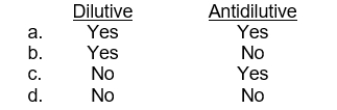
(Short Answer)
4.9/5 (93)
(93) The FASB states that when an issuer makes an additional payment to encourage conversion, the payment should be reported as an expense.
(True/False)
5.0/5 (78)
(78) Shipley Corporation had net income for the year of $600,000 and a weighted average number of common shares outstanding during the period of 250,000 shares. The company has a convertible bond issue outstanding. The bonds were issued four years ago at par ($2,500,000), carry a 7% interest rate, and are convertible into 50,000 shares of common stock. The company has a 40% tax rate. Diluted earnings per share are
(Multiple Choice)
4.7/5 (81)
(81) 
Filters
- Essay(0)
- Multiple Choice(0)
- Short Answer(0)
- True False(0)
- Matching(0)