



 Chat with AI
Exam 7: Cash and Receivables

Exam 1: Financial Accounting and Accounting Standards103 Questions
Exam 2: Conceptual Framework for Financial Reporting155 Questions
Exam 3: The Accounting Information System144 Questions
Exam 4: Income Statement and Related Information139 Questions
Exam 5: Balance Sheet and Statement of Cash Flows127 Questions
Exam 6: Accounting and the Time Value of Money152 Questions
Exam 7: Cash and Receivables173 Questions
Exam 8: Valuation of Inventories: a Cost-Basis Approach173 Questions
Exam 9: Inventories: Additional Valuation Issues168 Questions
Exam 10: Acquisition and Disposition of Property, Plant, and Equipment170 Questions
Exam 11: Depreciation, Impairments, and Depletion156 Questions
Exam 12: Intangible Assets171 Questions
Exam 13: Current Liabilities and Contingencies170 Questions
Exam 14: Long-Term Liabilities140 Questions
Exam 15: Stockholders Equity155 Questions
Exam 16: Dilutive Securities and Earnings Per Share160 Questions
Exam 17: Investments141 Questions
Exam 18: Revenue Recognition145 Questions
Exam 19: Accounting for Income Taxes127 Questions
Exam 20: Accounting for Pensions and Postretirement Benefits137 Questions
Exam 21: Accounting for Leases128 Questions
Exam 22: Accounting Changes and Error Analysis103 Questions
Exam 23: Statement of Cash Flows143 Questions
Exam 24: Full Disclosure in Financial Reporting108 Questions
Exam 25: Appendix89 Questions
Select questions type


The accounts receivable turnover ratio is computed by dividing

Free
(Multiple Choice)
4.9/5  (72)
(72) Correct Answer: Verified
D
Vasguez Corporation had a 1/1/14 balance in the Allowance for Doubtful Accounts of $30,000. During 2014, it wrote off $21,600 of accounts and collected $6,300 on accounts previously written off. The balance in Accounts Receivable was $600,000 at 1/1 and $720,000 at 12/31. At 12/31/14, Vasguez estimates that 5% of accounts receivable will prove to be uncollectible. What is Bad Debt Expense for 2014?
Free
(Multiple Choice)
5.0/5 (88)
(88) Correct Answer:Verified
VerifiedB
Use the following information to answer Questions 7 and 8.
Johnstone Company has a loan receivable with a carrying value of $125,000 at December 31, 2013. On January 1, 2014, the borrower, Ralph Young Industries, declares bankruptcy, and Johnstone estimates that it will collect only 45% of the loan balance.
-Assume that on January 4, 2015, Johnstone learns that Ralph Young Industries has emerged from bankruptcy. As a result, Johnstone now estimates that all but $11,500 will be paid on the loan. Under IFRS, which of the following entries would be made on January 4, 2015? 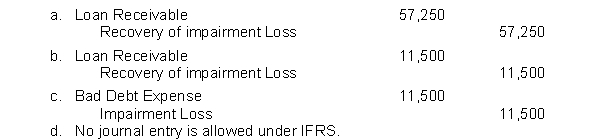
Free
(Short Answer)
4.9/5 (84)
(84) Correct Answer:Verified
VerifiedA
Which of the following should be recorded in Accounts Receivable?
(Multiple Choice)
4.9/5 (76)
(76) All of the following may be included under the heading of "cash" except
(Multiple Choice)
4.7/5 (69)
(69) Finley, Inc.'s checkbook balance on December 31, 2014 was $42,400. In addition, Finley held the following items in its safe on December 31.(1) A check for $900 from Peters, Inc. received December 30, 2014, which was not included in the checkbook balance.(2) An NSF check from Garner Company in the amount of $1,800 that had been deposited at the bank, but was returned for lack of sufficient funds on December 29. The check was to be redeposited on January 3, 2015. The original deposit has been included in the December 31 checkbook balance.(3) Coin and currency on hand amounted to $2,900.The proper amount to be reported on Finley's balance sheet for cash at December 31, 2014 is
(Multiple Choice)
4.9/5 (67)
(67) Amortization of discount on note.
On December 31, 2014, Green Company finished consultation services and accepted in exchange a promissory note with a face value of $600,000, a due date of December 31, 2017, and a stated rate of 5%, with interest receivable at the end of each year. The fair value of the services is not readily determinable and the note is not readily marketable. Under the circumstances, the note is considered to have an appropriate imputed rate of interest of 10%.
The following interest factors are provided:  Instructions
(a) Determine the present value of the note.
(b) Prepare a Schedule of Note Discount Amortization for Green Company under the effective interest method. (Round to whole dollars.)
(c) Explain how the accounting for a zero-interest-bearing note would differ in
(a) and (b) above.
Instructions
(a) Determine the present value of the note.
(b) Prepare a Schedule of Note Discount Amortization for Green Company under the effective interest method. (Round to whole dollars.)
(c) Explain how the accounting for a zero-interest-bearing note would differ in
(a) and (b) above. (Essay)
4.9/5 (79)
(79) Factoring Accounts Receivable.
On May 1, Dexter, Inc. factored $1,200,000 of accounts receivable with Quick Finance on a without recourse basis. Under the arrangement, Dexter was to handle disputes concerning service, and Quick Finance was to make the collections, handle the sales discounts, and absorb the credit losses. Quick Finance assessed a finance charge of 6% of the total accounts receivable factored and retained an amount equal to 2% of the total receivables to cover sales discounts.
Instructions
(a) Prepare the journal entry required on Dexter's books on May 1.
(b) Prepare the journal entry required on Quick Finance's books on May 1.
(c) Assume Dexter factors the $1,200,000 of accounts receivable with Quick Finance on a with recourse basis instead. The recourse provision has a fair value of $21,000. Prepare the journal entry required on Dexter's books on May 1.
(d) Explain the main advantage and disadvantage of selling receivables (1) without recourse and (2) with recourse.
(Essay)
4.9/5 (85)
(85) On the December 31, 2014 balance sheet of Vanoy Co., the current receivables consisted of the following: 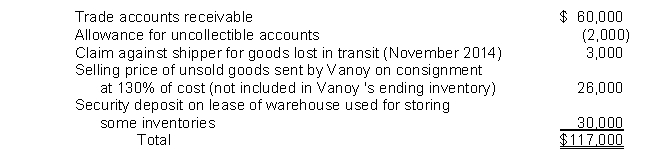 At December 31, 2014, the correct total of Vanoy's current net receivables was
 (Multiple Choice)
4.8/5 (77)
(77) Antique Company has notes receivable that have a fair value of $920,000 and a carrying amount of $710,000. Antique decides on December 31, 2014, to use the fair value option for these recently-acquired receivables. The adjusting entry to record this change will include a:
(Multiple Choice)
4.8/5 (83)
(83) The accounts receivable turnover ratio is computed by dividing net sales by the ending net receivables.
(True/False)
4.8/5 (83)
(83) Bank overdrafts are always offset against the cash account in the balance sheet.
(True/False)
4.9/5 (85)
(85) Smithson Corporation had a 1/1/14 balance in the Allowance for Doubtful Accounts of $20,000. During 2014, it wrote off $14,400 of accounts and collected $4,200 on accounts previously written off. The balance in Accounts Receivable was $400,000 at 1/1 and $480,000 at 12/31. At 12/31/14, Smithson estimates that 5% of accounts receivable will prove to be uncollectible. What is Bad Debt Expense for 2014?
(Multiple Choice)
4.8/5 (88)
(88) Sun Inc. factors $3,000,000 of its accounts receivables with recourse for a finance charge of 3%. The finance company retains an amount equal to 10% of the accounts receivable for possible adjustments. Sun estimates the fair value of the recourse liability at $150,000. What would be recorded as a gain (loss) on the transfer of receivables?
(Multiple Choice)
4.8/5 (76)
(76) Consider the following: Cash in Bank - checking account of $18,500, Cash on hand of $500, Post-dated checks received totaling $3,500, and Certificates of deposit totaling $124,000. How much should be reported as cash in the balance sheet?
(Multiple Choice)
4.7/5 (74)
(74) Under the allowance method of recognizing uncollectible accounts, the entry to write off an uncollectible account
(Multiple Choice)
4.9/5 (74)
(74) Ace Co. prepared an aging of its accounts receivable at December 31, 2014 and determined that the net realizable value of the receivables was $600,000. Additional information is available as follows:  For the year ended December 31, 2014, Ace's uncollectible accounts expense would be
 (Multiple Choice)
4.9/5 (93)
(93) Which of the following is a generally accepted method of determining the amount of the adjustment to bad debt expense?
(Multiple Choice)
4.9/5 (72)
(72) 
Filters
- Essay(0)
- Multiple Choice(0)
- Short Answer(0)
- True False(0)
- Matching(0)