



 Chat with AI
Exam 7: Cash and Receivables

Exam 1: Financial Accounting and Accounting Standards103 Questions
Exam 2: Conceptual Framework for Financial Reporting155 Questions
Exam 3: The Accounting Information System144 Questions
Exam 4: Income Statement and Related Information139 Questions
Exam 5: Balance Sheet and Statement of Cash Flows127 Questions
Exam 6: Accounting and the Time Value of Money152 Questions
Exam 7: Cash and Receivables173 Questions
Exam 8: Valuation of Inventories: a Cost-Basis Approach173 Questions
Exam 9: Inventories: Additional Valuation Issues168 Questions
Exam 10: Acquisition and Disposition of Property, Plant, and Equipment170 Questions
Exam 11: Depreciation, Impairments, and Depletion156 Questions
Exam 12: Intangible Assets171 Questions
Exam 13: Current Liabilities and Contingencies170 Questions
Exam 14: Long-Term Liabilities140 Questions
Exam 15: Stockholders Equity155 Questions
Exam 16: Dilutive Securities and Earnings Per Share160 Questions
Exam 17: Investments141 Questions
Exam 18: Revenue Recognition145 Questions
Exam 19: Accounting for Income Taxes127 Questions
Exam 20: Accounting for Pensions and Postretirement Benefits137 Questions
Exam 21: Accounting for Leases128 Questions
Exam 22: Accounting Changes and Error Analysis103 Questions
Exam 23: Statement of Cash Flows143 Questions
Exam 24: Full Disclosure in Financial Reporting108 Questions
Exam 25: Appendix89 Questions
Select questions type


Which of the following authoritative IFRS guidance specifically addresses issues related to cash?
(Multiple Choice)
4.8/5  (81)
(81) Which of the following concepts relates to using the allowance method in accounting for accounts receivable?
(Multiple Choice)
5.0/5 (86)
(86) During the year, Kiner Company made an entry to write off a $16,000 uncollectible account. Before this entry was made, the balance in accounts receivable was $200,000 and the balance in the allowance account was $18,000. The net realizable value of accounts receivable after the write-off entry was
(Multiple Choice)
4.8/5 (77)
(77) Companies value and report short-term receivables at net realizable value_the net amount they expect to receive in cash.
(True/False)
4.8/5 (78)
(78) On February 1, 2014, Henson Company factored receivables with a carrying amount of $500,000 to Agee Company. Agee Company assesses a finance charge of 3% of the receivables and retains 5% of the receivables. Relative to this transaction, you are to determine the amount of loss on sale to be reported in the income statement of Henson Company for February.Assume that Henson factors the receivables on a with recourse basis. The recourse obligation has a fair value of $2,500. The loss to be reported is
(Multiple Choice)
4.8/5 (83)
(83) All claims held against customers and others for money, goods, or services are reported as current assets.
(True/False)
4.8/5 (76)
(76) On April 2, Kelvin sold $30,000 of inventory items on credit with the terms 1/10, net 30. Payment on $18,000 sales was received on April 8 and the remaining payment on $12,000 sales was received on April 27. Assuming Kelvin uses the net method of accounting for sales discounts, the entry recorded on April 27 would include a:
(Multiple Choice)
4.8/5 (69)
(69) Savings accounts are usually classified as cash on the balance sheet.
(True/False)
4.9/5 (84)
(84) AG Inc. made a $15,000 sale on account with the following terms: 1/15, n/30. If the company uses the gross method to record sales made on credit, what is/are the debit(s) in the journal entry to record the sale?
(Multiple Choice)
4.7/5 (77)
(77) Which of the following statements is incorrect regarding the classification of accounts and notes receivable?
(Multiple Choice)
4.7/5 (89)
(89) Which of the following methods of determining annual bad debt expense best achieves the matching concept?
(Multiple Choice)
4.9/5 (83)
(83) Of the approaches to record cash discounts related to accounts receivable, which is more theoretically correct?
(Multiple Choice)
4.8/5 (65)
(65) The percentage-of-sales method results in a more accurate valuation of receivables on the balance sheet.
(True/False)
5.0/5 (77)
(77) If a company employs the gross method of recording accounts receivable from customers, then sales discounts taken should be reported as
(Multiple Choice)
4.8/5 (74)
(74) Key similarities between U.S. GAAP and IFRS include all of the following except
(Multiple Choice)
4.9/5 (90)
(90) On July 22, Peter sold $15,500 of inventory items on credit with the terms 2/15, net 30. Payment on $10,000 sales was received on August 1 and the remaining payment was received on August 12. Assuming Peter uses the gross method of accounting for sales discounts, which one of the following entries was made on August 1 to record the cash received? 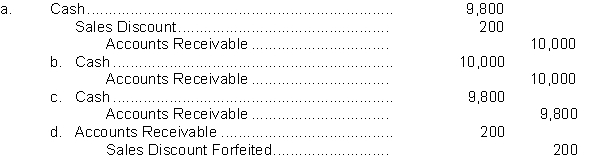
(Short Answer)
4.8/5 (87)
(87) Entries for bad debt expense.
The trial balance before adjustment of Risen Company reports the following balances:
 Instructions
(a) Prepare the entries for estimated bad debts assuming that doubtful accounts are estimated to be (1) 6% of gross accounts receivable and (2) 1% of net sales.
(b) Assume that all the information above is the same, except that the Allowance for Doubtful Accounts has a debit balance of $2,500 instead of a credit balance. How will this difference affect the journal entries in part
(a)?
(c) What is the theoretical justification for each of the two allowance methods used to estimate bad debts?
Instructions
(a) Prepare the entries for estimated bad debts assuming that doubtful accounts are estimated to be (1) 6% of gross accounts receivable and (2) 1% of net sales.
(b) Assume that all the information above is the same, except that the Allowance for Doubtful Accounts has a debit balance of $2,500 instead of a credit balance. How will this difference affect the journal entries in part
(a)?
(c) What is the theoretical justification for each of the two allowance methods used to estimate bad debts? (Essay)
4.9/5 (75)
(75) Under IFRS, there is no specific standard related to pledging receivables.
(True/False)
5.0/5 (77)
(77) Use the following information for questions 104 and 105.
A trial balance before adjustments included the following:  -If the estimate of uncollectibles is made by taking 10% of gross account receivables, the amount of the adjustment is
 (Multiple Choice)
4.9/5 (82)
(82) 
Filters
- Essay(0)
- Multiple Choice(0)
- Short Answer(0)
- True False(0)
- Matching(0)