



 Chat with AI
Exam 1: The Earliest Human Societies, to 2500 Bce

Exam 1: The Earliest Human Societies, to 2500 Bce82 Questions
Exam 2: Complex Societies in Southwest Asia and the Nile Valley, 3800-500 Bce75 Questions
Exam 3: The Foundation of Indian Society, to 300 Ce81 Questions
Exam 4: Chinas Classical Age, to 221 Bce80 Questions
Exam 5: The Greek Experience, 3500-30 Bce75 Questions
Exam 6: The World of Rome, Ca 1000 Bce-400 Ce75 Questions
Exam 7: East Asia and the Spread of Buddhism, 221 Bce-845 Ce77 Questions
Exam 8: Continuity and Change in Europe and Western Asia, 250-85078 Questions
Exam 9: The Islamic World, 600-140065 Questions
Exam 10: African Societies and Kingdoms, 1000 Bce-1500 Ce77 Questions
Exam 11: The Americas, 3200 Bce-1500 Ce77 Questions
Exam 12: Cultural Exchange in Central and Southern Asia, 300-140076 Questions
Exam 13: States and Cultures in East Asia, 800-140079 Questions
Exam 14: Europe and Western Asia in the Middle Ages, 800-145079 Questions
Exam 15: Europe in the Renaissance and Reformation, 1350-160079 Questions
Exam 16: The Acceleration of Global Contact, 1450-160078 Questions
Exam 17: The Islamic World Powers, 1300-180077 Questions
Exam 18: European Power and Expansion, 1500-175078 Questions
Exam 19: New Worldviews and Ways of Life, 1540-179081 Questions
Exam 20: Africa and the World, 1400-180076 Questions
Exam 21: Continuity and Change in East Asia, 1400-180073 Questions
Exam 22: Revolutions in the Atlantic World, 1775-182581 Questions
Exam 23: The Revolution in Energy and Industry, 1760-185079 Questions
Exam 24: Ideologies of Change in Europe, 1815-191482 Questions
Exam 25: Africa, the Ottoman Empire, and the New Imperialism, 1800-191479 Questions
Exam 26: Asia and the Pacific in the Era of Imperialism, 1800-191479 Questions
Exam 27: The Americas in the Age of Liberalism, 1810-191776 Questions
Exam 28: World War and Revolution, 1914-192981 Questions
Exam 29: Nationalism in Asia, 1914-193976 Questions
Exam 30: The Great Depression and World War Ii, 1929-194580 Questions
Exam 31: Review82 Questions
Exam 32: Liberalization, 1968-2000s75 Questions
Exam 33: The Contemporary World in Historical Perspective73 Questions
Exam 34: 20th Century Global Issues and Developments20 Questions
Select questions type


Animal domestication led to humans becoming able to digest which of the following?
(Multiple Choice)
5.0/5  (88)
(88) Paleolithic humans may have encouraged the growth of new plants by doing what?
(Multiple Choice)
4.8/5 (84)
(84) How did the amount of labor required for horticulture compare to that for foraging?
(Multiple Choice)
4.8/5 (72)
(72) According to Map 1.1, "Human Migration in the Paleolithic and Neolithic Eras," low sea levels were likely what enabled Homo sapiens to migrate into which part of the world? 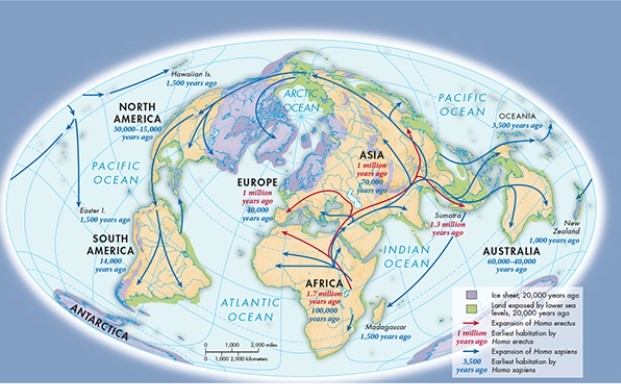
(Multiple Choice)
4.9/5 (81)
(81) In most Neolithic communities, which group of people were the first to work out written codes of law?
(Multiple Choice)
4.9/5 (89)
(89) What are some of the theories about gender relationships in Paleolithic societies? What changed in those relationships in the Neolithic period? What kinds of evidence are used in supporting or arguing against these theories?
(Essay)
4.9/5 (75)
(75) Use the following to answer questions :
-social hierarchies
(Multiple Choice)
4.9/5 (73)
(73) Which feature of the remains of the Neolithic-era Village at Banpo, pictured in Global Viewpoints, is indicative of this community's sedentary nature? 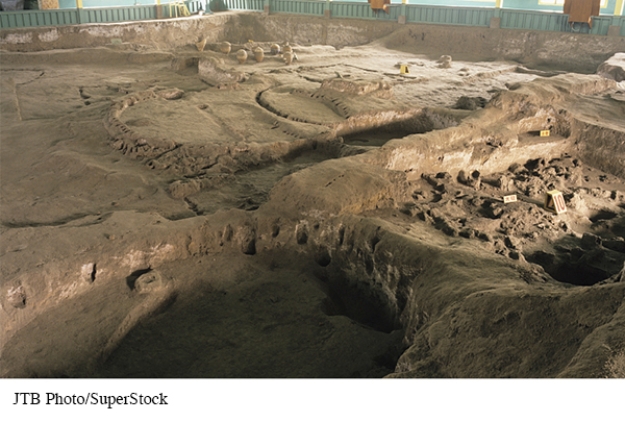
(Multiple Choice)
4.8/5 (88)
(88) The natural herding instinct of what animal paved the way for pastoralism?
(Multiple Choice)
5.0/5 (81)
(81) How did early Homo erectus spread out of East Africa into other parts of the world? Where did they go, and how early did they reach those places?
(Essay)
4.9/5 (67)
(67) Which of the following skills did Homo sapiens acquire around 25,000 years ago?
(Multiple Choice)
4.9/5 (76)
(76) What are the advantages and disadvantages to Homo sapiens in having a larger forebrain?
(Essay)
4.8/5 (73)
(73) Which of the following is evidence that Neanderthals understood death to have significance?
(Multiple Choice)
4.9/5 (83)
(83) Which of the following was an important feature of the houses of Çatal Hüyük?
(Multiple Choice)
4.8/5 (81)
(81) The burial sites of Paleolithic humans reveal that they believed that all things and natural occurrences had which of the following?
(Multiple Choice)
4.7/5 (84)
(84) What kinds of religious rituals did Neolithic people develop? Who performed them?
(Essay)
4.8/5 (90)
(90) What term describes a crop that has been modified by selective breeding?
(Multiple Choice)
4.9/5 (76)
(76) 
Filters
- Essay(0)
- Multiple Choice(0)
- Short Answer(0)
- True False(0)
- Matching(0)