



 Chat with AI
Exam 18: European Power and Expansion, 1500-1750

Exam 1: The Earliest Human Societies, to 2500 Bce82 Questions
Exam 2: Complex Societies in Southwest Asia and the Nile Valley, 3800-500 Bce75 Questions
Exam 3: The Foundation of Indian Society, to 300 Ce81 Questions
Exam 4: Chinas Classical Age, to 221 Bce80 Questions
Exam 5: The Greek Experience, 3500-30 Bce75 Questions
Exam 6: The World of Rome, Ca 1000 Bce-400 Ce75 Questions
Exam 7: East Asia and the Spread of Buddhism, 221 Bce-845 Ce77 Questions
Exam 8: Continuity and Change in Europe and Western Asia, 250-85078 Questions
Exam 9: The Islamic World, 600-140065 Questions
Exam 10: African Societies and Kingdoms, 1000 Bce-1500 Ce77 Questions
Exam 11: The Americas, 3200 Bce-1500 Ce77 Questions
Exam 12: Cultural Exchange in Central and Southern Asia, 300-140076 Questions
Exam 13: States and Cultures in East Asia, 800-140079 Questions
Exam 14: Europe and Western Asia in the Middle Ages, 800-145079 Questions
Exam 15: Europe in the Renaissance and Reformation, 1350-160079 Questions
Exam 16: The Acceleration of Global Contact, 1450-160078 Questions
Exam 17: The Islamic World Powers, 1300-180077 Questions
Exam 18: European Power and Expansion, 1500-175078 Questions
Exam 19: New Worldviews and Ways of Life, 1540-179081 Questions
Exam 20: Africa and the World, 1400-180076 Questions
Exam 21: Continuity and Change in East Asia, 1400-180073 Questions
Exam 22: Revolutions in the Atlantic World, 1775-182581 Questions
Exam 23: The Revolution in Energy and Industry, 1760-185079 Questions
Exam 24: Ideologies of Change in Europe, 1815-191482 Questions
Exam 25: Africa, the Ottoman Empire, and the New Imperialism, 1800-191479 Questions
Exam 26: Asia and the Pacific in the Era of Imperialism, 1800-191479 Questions
Exam 27: The Americas in the Age of Liberalism, 1810-191776 Questions
Exam 28: World War and Revolution, 1914-192981 Questions
Exam 29: Nationalism in Asia, 1914-193976 Questions
Exam 30: The Great Depression and World War Ii, 1929-194580 Questions
Exam 31: Review82 Questions
Exam 32: Liberalization, 1968-2000s75 Questions
Exam 33: The Contemporary World in Historical Perspective73 Questions
Exam 34: 20th Century Global Issues and Developments20 Questions
Select questions type


What were the political, economic, and religious factors and events that ultimately led to the Glorious Revolution?
(Essay)
4.7/5  (79)
(79) Based on Map 18.3, "Europe After the Peace of Utrecht, 1715," which territory remained the most stable in terms of territory retained or expanded between the end of the Thirty Years' War and the War of the Spanish Succession? 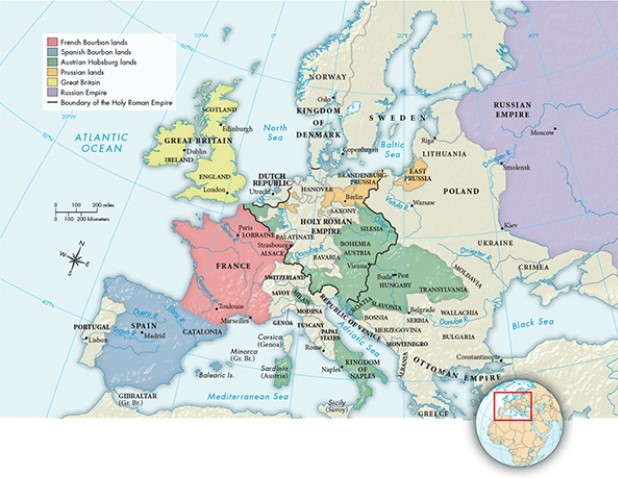
(Multiple Choice)
4.9/5 (90)
(90) According to the map "European Claims in North America, 1714," what advantage did the French have over the British and Spanish in colonizing much of North America? 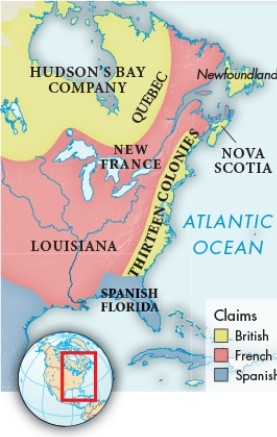
(Multiple Choice)
4.9/5 (65)
(65) The Glorious Revolution of 1688 brought an end to what in England?
(Multiple Choice)
5.0/5 (77)
(77) Which of the following was a consequence of the Peace of Utrecht?
(Multiple Choice)
4.9/5 (81)
(81) In what ways did Louis XIV collaborate with others to maintain his power?
(Essay)
4.7/5 (85)
(85) What was an important aspect of Peter the Great's tour of western Europe?
(Multiple Choice)
4.7/5 (78)
(78) Use the following to answer questions:
-Bill of Rights of 1689
(Multiple Choice)
4.9/5 (83)
(83) Why was the English monarchy restored after the civil war? What problems was it supposed to fix, and what problems did it cause?
(Essay)
4.8/5 (68)
(68) French foreign policy under Cardinal Richelieu focused primarily on what goal?
(Multiple Choice)
4.8/5 (65)
(65) What nation was Colbert hoping to compete with when he created the Company of the East Indies?
(Multiple Choice)
4.8/5 (87)
(87) What were some of the problems that hampered the attempts by seventeenth-century European governments to centralize?
(Essay)
4.8/5 (75)
(75) Who held the political power in the Dutch Republic in the seventeenth century?
(Multiple Choice)
4.9/5 (73)
(73) 
Filters
- Essay(0)
- Multiple Choice(0)
- Short Answer(0)
- True False(0)
- Matching(0)