



 Chat with AI
Exam 20: Africa and the World, 1400-1800

Exam 1: The Earliest Human Societies, to 2500 Bce82 Questions
Exam 2: Complex Societies in Southwest Asia and the Nile Valley, 3800-500 Bce75 Questions
Exam 3: The Foundation of Indian Society, to 300 Ce81 Questions
Exam 4: Chinas Classical Age, to 221 Bce80 Questions
Exam 5: The Greek Experience, 3500-30 Bce75 Questions
Exam 6: The World of Rome, Ca 1000 Bce-400 Ce75 Questions
Exam 7: East Asia and the Spread of Buddhism, 221 Bce-845 Ce77 Questions
Exam 8: Continuity and Change in Europe and Western Asia, 250-85078 Questions
Exam 9: The Islamic World, 600-140065 Questions
Exam 10: African Societies and Kingdoms, 1000 Bce-1500 Ce77 Questions
Exam 11: The Americas, 3200 Bce-1500 Ce77 Questions
Exam 12: Cultural Exchange in Central and Southern Asia, 300-140076 Questions
Exam 13: States and Cultures in East Asia, 800-140079 Questions
Exam 14: Europe and Western Asia in the Middle Ages, 800-145079 Questions
Exam 15: Europe in the Renaissance and Reformation, 1350-160079 Questions
Exam 16: The Acceleration of Global Contact, 1450-160078 Questions
Exam 17: The Islamic World Powers, 1300-180077 Questions
Exam 18: European Power and Expansion, 1500-175078 Questions
Exam 19: New Worldviews and Ways of Life, 1540-179081 Questions
Exam 20: Africa and the World, 1400-180076 Questions
Exam 21: Continuity and Change in East Asia, 1400-180073 Questions
Exam 22: Revolutions in the Atlantic World, 1775-182581 Questions
Exam 23: The Revolution in Energy and Industry, 1760-185079 Questions
Exam 24: Ideologies of Change in Europe, 1815-191482 Questions
Exam 25: Africa, the Ottoman Empire, and the New Imperialism, 1800-191479 Questions
Exam 26: Asia and the Pacific in the Era of Imperialism, 1800-191479 Questions
Exam 27: The Americas in the Age of Liberalism, 1810-191776 Questions
Exam 28: World War and Revolution, 1914-192981 Questions
Exam 29: Nationalism in Asia, 1914-193976 Questions
Exam 30: The Great Depression and World War Ii, 1929-194580 Questions
Exam 31: Review82 Questions
Exam 32: Liberalization, 1968-2000s75 Questions
Exam 33: The Contemporary World in Historical Perspective73 Questions
Exam 34: 20th Century Global Issues and Developments20 Questions
Select questions type


Roughly 35 percent of Swahili words come from which of the following languages?
(Multiple Choice)
4.8/5  (72)
(72) Defeated by General Ahmad ibn-Ghazi in 1529, the Ethiopian emperor Lebna Dengel sought aid from which of the following?
(Multiple Choice)
4.9/5 (74)
(74) In the fifteenth century, Kano and Katsina in Hausaland became centers for which of the following?
(Multiple Choice)
4.9/5 (81)
(81) What goods were African slaves traded for in the American colonies?
(Multiple Choice)
4.8/5 (78)
(78) What was the nature of trade and commerce in the Swahili city-states? What kinds of goods were traded?
(Essay)
4.8/5 (71)
(71) What kinds of external threats did Ethiopia face in the sixteenth and seventeenth centuries? How did Ethiopians deal with these threats?
(Essay)
4.7/5 (74)
(74) What New World country received the largest numbers of slaves from the transatlantic trade during the late eighteenth and early nineteenth centuries?
(Multiple Choice)
4.9/5 (75)
(75) What are the various theories as to why black Africans were enslaved in the sixteenth to eighteenth centuries more than other races? What are some of the problems with these theories?
(Essay)
4.8/5 (75)
(75) Which European nation monopolized the slave trade until about 1600?
(Multiple Choice)
4.7/5 (77)
(77) Based on Map 20.1, "West African Societies, ca. 1500-1800," which of the following played a major role in the Portuguese slave trade, due largely to its geographic location? 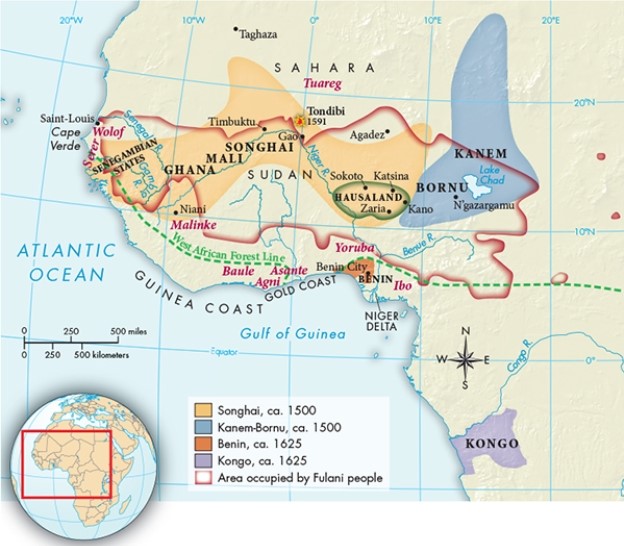
(Multiple Choice)
4.9/5 (68)
(68) Scholars have determined that the transatlantic slave trade had what effect on African societies?
(Multiple Choice)
4.8/5 (90)
(90) 
Filters
- Essay(0)
- Multiple Choice(0)
- Short Answer(0)
- True False(0)
- Matching(0)