



 Chat with AI
Exam 21: Continuity and Change in East Asia, 1400-1800

Exam 1: The Earliest Human Societies, to 2500 Bce82 Questions
Exam 2: Complex Societies in Southwest Asia and the Nile Valley, 3800-500 Bce75 Questions
Exam 3: The Foundation of Indian Society, to 300 Ce81 Questions
Exam 4: Chinas Classical Age, to 221 Bce80 Questions
Exam 5: The Greek Experience, 3500-30 Bce75 Questions
Exam 6: The World of Rome, Ca 1000 Bce-400 Ce75 Questions
Exam 7: East Asia and the Spread of Buddhism, 221 Bce-845 Ce77 Questions
Exam 8: Continuity and Change in Europe and Western Asia, 250-85078 Questions
Exam 9: The Islamic World, 600-140065 Questions
Exam 10: African Societies and Kingdoms, 1000 Bce-1500 Ce77 Questions
Exam 11: The Americas, 3200 Bce-1500 Ce77 Questions
Exam 12: Cultural Exchange in Central and Southern Asia, 300-140076 Questions
Exam 13: States and Cultures in East Asia, 800-140079 Questions
Exam 14: Europe and Western Asia in the Middle Ages, 800-145079 Questions
Exam 15: Europe in the Renaissance and Reformation, 1350-160079 Questions
Exam 16: The Acceleration of Global Contact, 1450-160078 Questions
Exam 17: The Islamic World Powers, 1300-180077 Questions
Exam 18: European Power and Expansion, 1500-175078 Questions
Exam 19: New Worldviews and Ways of Life, 1540-179081 Questions
Exam 20: Africa and the World, 1400-180076 Questions
Exam 21: Continuity and Change in East Asia, 1400-180073 Questions
Exam 22: Revolutions in the Atlantic World, 1775-182581 Questions
Exam 23: The Revolution in Energy and Industry, 1760-185079 Questions
Exam 24: Ideologies of Change in Europe, 1815-191482 Questions
Exam 25: Africa, the Ottoman Empire, and the New Imperialism, 1800-191479 Questions
Exam 26: Asia and the Pacific in the Era of Imperialism, 1800-191479 Questions
Exam 27: The Americas in the Age of Liberalism, 1810-191776 Questions
Exam 28: World War and Revolution, 1914-192981 Questions
Exam 29: Nationalism in Asia, 1914-193976 Questions
Exam 30: The Great Depression and World War Ii, 1929-194580 Questions
Exam 31: Review82 Questions
Exam 32: Liberalization, 1968-2000s75 Questions
Exam 33: The Contemporary World in Historical Perspective73 Questions
Exam 34: 20th Century Global Issues and Developments20 Questions
Select questions type


Which of the following was a major feature of Japanese Nō theater?
(Multiple Choice)
4.9/5  (79)
(79) When did Zhu Yuanzhang proclaim himself "Taizu," or the Hongwu emperor?
(Multiple Choice)
4.7/5 (89)
(89) Under the Tokugawa, how were the roles of many daimyo transformed?
(Multiple Choice)
4.9/5 (83)
(83) Use the following to answer questions :
-alternate residence system
(Multiple Choice)
4.8/5 (90)
(90) Was divorce possible among the peasant classes in Tokugawa Japan?
(Multiple Choice)
4.9/5 (99)
(99) Within Beijing was the Forbidden City, which served as what?
(Multiple Choice)
5.0/5 (83)
(83) Where can the influence of the Tokugawa government be seen in the illustration "Interior View of a Kabuki Theater"? 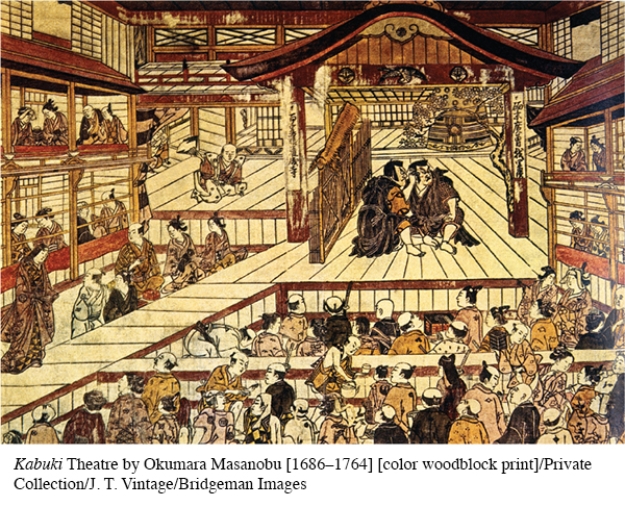
(Multiple Choice)
4.8/5 (75)
(75) By the sixteenth century, Ming publishers began producing what type of books?
(Multiple Choice)
4.9/5 (68)
(68) Although the shoguns forbade travel by commoners, commoners could get permission to do which of the following?
(Multiple Choice)
4.9/5 (73)
(73) Compare and contrast the Qing Dynasty in China with the Tokugawa Shogunate in Japan. How do they reflect their respective societies?
(Essay)
4.8/5 (91)
(91) Historians describe Japanese society as "feudalistic." What were the key features of Japanese feudalism? How did feudalism affect the nation's social, political, and economic development?
(Essay)
4.7/5 (78)
(78) Which of the following did the Qianlong emperor sometimes do when the Qing treasury became full from trade profits?
(Multiple Choice)
4.9/5 (82)
(82) Between 1400 and 1800, both China and Japan came into increasing contact with Europe. How did each society respond to the increased European presence? How successful were China and Japan in controlling the impact of Europeans on their society?
(Essay)
4.9/5 (72)
(72) 
Filters
- Essay(0)
- Multiple Choice(0)
- Short Answer(0)
- True False(0)
- Matching(0)