



 Chat with AI
Exam 22: Revolutions in the Atlantic World, 1775-1825

Exam 1: The Earliest Human Societies, to 2500 Bce82 Questions
Exam 2: Complex Societies in Southwest Asia and the Nile Valley, 3800-500 Bce75 Questions
Exam 3: The Foundation of Indian Society, to 300 Ce81 Questions
Exam 4: Chinas Classical Age, to 221 Bce80 Questions
Exam 5: The Greek Experience, 3500-30 Bce75 Questions
Exam 6: The World of Rome, Ca 1000 Bce-400 Ce75 Questions
Exam 7: East Asia and the Spread of Buddhism, 221 Bce-845 Ce77 Questions
Exam 8: Continuity and Change in Europe and Western Asia, 250-85078 Questions
Exam 9: The Islamic World, 600-140065 Questions
Exam 10: African Societies and Kingdoms, 1000 Bce-1500 Ce77 Questions
Exam 11: The Americas, 3200 Bce-1500 Ce77 Questions
Exam 12: Cultural Exchange in Central and Southern Asia, 300-140076 Questions
Exam 13: States and Cultures in East Asia, 800-140079 Questions
Exam 14: Europe and Western Asia in the Middle Ages, 800-145079 Questions
Exam 15: Europe in the Renaissance and Reformation, 1350-160079 Questions
Exam 16: The Acceleration of Global Contact, 1450-160078 Questions
Exam 17: The Islamic World Powers, 1300-180077 Questions
Exam 18: European Power and Expansion, 1500-175078 Questions
Exam 19: New Worldviews and Ways of Life, 1540-179081 Questions
Exam 20: Africa and the World, 1400-180076 Questions
Exam 21: Continuity and Change in East Asia, 1400-180073 Questions
Exam 22: Revolutions in the Atlantic World, 1775-182581 Questions
Exam 23: The Revolution in Energy and Industry, 1760-185079 Questions
Exam 24: Ideologies of Change in Europe, 1815-191482 Questions
Exam 25: Africa, the Ottoman Empire, and the New Imperialism, 1800-191479 Questions
Exam 26: Asia and the Pacific in the Era of Imperialism, 1800-191479 Questions
Exam 27: The Americas in the Age of Liberalism, 1810-191776 Questions
Exam 28: World War and Revolution, 1914-192981 Questions
Exam 29: Nationalism in Asia, 1914-193976 Questions
Exam 30: The Great Depression and World War Ii, 1929-194580 Questions
Exam 31: Review82 Questions
Exam 32: Liberalization, 1968-2000s75 Questions
Exam 33: The Contemporary World in Historical Perspective73 Questions
Exam 34: 20th Century Global Issues and Developments20 Questions
Select questions type


In August 1791, who revolted on the island of Saint-Domingue?
(Multiple Choice)
4.7/5  (76)
(76) Use the following to answer questions :
-Declaration of Independence
(Multiple Choice)
5.0/5 (87)
(87) In what ways did the three estates of the Estates General agree and disagree on issues in 1789?
(Essay)
4.8/5 (88)
(88) This painting shows a Spanish rebel about to be executed. His arms are upraised and he is bathed in light. What do these elements suggest the artist was trying to portray? 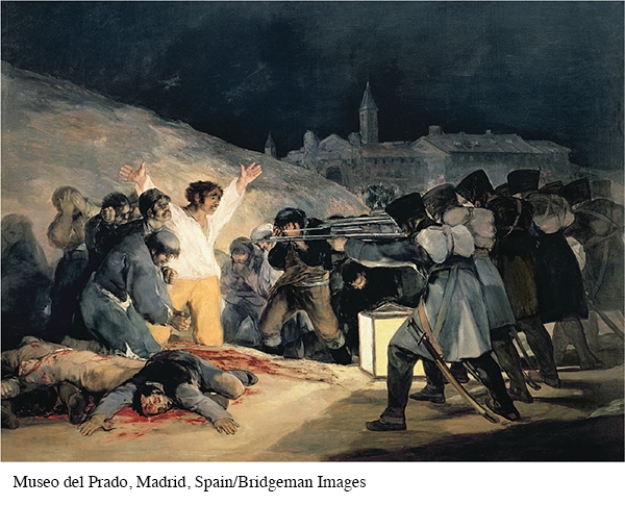
(Multiple Choice)
4.7/5 (63)
(63) By the late eighteenth century, European law recognized only what kinds of people as slaves?
(Multiple Choice)
4.8/5 (72)
(72) Why did Napoleon negotiate the Concordat of 1801 with the pope?
(Multiple Choice)
4.8/5 (84)
(84) According to the map "Loyalist Strength in the Colonies, ca. 1774-1776," Britain had reason to believe their southern strategy during the American Revolution would be successful due to which of the following? 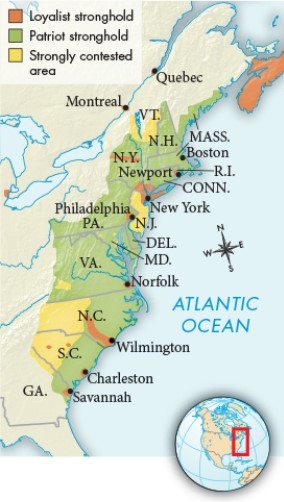
(Multiple Choice)
4.7/5 (78)
(78) Who did Abbé Sieyès argue should have more authority in the Estates General?
(Multiple Choice)
4.7/5 (79)
(79) Use the following to answer questions :
-Thermidorian reaction
(Multiple Choice)
4.8/5 (67)
(67) Compare the origins of the American and French revolutions. In what ways do the factors behind each revolution reflect the situation in each country? How did these factors influence the course of each revolution?
(Essay)
4.8/5 (84)
(84) The Atlantic revolutions, spanning from France to North and South America, shared many common traits. But in important ways, they were also very different. Discuss some of the broad similarities and differences in the Atlantic revolutions.
(Essay)
4.8/5 (72)
(72) Spaniards, Creoles, and Indian nobles joined forces to defeat who in 1780?
(Multiple Choice)
4.9/5 (74)
(74) Which of the following did the British use to assist their efforts in the American Revolution?
(Multiple Choice)
4.8/5 (84)
(84) Liberalism inspired political revolutionaries in both North America and France. What was liberalism? How was it manifested in the Declaration of Independence, Constitution, and Bill of Rights in the United States and the Declaration of the Rights of Man and of the Citizen and the Civil Code in France? What were the limits of liberalism in all of these documents?
(Essay)
4.9/5 (71)
(71) Why did Robespierre call a halt to efforts at de-Christianization?
(Multiple Choice)
4.9/5 (67)
(67) What did both Britain and France do as a result of the Seven Years' War?
(Multiple Choice)
4.9/5 (81)
(81) Which of the following was included in the 1763 Treaty of Paris?
(Multiple Choice)
4.7/5 (80)
(80) 
Filters
- Essay(0)
- Multiple Choice(0)
- Short Answer(0)
- True False(0)
- Matching(0)