



 Chat with AI
Exam 5: The Greek Experience, 3500-30 Bce

Exam 1: The Earliest Human Societies, to 2500 Bce82 Questions
Exam 2: Complex Societies in Southwest Asia and the Nile Valley, 3800-500 Bce75 Questions
Exam 3: The Foundation of Indian Society, to 300 Ce81 Questions
Exam 4: Chinas Classical Age, to 221 Bce80 Questions
Exam 5: The Greek Experience, 3500-30 Bce75 Questions
Exam 6: The World of Rome, Ca 1000 Bce-400 Ce75 Questions
Exam 7: East Asia and the Spread of Buddhism, 221 Bce-845 Ce77 Questions
Exam 8: Continuity and Change in Europe and Western Asia, 250-85078 Questions
Exam 9: The Islamic World, 600-140065 Questions
Exam 10: African Societies and Kingdoms, 1000 Bce-1500 Ce77 Questions
Exam 11: The Americas, 3200 Bce-1500 Ce77 Questions
Exam 12: Cultural Exchange in Central and Southern Asia, 300-140076 Questions
Exam 13: States and Cultures in East Asia, 800-140079 Questions
Exam 14: Europe and Western Asia in the Middle Ages, 800-145079 Questions
Exam 15: Europe in the Renaissance and Reformation, 1350-160079 Questions
Exam 16: The Acceleration of Global Contact, 1450-160078 Questions
Exam 17: The Islamic World Powers, 1300-180077 Questions
Exam 18: European Power and Expansion, 1500-175078 Questions
Exam 19: New Worldviews and Ways of Life, 1540-179081 Questions
Exam 20: Africa and the World, 1400-180076 Questions
Exam 21: Continuity and Change in East Asia, 1400-180073 Questions
Exam 22: Revolutions in the Atlantic World, 1775-182581 Questions
Exam 23: The Revolution in Energy and Industry, 1760-185079 Questions
Exam 24: Ideologies of Change in Europe, 1815-191482 Questions
Exam 25: Africa, the Ottoman Empire, and the New Imperialism, 1800-191479 Questions
Exam 26: Asia and the Pacific in the Era of Imperialism, 1800-191479 Questions
Exam 27: The Americas in the Age of Liberalism, 1810-191776 Questions
Exam 28: World War and Revolution, 1914-192981 Questions
Exam 29: Nationalism in Asia, 1914-193976 Questions
Exam 30: The Great Depression and World War Ii, 1929-194580 Questions
Exam 31: Review82 Questions
Exam 32: Liberalization, 1968-2000s75 Questions
Exam 33: The Contemporary World in Historical Perspective73 Questions
Exam 34: 20th Century Global Issues and Developments20 Questions
Select questions type


After defeating Athens in the Peloponnesian War, Sparta was defeated in 371 B.C.E. by what city-state?
(Multiple Choice)
4.8/5  (85)
(85) According to Map 5.3, "Alexander's Conquests, 336-324, B.C.E.," during his trek through Egypt, Alexander successfully overcame which obstacle that some historians suggest had long protected Egypt from invasion? 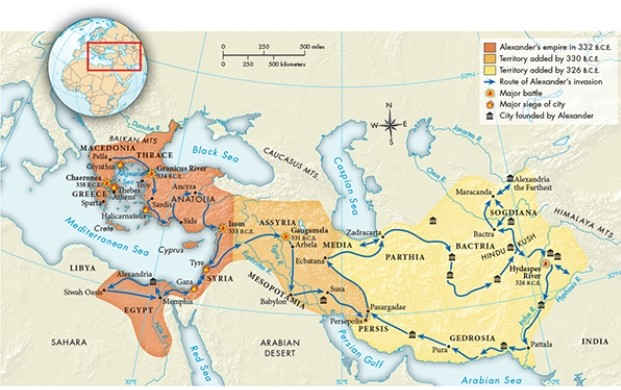
(Multiple Choice)
4.8/5 (78)
(78) Which of the following was a central component of the expansion of Alexander the Great's empire, but was absent from the process of Greek colonization as illustrated in Map 5.2, "Greek Colonization, ca. 750-550 B.C.E."? 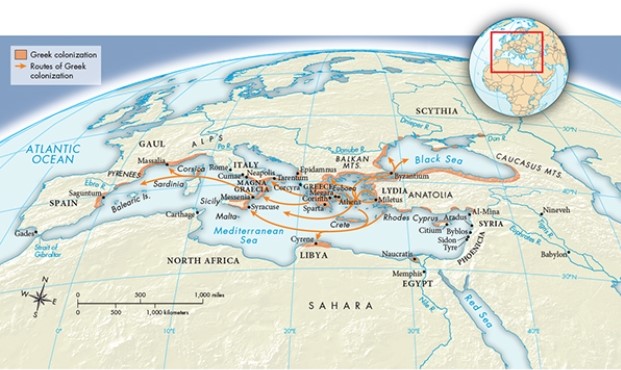
(Multiple Choice)
4.8/5 (93)
(93) Describe the various commodities that were the basis of the commercial trading network of the Hellenistic world. Consider material and nonmaterial trade. How did this commercial network enhance the unification of the Mediterranean world and beyond?
(Essay)
4.8/5 (83)
(83) Describe Greece in what historians have called the Dark Age. How did the development of the polis help Greece avoid some of the weaknesses of this period?
(Essay)
4.8/5 (85)
(85) Discuss how Athenian playwrights used their forum to address issues and attempt to understand or resolve life's basic conflicts.
(Essay)
4.9/5 (79)
(79) Which of the following contributed to the outbreak of the Peloponnesian War?
(Multiple Choice)
4.9/5 (63)
(63) How was the Greek polis different from older models of city-states?
(Multiple Choice)
4.8/5 (78)
(78) Why did Alexander's eastward expansion of his empire stop at the Hyphasis River?
(Multiple Choice)
5.0/5 (73)
(73) What did Hippocrates think was the best way to treat illnesses?
(Multiple Choice)
4.9/5 (77)
(77) The spread of Hellenistic culture was bolstered by Alexander's tradition of doing what in his newly conquered territories?
(Multiple Choice)
4.7/5 (87)
(87) Which of the following was one of the causes of Greek colonization and a particularly persistent problem for Sparta?
(Multiple Choice)
5.0/5 (77)
(77) Which of the following refers to heavily armed Greek foot soldiers?
(Multiple Choice)
4.8/5 (59)
(59) According to Map 5.1, "Classical Greece, ca. 450 B.C.E.," which geographic features lent themselves to the political fragmentation of Greece, but were not present in ancient civilizations such as Egypt or Mesopotamia? 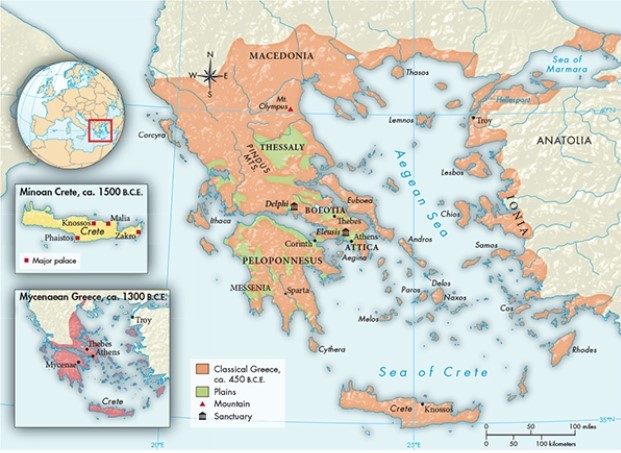
(Multiple Choice)
4.8/5 (91)
(91) 
Filters
- Essay(0)
- Multiple Choice(0)
- Short Answer(0)
- True False(0)
- Matching(0)