



 Chat with AI
Exam 9: The Islamic World, 600-1400

Exam 1: The Earliest Human Societies, to 2500 Bce82 Questions
Exam 2: Complex Societies in Southwest Asia and the Nile Valley, 3800-500 Bce75 Questions
Exam 3: The Foundation of Indian Society, to 300 Ce81 Questions
Exam 4: Chinas Classical Age, to 221 Bce80 Questions
Exam 5: The Greek Experience, 3500-30 Bce75 Questions
Exam 6: The World of Rome, Ca 1000 Bce-400 Ce75 Questions
Exam 7: East Asia and the Spread of Buddhism, 221 Bce-845 Ce77 Questions
Exam 8: Continuity and Change in Europe and Western Asia, 250-85078 Questions
Exam 9: The Islamic World, 600-140065 Questions
Exam 10: African Societies and Kingdoms, 1000 Bce-1500 Ce77 Questions
Exam 11: The Americas, 3200 Bce-1500 Ce77 Questions
Exam 12: Cultural Exchange in Central and Southern Asia, 300-140076 Questions
Exam 13: States and Cultures in East Asia, 800-140079 Questions
Exam 14: Europe and Western Asia in the Middle Ages, 800-145079 Questions
Exam 15: Europe in the Renaissance and Reformation, 1350-160079 Questions
Exam 16: The Acceleration of Global Contact, 1450-160078 Questions
Exam 17: The Islamic World Powers, 1300-180077 Questions
Exam 18: European Power and Expansion, 1500-175078 Questions
Exam 19: New Worldviews and Ways of Life, 1540-179081 Questions
Exam 20: Africa and the World, 1400-180076 Questions
Exam 21: Continuity and Change in East Asia, 1400-180073 Questions
Exam 22: Revolutions in the Atlantic World, 1775-182581 Questions
Exam 23: The Revolution in Energy and Industry, 1760-185079 Questions
Exam 24: Ideologies of Change in Europe, 1815-191482 Questions
Exam 25: Africa, the Ottoman Empire, and the New Imperialism, 1800-191479 Questions
Exam 26: Asia and the Pacific in the Era of Imperialism, 1800-191479 Questions
Exam 27: The Americas in the Age of Liberalism, 1810-191776 Questions
Exam 28: World War and Revolution, 1914-192981 Questions
Exam 29: Nationalism in Asia, 1914-193976 Questions
Exam 30: The Great Depression and World War Ii, 1929-194580 Questions
Exam 31: Review82 Questions
Exam 32: Liberalization, 1968-2000s75 Questions
Exam 33: The Contemporary World in Historical Perspective73 Questions
Exam 34: 20th Century Global Issues and Developments20 Questions
Select questions type


Which of the following was an important financial innovation developed by Muslim merchants?
(Multiple Choice)
4.8/5  (66)
(66) How did Muslim trade routes affect the development of agriculture?
(Multiple Choice)
4.9/5 (78)
(78) The hijra of 622 occurred when Muhammad and his followers fled to what city?
(Multiple Choice)
5.0/5 (98)
(98) What evidence is there in this illustration of the practice of Arab conquerors adopting certain practices of subjugated peoples? 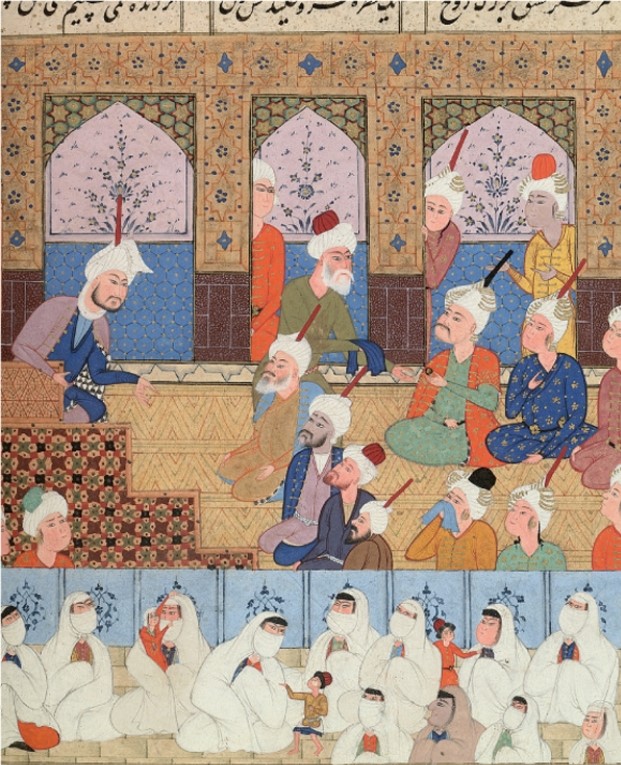
(Multiple Choice)
4.9/5 (78)
(78) How did the status of Arab women change with the introduction of Islam, and how did that status change from the Umayyad to the Abbasid caliphates?
(Essay)
4.9/5 (85)
(85) Weakness in the Abbasid Empire was revealed when Tahir did which of the following?
(Multiple Choice)
4.9/5 (68)
(68) Which of the following gave rise to a fundamental division in the umma and in Muslim theology?
(Multiple Choice)
4.8/5 (75)
(75) What rights did women have under pre-Islamic Arab tribal law?
(Multiple Choice)
4.8/5 (67)
(67) According to Map 9.2, "The Expansion of Islam and Its Trading Networks in the Thirteenth and Fourteenth Centuries," which of the following was the northernmost river reached by Islamic traders by the year 1500? 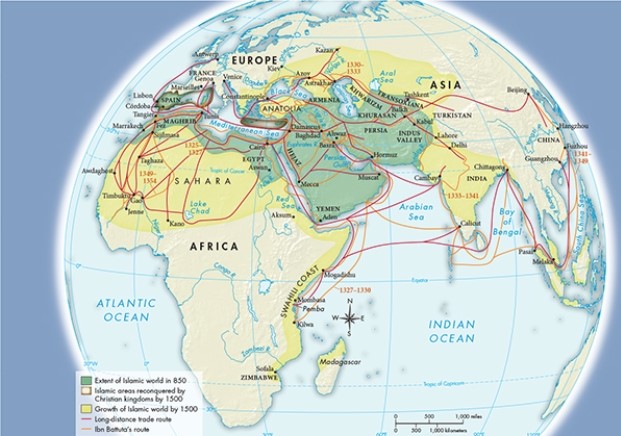
(Multiple Choice)
4.8/5 (74)
(74) Why were eunuchs allowed to serve in a variety of occupations in the Muslim world?
(Multiple Choice)
4.9/5 (73)
(73) Islam was unable to maintain its cultural and political unity. What kinds of religious and political issues divided the Islamic world?
(Essay)
4.7/5 (75)
(75) The presence of the Ka'ba attracted pilgrims to what city?
(Multiple Choice)
4.7/5 (100)
(100) Who dominated political affairs in northern and central Arabia before Muhammad?
(Multiple Choice)
4.7/5 (68)
(68) Muslim and Jewish merchants in the Indian Ocean trade used what language for commerce?
(Multiple Choice)
4.9/5 (86)
(86) According to the text, the Qur'an's injunctions regarding the treatment of women
(Multiple Choice)
4.8/5 (80)
(80) Which of the following describes the similarities between Islamic, European, and Chinese education systems?
(Multiple Choice)
4.7/5 (63)
(63) What were the function and status of slaves within the Islamic world?
(Essay)
5.0/5 (85)
(85) Describe some of the intellectual innovations of the Abbasids and Harun al-Rashid.
(Essay)
4.7/5 (73)
(73) 
Filters
- Essay(0)
- Multiple Choice(0)
- Short Answer(0)
- True False(0)
- Matching(0)