



 Chat with AI
Exam 2: Economic Models: Trade-Offs and Trade

Exam 1: First Principles183 Questions
Exam 2: Economic Models: Trade-Offs and Trade341 Questions
Exam 3: Supply and Demand230 Questions
Exam 4: Price Controls and Quotas: Meddling With Markets187 Questions
Exam 5: International Trade224 Questions
Exam 6: Macroeconomics: the Big Picture128 Questions
Exam 7: GDP and the CPI: Tracking the Macroeconomy213 Questions
Exam 8: Unemployment and Inflation300 Questions
Exam 9: Long-Run Economic Growth268 Questions
Exam 10: Savings, Investment Spending, and the Financial Syst355 Questions
Exam 11: Income and Expenditure114 Questions
Exam 12: Aggregate Demand and Aggregate Supply308 Questions
Exam 13: Fiscal Policy120 Questions
Exam 14: Money, Banking, and the Federal Reserve System135 Questions
Exam 15: Monetary Policy316 Questions
Exam 16: Inflation, Disinflation, and Deflation194 Questions
Exam 17: Macroeconomics: Events and Ideas283 Questions
Exam 18: International Macroeconomics411 Questions
Select questions type


In one day, Kessy can bake 10 cookies or mix 15 glasses of lemonade. His friend Ava can make 10 cookies or 10 glasses of lemonade. His other friend, Ian, can make 10 cookies or 20 glasses of lemonade. Who has the LOWEST opportunity cost in cookie production?
(Multiple Choice)
4.9/5  (85)
(85) In a single day, George can bake 10 cakes and Greta can bake 5 cakes. We know that _____ has a(n) _____ advantage in baking cakes.
(Multiple Choice)
4.7/5 (77)
(77) Use the following to answer questions:
\\ 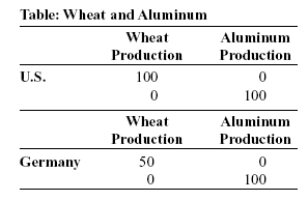 -(Table: Wheat and Aluminum) Use Table: Wheat and Aluminum. The United States and Germany can produce both wheat and aluminum. The table shows the maximum annual output combinations of wheat and aluminum that can be produced. Based on the table:
 (Multiple Choice)
4.8/5 (78)
(78) In Kessy's old kitchen, he could bake 10 cookies or mix 15 glasses of lemonade in one day. Now Kessy has a larger oven and refrigerator. How does this affect his production possibility frontier?
(Multiple Choice)
4.9/5 (76)
(76) The production possibility frontier will NOT shift outward due to an:
(Multiple Choice)
4.9/5 (73)
(73) Use the following to answer questions:  -(Figure: Seasonally Adjusted Unemployment Rate) Use Figure: Seasonally Adjusted Unemployment Rate. The distance between each labeled point on the horizontal axis is one year, and the distance between each labeled point on the vertical axis is one percentage point of unemployment. What is the approximate slope of the graph between 1/2001 and 1/2003 (using percentage point and years as the units on the vertical and horizontal axes, respectively)?
 (Multiple Choice)
4.7/5 (76)
(76) Mark and Julie are going to sell brownies and cookies for their third annual fundraiser bake sale. In one day, Mark can make 40 brownies or 20 cookies, and Julie can make 15 brownies or 15 cookies. Based on this information, _____ has the absolute advantage in making brownies and _____ has the absolute advantage in making cookies.
(Multiple Choice)
4.9/5 (83)
(83) Economists who are asked to choose between two government policies may disagree because:
(Multiple Choice)
4.7/5 (74)
(74) Use the following to answer questions: 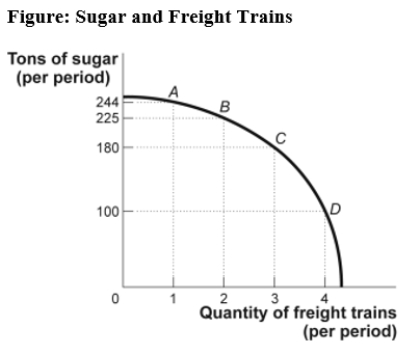 \\
-(Figure: Sugar and Freight Trains) Use Figure: Sugar and Freight Trains. Suppose the economy is operating at point B. The opportunity cost of producing the third freight train would be _____ tons of sugar.
\\
-(Figure: Sugar and Freight Trains) Use Figure: Sugar and Freight Trains. Suppose the economy is operating at point B. The opportunity cost of producing the third freight train would be _____ tons of sugar. (Multiple Choice)
4.9/5 (79)
(79) Use the following to answer questions:
\\  -(Figure: Unemployment Rate over Time) Look at the figure Unemployment Rate over Time. In the time-series graph, as we move from the beginning of 2001 to the beginning of 2003, we see that the unemployment rate has _____ from approximately _____ to approximately _____.
 (Multiple Choice)
4.9/5 (76)
(76) Use the following to answer questions:
\\  -(Table: Production Possibilities Schedule I) Use Table: Production Possibilities Schedule I. If the economy produces 4 units of consumer goods per period, it also can produce, at MOST, _____ units of capital goods per period.
 (Multiple Choice)
4.8/5 (95)
(95) The economy's factors of production are not equally suitable for producing different types of goods. This principle generates:
(Multiple Choice)
4.9/5 (83)
(83) Use the following to answer questions:
\\  -(Table: Trade-off of Study Time and Leisure Time) Use Table: Trade-off of Study Time and Leisure Time. A student sleeps 8 hours per day and divides the remaining time between study time and leisure time. The table shows the combinations of study and leisure time that can be produced in the 16 waking hours of each day. Suppose the student completes a speed-reading course that allows him to do the same amount of studying in half as many hours. His opportunity cost:
 (Multiple Choice)
4.9/5 (74)
(74) Use the following to answer questions:
\\
-(Table: Production Possibilities Schedule I) Use Table: Production Possibilities Schedule I. The opportunity cost of producing the third unit of consumer goods is _____ units of capital goods.
-(Table: Production Possibilities Schedule I) Use Table: Production Possibilities Schedule I. The opportunity cost of producing the third unit of consumer goods is _____ units of capital goods. (Multiple Choice)
4.7/5 (71)
(71) Suppose residents of Montana operate on their production possibility frontier, and they want to increase production of both wheat and fly-fishing rods. According to the production possibility frontier, this cannot happen without new resources or technological improvement.
(True/False)
4.8/5 (83)
(83) Use the following to answer questions:
\\  -(Figure: Strawberries and Submarines II) Use Figure: Strawberries and Submarines II. Assume that the economy is operating at point A. The opportunity cost of moving to point C is equal to _____ million tons of strawberries:
 (Multiple Choice)
4.9/5 (69)
(69) If they bake only cakes, in a single day George can bake 10 cakes, and Greta can bake 5 cakes. If they make only pies, in a single day George can bake 10 pies, while Greta can bake 4 pies. We know that _____ has an absolute advantage and a comparative advantage in making _____.
(Multiple Choice)
4.9/5 (92)
(92) Jim is being paid $7.25 an hour to work at a restaurant. In the circular flow, this is an example of a:
(Multiple Choice)
4.9/5 (68)
(68) 
Filters
- Essay(0)
- Multiple Choice(0)
- Short Answer(0)
- True False(0)
- Matching(0)